Improvised Weapons Roundup

There’s something special about improvised weapons built for the upcoming zombie apocalypse. Whether it’s a Lousiville Decapitron or a shotgun revolver, we’re always fascinated by homemade weapons. Here’s a few that rolled into the tip line over the last few weeks:

You call that a knife?

[Joerg Sprave], a.k.a. that German guy on YouTube that has fun with slingshots, built a spinning steak knife saw thing. Basically, it’s eight steak knives attached to a wheel and driven with an electric drill. It’s not a terribly complex build, but it does give off a zombie apocalypse/first person shooter melee weapon vibe.

Battery cannon, because why not

Why use potatoes when you can use D-cell batteries? [CasterTown] on YouTube put together a small propane-powered spud gun that can put a battery through a car door. This isn’t the first time we’ve seen batteries used as ammo, but it’s still an extremely powerful build.

Oh man the 60s were cool.

Back in the 60s, safety wasn’t a huge concern. Any 10-year-old could walk into a dime store and buy Jarts – a game consisting of kids throwing sharp spikes at each other. Also, magazines had descriptions of how to build a freaking mortar in a backyard. Able to make a 20-foot grouping at 1900 feet, this would probably merit a visit from a SWAT team today. Needless to say, don’t try this at home.

Don’t do this. Please.

Last but not least is [Rocketlab] and [SadisticTheory]’s $15 flamethrower. It’s just a gas tank from a 2-stroke engine, a 12 volt battery and a pump. Common sense requires us to mention this build is very, very illegal (apparently it is legal)and extremely unsafe. Don’t replicate this build.

Actually, we take that back. You shouldn’t build any of these weapons because they’re very dangerous. Just think of these as a neat thing to look at. Let other people hurt themselves. You may complain about how unsafe these weapons are in the comments.

A Color Maximite For Glorious 3-bit BASIC

[Kilian] sent in a link to a color version of a tiny educational computer. It’s called the Quantumite and it’s designed to be a throwback to the early 80s microcomputers we all grew up on.

The Quantumite is a clone of the Maximite, the tiny single board computer / BASIC interpreter designed by [Geoff Graham]. Both the Quantumite and Maximite are meant to be a throwback to the amazingly simple microcomputers of the early 80s, giving the 8-year-olds of today the simplicity of a BASIC compter most Hackaday readers had back in 1980s.

Both the Maximite and Quantumite are powered by the same 32-bit PIC microcontroller and have connections for a composite or VGA monitor, SD card, and PS/2 keyboard. Unlike the Maximite, the Quantumite can display 8 colors on its screen; a great addition that somehow seems even more retro than a monochrome display.

As far as getting the younglings to learn programming, we couldn’t think of a better tool than the ‘boot straight into a programming language’ Maximite. With a retro-impressive 3 bits of color, it’s sure to be a hit with the schoolchildren this computer is targeted at.

A Rocking And Walking BEAM Robot

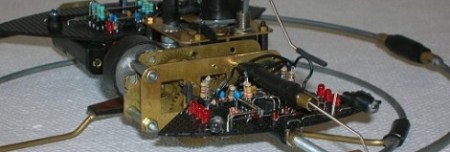
We’ve seen a few minimalist robots in our time, but very few compare to [Thomas Rinsma]’s amazingly agile BEAM robot. It’s absolutely fascinating to watch this little robot crawl around on its circular legs.

BEAM robots are extremely simple robots built without a microcontroller of any kind. The idea that extremely simple circuits built from logic chips and amplifiers came from the fruitful mind of [Mark Tilden] while studying insectoid robots at Los Alamos National Laboratory. The first BEAM robot – a small walker made out of a Sony Walkman – impressed a lot of mid-90s makers and tinkerers. Although interest in these robots died out, there are communities around the web for BEAM builders to get together and show off their creation.

Most BEAM robots use four to six legs as a means of locomotion. [Thomas]’ robot only uses two metal rings to get around; an extremely simple design and also the most fluid gait we’ve seen from a BEAM robot. You can check out the video of [Thomas]’ build walking around after the break.

Tip ‘o the hat to [mefeder] for sending this one in.

Continue reading “A Rocking And Walking BEAM Robot”

Mixing Colors On The Reprap

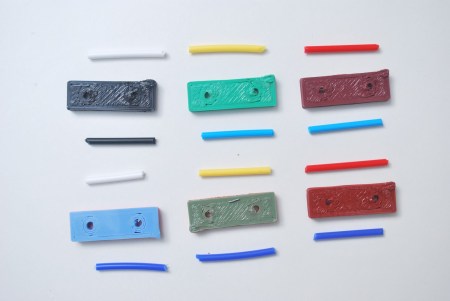
3d printing has come huge strides in ability to construct detailed objects. Unfortunately, color is still a considerable limitation. Here, some people at the Reprap blog are having fun coming up with an extruder head that actually mixes two colors as it deposits them. Don’t confuse this with the dual head that Makerbot is touting that allows you to switch colors on the fly, this is a single head that actually has a cavity where the material is melted, then stirred to create a combination of the two. It is an interesting method of overcoming a limited supply of colors.

Having this extra stirring chamber means that there would be a small amount of material wasted any time that you wanted to make a change to the color, as it would have to be purged. There are some interesting thoughts in their comments on how to use this extra material most efficiently.

Hacking IPod Headphone Controller For Use With Android

[Buddhra] wanted to use a set of ear buds that also had a controller built into the wire. The headset he chose to go with is meant for use with iPod, but he figured it should be possible to make it work with Android too. He was right, and managed to alter the controller for Android use and still fit it into the original case.

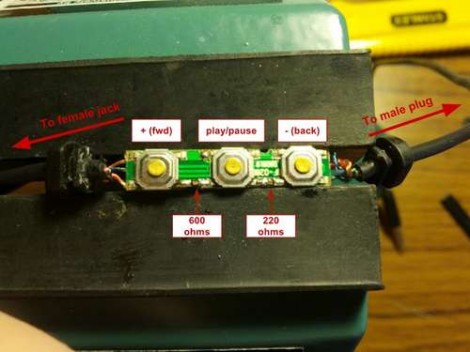
He had already made a custom control module that has fast forward and rewind features and play/pause events. The signals used for the controls are based on resistive dividers. The play/pause button on the iLuv headset already worked, so he cracked the controller open to see why the forward and back buttons didn’t work. It turns out all he needed to do was add the right resistors to those buttons. Here you can almost see the 0603 surface mount packages he used to add a 220 Ohm resistor to the back button, and a 600 Ohm resistor to the forward switch.

3d Printed Nes Portable Looks Fantastic And Contains No Hot Glue

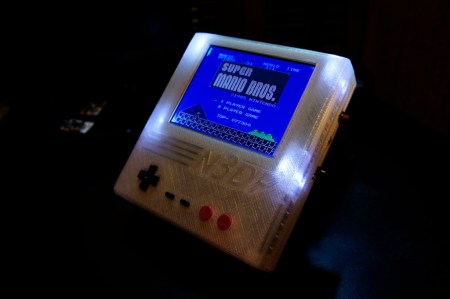
[Parker] emailed us today to show off his latest NES portable build. This time he’s using the standard “top loader” NES instead of the typically used NES on a chip. This is pretty cool since the NES on a chip has compatibility issues with some games. For the screen, he uses a common PSone screen with a slight power modification. From the factory, the screen takes 7.4 V and converts it down to 5V to use. He removed this and ran it directly from his own 5V power source. It may not seem like that big of a deal, but with portables, every bit counts. He also ditched the sound amplifier from the PSone screen in favor of something a little more efficient. He seems to have done a pretty good job because he says it gets roughly 10 hours at full volume right now.

Another cool aspect of this deign is that the cartridge serves as a sort of stand for the unit, although the button placement looks like it might be a tiny bit awkward when used this way.


Building Sensors For The Scratch Programming Language

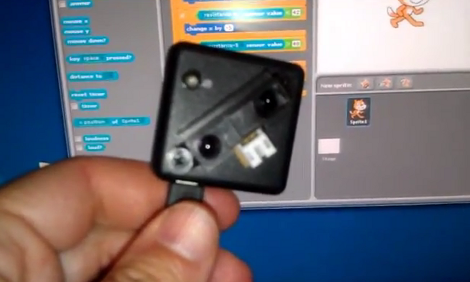
[Kevin Osborn] is making it a bit easier for young programmers to write programs that interact with the physical world. The device he’s holding in the picture is an Arduino based accelerometer and distance sensor meant for the Scratch language.

Scratch is a programming language developed at MIT. It has kids in mind, and focuses on graphical building blocks. This can make it quite a bit easier to introduce youngsters to programming concepts without the roadblocks and gotchas that come with learning syntax.

As you can see in the clip after the break, [Kevin’s] Arduino sketch includes hooks that automatically pull the accelerometer and distance data into the Scratch environment. We figure his example provides everything you need to get just about any type of sensor up and running, be it a magnetometer or LDR (both of which would make a nice burglar-alarm type project). Give it a try with your own hardware and see what you can accomplish.

Continue reading “Building Sensors For The Scratch Programming Language”