Paint Your Pictures, No PC Needed

LEDs and and cameras always make a fun mixture, and its not all that hard to have quite a bit of fun as well. The Light Painting Stick is similar to other long exposure camera tricks like LightScythe and gets about the same reults. The difference is the Light Painting Stick is self contained meaning you don’t have to drag nearly as much stuff along with you to have fun.

Hardware used is HL1606 controlled RGB led strip commonly found at Adafruit, the brains are a Leaf Labs Maple micro controller board with an SD card and some human interfaces attached, and is powered by a 6 volt lantern battery.

Images are 64*infinity 24 bit BMP files which means there is not much fuss preparing your graphics other than doing a simple rotate. You can select which image is displayed by using a 2 way switch and the LEDs on the stick. Select your images, dial in your speed with the potentiometer, and you’re  ready to hit the fire button for some photo fun.
Powering An Ultrasonic Transducer

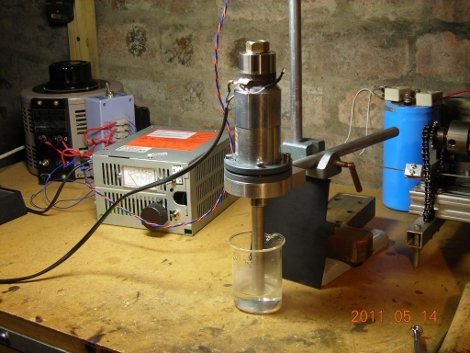
[Lindsay] has a wonderful writeup about a new toy in the shop, an ultrasonic transducer. The 28kHz, 70W bolt-clamped Langevin transducer by itself is not much use, you need a power supply, a horn to focus the energy, and a way to tune it. [Lindsay] starts off by showing how to find out the resonant frequency of the transducer, designing and building a high voltage high frequency AC power supply, and how to design a horn.

Not missing the meaning of DIY [Lindsay] casts and machines a horn for the transducer with a high level of precision as this will also tune the horn to the correct frequency. Once some brackets are machined the whole setup is put through some fun experiments in water and lemonaide, but the real purpose is to drill fine holes in glass for his home made Panaplex displays.

Join us after the break for a short video.

Continue reading “Powering An Ultrasonic Transducer”

Simulated Dashboard For A Simulated Race

Simulators might have lost their cool for a lot of gamers, but [Fergo] is trying for a comeback. He built an electronic dashboard for a car racing simulator.

[Fergo] spends most of his track time on iRacing, an MMO racing simulator. Possibly due to a little bit of influence from Formula 1 steering wheels, he wanted to add to his dashboard that included Microsoft racing wheel. The dashboard includes RPM lights, a gear indicator, five general buttons, a rotary encoder, and a pit limiter, rev limiter and low fuel indicators.

The build is powered a VB.NET app that connects the iRacing API to an Arduino. To get all those buttons and LEDs talking to the Arduino, [Fergo] used an IO expander that communicates over an I2C bus. It’s a surprisingly simple design that should scale well if [Fergo] ever decides to expand his cockpit. We’re not sure if it could handle controlling a 737, but it would be more than sufficient for a Cessna 172 or Mercury capsule.

Check out [Fergo] tearing around the track with his buttonbox dashboard after the break.

Continue reading “Simulated Dashboard For A Simulated Race”

LiPo Charging Circuit Tutorial

As far as battery technology goes, Lithium Polymer cells are the bee’s knees. They’re powerful enough to handle very demanding applications and come in a multitude of sizes for any conceivable application. There’s a problem with LiPos, though – they have the tendency to explode when charged incorrectly. Luckily, [Paul] sent in a great tutorial on building a LiPo charger that works over USB.

In the original design of [Paul]’s board, he chose a Maxim MAX1551 Lithium battery charger. Confounded by the expense and/or unavailability of this IC (although Sparkfun has a few), he moved onto the similar Microchip MCP7813. This IC supports charging from a power source from 3.5 to 6 Volts as would be found in a USB hub.

The board [Paul] came up with is incredibly small – just barely larger than the USB plug itself. The layout is fairly simple as well. We’re thinking this could be a highly useful application of some home board fabrication. If you have a simpler way to charge LiPos that don’t require a specialized chip, send it into the tip line.

The Fukushima Robot Diaries

After the terrible tragedy in Fukushima, the cleanup and damage assessment has begun. A robot operator, known only as [S.H.] has decided to write a blog about their efforts.  As pictured above, they are using iRobot models, including the [510 Packbot], and the [710 Warrior].

Since cleanup efforts started, [S.H.] was posting on his or her blog daily.  After word of this blog started getting out via various social media outlets, the blog was mysteriously taken down. The blog was at times critical of elements of the cleanup effort, but it’s unknown why the disappearance happened. Efforts to reach [S.H.] were unsuccessfull according to [IEEE].

Fortunately, before the takedown, [IEEE]’s [Erico Guizzo] decided to make a copy of the posts. These have been translated into English and portions are now available at the link listed above. Be sure to check out robot training video after the break. Continue reading “The Fukushima Robot Diaries”

Petition For DMCA Exemptions Regarding Rooting/unlocking Gadgets

So you’ve been rooting devices eh? If you get caught you’re headed for the big house, the lockup, the pen, the joint, they’ll send you up the river, you better be careful! Seriously though, if you buy a device and circumvent the security features should that in itself be breaking the law? We’re not talking about stealing intellectual property, like playing copied games on a chipped system (yeah, that’s stealing). We mean unlocking a device so that you can use it for what you wish. Be it your own prototyping, or running open-source applications. Unfortunately if the current Digital Millennium Copyright Act exemptions expire it will be a crime.

Thankfully, [Bunnie] is doing something about this. You may remember him as the guy that found most of the ridiculous security holes in the original Xbox, or the brain behind the Chumby. Now’s he’s got an online petition where your voice can be heard. Speak up and let the US politicians know why unlocking a device isn’t a crime.

[via Twitter]

Weekly Roundup 1/28/12


Another week has passed and it is time to review the best of what hit our blog in the past week.

In first place is a repeat from last week showing how you can turn an Android device with a CMOS camera into a radiation detector.

In first place if we ignore repeats is a post about how the Raspberry Pi board can decode 1080p video! We’re just itching to get our grubbly little hands on some of these guys when they are finally released.

Up next is a project from one of our own. This week [Brian Benchoff] put up a post about how he built a manifold clock after seeing a similar project on Kickstarter.

Following that is a post showing how you can overlay video onto an encrypted HDMI signal. The MPAA would probably like to crack [bunnie] over the knuckles with a ruler for this one but he actually isn’t decrypting anything. Instead, he is encrypting the overlay and just replacing the normal video with it.

We like this next one a lot because it not only is a nice hack but it allows you to subtly control what can and cannot happen around you. Specifically, you can jam remote control helicopters with this device. It probably wouldn’t be too hard to pair this up with a TV B Gone to keep people from turning the TV back on once you have wrought your mischief.

Finally, another really neat one for you. In this post, we show [Sprite_tm’s] radio transmitter that is composed out of two button cell batteries, two lengths of wire and an ATtiny processor. It is amazing that this even works but with the right tools, a good hacker can do just about anything.