VR Bowling Game Combines An Oculus Rift With A Wii Remote

d [marclar83] was given an Oculus Rift so that he could prepare for an upcoming conference presentation. He began to download demos, getting familiar with the VR interface but was disappointed to find out that someone hadn’t developed a good virtual reality bowling experience yet. This prompted him to design a VR game that integrates a Wii Remote, recording the movements of the controller and sending accelerometer data to his computer.

The game he created is similar to Wii Sports Bowling but with the added bonus of being immersed in a virtual world with the Oculus Rift. The D-pad on the Wii Remote was programmed to switch stances and bowling methods, allowing the user to choose whether they want to throw the ball down the middle or curve it a long the way. Pressing the trigger button on the back started the swinging motion, and when released, the bowling ball shot down the alley at a high rate of speed crashing into the pins at the end.

Because the game was designed on the original DK1, the resolution of the images was a challenge that needed to be addressed, but [marclar83] solved this problem by implementing two user interfaces on the side of the screen that showed replays and depicted how many pins remained; proving to be a better experience for the gamer. This free public alpha version was made available for Windows, Mac, and Linux on the official VRBowling website. A video describing the project can be seen below. Continue reading “VR Bowling Game Combines An Oculus Rift With A Wii Remote”
Hydroforming In The Garage With A Pressure Washer

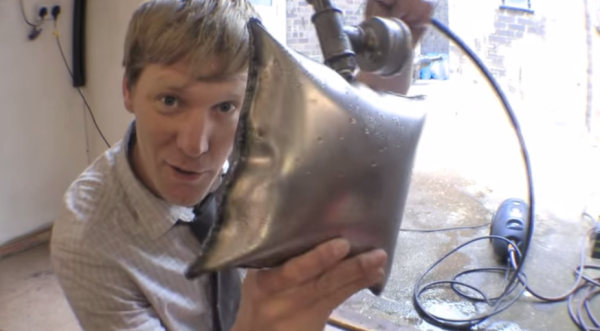
Ever heard of hydroforming? It’s a manufacturing process used to form sheet metal into shapes using water at extremely high pressures. Not something you can do at home… unless of course you’re [Colin Furze].

Hydroforming works by evenly distributing pressure via water (conveniently, in-compressible) against sheet metal inside of a mold. Many automotive parts are created in this fashion. Typical systems run at around 15,000 PSI.

After building a giant pulse jet engine (complete with butt) to fart on France, [Colin] got the idea from a YouTube comment to try to do hydroforming at home — bending the sheet metal for the giant derriere wasn’t that easy. Hydroforming on the other hand is a surprisingly simple process. Weld some sheet metal together, add a pipe fitting to connect your cheap pressure washer and boom — hydoformed metal parts.

Continue reading “Hydroforming In The Garage With A Pressure Washer”

Hackerspace Tours: Pasadena City College

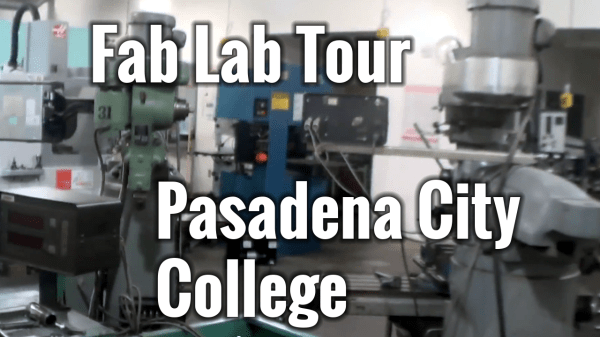
Pasadena City College is putting together an amazing combination of tools, education techniques, and innovative projects pinning them on the map as one of the best hackerspaces in the Southern California area. Led by [Deborah Bird], the Director of the Design Technology Pathway at PCC, and Sandy Lee the DTP Faculty Chair, this Fab Lab provides students with cutting-edge workshops and internships that will define future jobs.

We were invited to the space by Joan Horvath, the VP of Business Development over at a local 3D printing store called Deezmaker, after meeting her at an Arduino electronics class taught by a young, talented maker named [Quin]. When we arrived, we were greeted by several students who were working on a 3D printed portable map for the blind which was created for an elementary school nearby. The team behind the design attempted to step out of the visual world and into unfamiliar unsighted territory. One of the members gave us a tour of the space showing us the tools and resources they had made available to PCC students. A variety of 3D printers, ventilators, CNC machines, laser cutters, metal lathes, and even a chainsaw were found inside.

Continue reading “Hackerspace Tours: Pasadena City College”

A Homemade Bubble Robot For The Kids

bubbles-machine

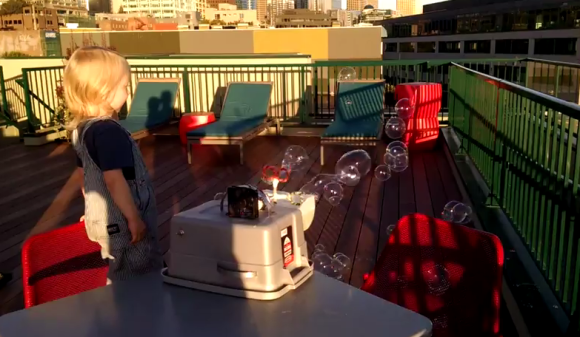
Kids generally can be amused pretty easily, but when jangling keys stop holding their interest you might want to take a look at [drenehtsral]’s new project. He’s created an automatic bubble robot (YouTube link) that keeps the kids endlessly entertained!

The project started as an idea at a festival where one of [drenehtsral]’s kids took great interest at a bubble machine. [drenehtsral] had never heard of a bubble machine before, but it turns out that it’s pretty simple in practice. All that’s required is a tank of soapy water, a motor to turn the bubble wands, and a fan to form the bubbles and make them waft gently through the air.

[drenehtsral] also used a 12V battery for power, some other hardware to hold it all together, and a 5V regulator and some other control electronics for the fan and the motor. He notes that he could have bought a bubble machine but in true hacker style found it fun to build himself. The next step in this project could be something to vary the size of the bubbles, or perhaps a set of wheels for the robot so it can entertain the kids on the move!

Continue reading “A Homemade Bubble Robot For The Kids”

Upgrading a Laser Cutter with RAMPS

Upgrade That Cheap-o Laser Cutter!

Laser cutters are perhaps one of the most useful tools in a hackerspace’s arsenal of tools, rivaled only by 3D printers and CNC mills. The problem is they’re quite expensive — unless you get one of the cheap little ones from China that is! Unfortunately, you get what you pay for. Lucky for us though they aren’t that hard to upgrade!

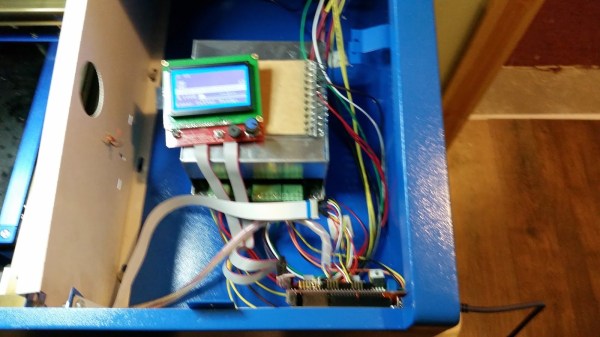
[Dan Beaven] just finished upgrading his 40W CO2 laser to use an Arduino Mega 2560 and RAMPS 1.4 — wanting to share his knowledge he’s posted a guide to help others do the same. The upgrade itself isn’t that difficult, although can be a bit messy for wiring. In the future [Dan] hopes to design a PCB with all the connectors so it’s as simple as plugging it into the RAMPS board.

To control the laser he’s using firmware from the Lansing Makers Network (GitHub) designed for use with marlin electronics. He’s modified it a bit for his own purposes (Google Drive) including a low output LASAR activation signal.The cool thing with setting up your laser with this hardware is that you can use a laser output plugin right in Inkscape!

Electric Longboard Roundup

ev longboards everywhere!

Everybody and their grandmother is longboarding electric-style these days: here are some of the most recent developments in the world of kickless cruising.

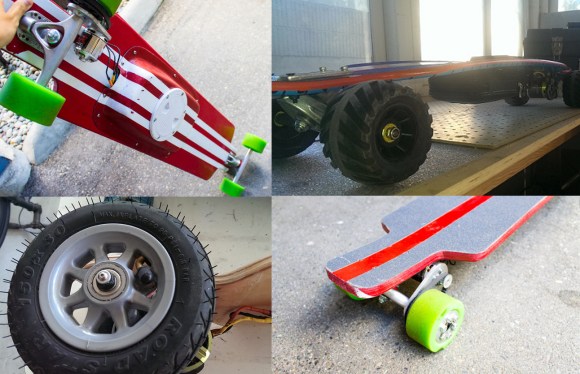
First up, [comsa42] has punched up an excellent step-by-step visual guide for first-time EV hopefuls, detailing the basics of a battery-powered longboard setup and thoroughly explaining the particulars behind component choices. His build is relatively straightforward: combine a board with a low(ish) kV outrunner motor, some LiPo batteries, an ESC (Electronic Speed Controller), a transmitter/receiver, and a few custom parts for gearing and mounting. This build should be commended not only for its simplicity but also for its frugality: [comsa42] estimates a final cost of around only $300, which is a staggering difference from commercial alternatives such as the Boosted Board and newcomer Marbel.

[comsa42’s] other significant contribution is a low-key and low-cost cover to house the electronics. He simply fiberglassed a small enclosure to protect the expensive internals, then mounted and painted it to blend seamlessly with the rest of the deck. You can find loads of other useful goodies in his guide, including CAD files for the motor mounts and for the wheel assembly.

But wait, there’s more! Stick around after the jump for a few other builds that ditch traditional wheels in favor of a smoother alternative. There’s also a smattering of videos, including comsa42’s] guide overview and some excellent cruising footage of the other board builds doing what they do best.

Continue reading “Electric Longboard Roundup”

VRcade’s The Nightmare Machine (Kickstarter Campaign)

vrcade2

Aiming to be the leader in Virtual Reality horror experiences is the immersive VR haunted house in Seattle called ‘The Nightmare Machine’ which promises to be one of the most terrifying events this Halloween. But they need some assistance raising money to achieve the type of scale on a large public level that the project is attempting. The goal is $70,000 within a 30 day period which is quite the challenge, and the team will need to hustle every single day in order to accomplish it.

Yet the focus of the project looks good though, which is to lower the massive barriers of entry in VR that are associated with high hardware costs and provide people with a terrifying 5 minutes of nightmare-inducing experiences. This type of fidelity and range is usually only seen in military research facilities and university labs, like the MxR Lab at USC. And, their custom-built head mounted displays bring out this technology into the reach of the public ready to scare the pants off of anyone willing to put on the VR goggles.

The headsets are completely wireless, multi-player and contain immersive binaural audio inside. A motion sensing system has also been integrated that can track movements of the users within hundreds of square feet. Their platform is a combination of custom in-house and 3rd party hardware along with a slick software framework. The technology looks amazing, and the prizes given out through the Kickstarter are cool too! For example, anyone who puts in $175 or more gets to have their head 3D scanned and inserted into the Nightmare Machine. The rest of the prices include tickets to the October showcase where demos of the VR experience will be shown.

Continue reading “VRcade’s The Nightmare Machine (Kickstarter Campaign)”