
2025: As The Hardware World Turns

If you’re reading this, that means you’ve successfully made it through 2025! Allow us to be the first to congratulate you — that’s another twelve months of skills learned, projects started, and hacks….hacked. The average Hackaday reader has a thirst for knowledge and an insatiable appetite for new challenges, so we know you’re already eager to take on everything 2026 has to offer.

But before we step too far into the unknown, we’ve found that it helps to take a moment and reflect on where we’ve been. You know how the saying goes: those that don’t learn from history are doomed to repeat it. That whole impending doom bit obviously has a negative connotation, but we like to think the axiom applies for both the lows and highs in life. Sure you should avoid making the same mistake twice, but why not have another go at the stuff that worked? In fact, why not try to make it even better this time?

As such, it’s become a Hackaday tradition to rewind the clock and take a look at some of the most noteworthy stories and trends of the previous year, as seen from our rather unique viewpoint in the maker and hacker world. With a little luck, reviewing the lessons of 2025 can help us prosper in 2026 and beyond.

Continue reading “2025: As The Hardware World Turns”

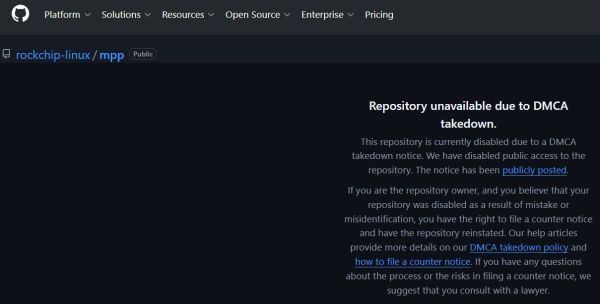
GitHub Disables Rockchip’s Linux MPP Repository After DMCA Request

Recently GitHub disabled the Rockchip Linux MPP repository, following a DMCA takedown request from the FFmpeg team. As of writing the affected repository remains unavailable. At the core of this issue is the Rockchip MPP framework, which provides hardware-accelerated video operations on Rockchip SoCs. Much of the code for this was lifted verbatim from FFmpeg, with the allegation being that this occurred with the removal of the original copyright notices and authors. The Rockchip MPP framework was further re-licensed from LGPL 2.1 to the Apache license.

Most egregious of all is perhaps that the FFmpeg team privately contacted Rockchip about this nearly two years ago, with clearly no action taken since. Thus FFmpeg demands that Rockchip either undoes these actions that violate the LGPL, or remove all infringing files.

This news and further context is also covered by [Brodie Robertson] in a video. What’s interesting is that Rockchip in public communications and in GitHub issues are clearly aware of this license issue, but seem to defer dealing with it until some undefined point in the future. Clearly that was the wrong choice by Rockchip, though it remains a major question what will happen next. [Brodie] speculates that Rockchip will keep ignoring the issue, but is hopeful that he’ll be proven wrong.

Unfortunately, these sort of long-standing license violations aren’t uncommon in the open source world.

Continue reading “GitHub Disables Rockchip’s Linux MPP Repository After DMCA Request”

The clock and the rebuilt calculator from which its VFD was donated.

An RPN Calculator And A Bonus VFD Clock From Casio Revival

Have you heard the saying “the problem is the solution”? It seems to originate in the permaculture movement, but it can apply equally well to electronics. Take the problem [shiura] had: a Casio Mini CM-602 that had let out the magic smoke. The solution was a twofer: rebuild the Casio into a modern number cruncher with Reverse Polish Notation (RPN), and save the Vacuum Fluorescent Display (VFD) for a gorgeous WiFi clock.

[shiura]’s write-up includes a helpful guide for reverse engineering the pins on this sort of VFD, if you don’t happen to have the same model calculator (or VFD tube) they’re working with. If you’ve done this sort of thing, you know what to expect: power it up and kill power to the pins, one by one, to map out which segments or characters go out, thereby identifying the anodes and grid electrodes. The cathodes had already been ID’d from looking at the PCB. After that it’s just a matter of wiring the VFD to an ESP32 via a transistor array to get the voltages right, and voila! Clock. The code and case design files for this clock — including an editable .blend — are available via GitHub.

The calculator half of the project is an incredibly elegant hack that relies on the fact that the Casio’s CPU has the same pin pitch as modern micros: 2.54 mm, or 0.1″, so an RP2040 zero can sit in the footprint of the original CPU, scanning the keypads with its GPIO. Then an I2C display is separately wired up to replace the clockified VFD. Perhaps some driver circuitry for the VFD died, or [shiura] salvaged the display before deciding to save the calculator, because otherwise we see no reason why this brain transplant couldn’t be done while keeping the original display. Admittedly having two lines on the display instead of one make the “new” calculator a tad more usable. The code for that is also available on GitHub, and while the readme is in Japanese, machine translations have gotten pretty good and the code is quite readable on its own.

Longtime readers will likely be familiar with [shiura]’s work, with a number of finely crafted clocks having been featured from the Japanese maker, along with vintage pocket computer repairs. Bringing both together makes this twin hack particularly on-brand.

Continue reading “An RPN Calculator And A Bonus VFD Clock From Casio Revival”