

The “Tin Blimp” Was A Neither Tin Nor A Blimp: The Detroit ZMC-2 Story

That fireball was LZ37. Nobody wanted to see repeats post-war.
Image: “The great exploit of lieutenant Warnefort 1916 England” by Gordon Crosby, public domain.

After all the crashing and burning of Imperial Germany’s Zeppelins in the later part of WWI – once the Brits managed to build interceptors that could hit their lofty altitude, and figured out the trick of using incendiary rounds to set off the hydrogen lift gas – there was a certain desire in airship circles to avoid fires. In the USA, that mostly took the form of replacing hydrogen with helium. Sure, it didn’t lift quite as well, but it also didn’t explode.

Still, supplies of helium were– and are– very much limited, and at least on a rigid Zeppelin, the hydrogen wasn’t even the most flammable part. As has become widely known, thanks in large part to the Mythbusters episode about the Hindenburg disaster, the doped cotton skin in use in those days was more flammable than some firestarters you can buy these days.

That’s a problem, because, as came up in the comments of our last airship article, rigid airships beat blimps largely on Rule of Cool. Who invented the blimp? Well, arguably it was Henri Griffard with his steam-driven balloon in 1857, but not many people have ever heard his name. Who invented the rigid airship? You know his name: Ferdinand Adolf Heinrich August Graf von Zeppelin. No relation. Probably. Well, admittedly most people don’t know the full name, but Count Zeppelin is still practically a household name over a century after his death. His invention was just that much cooler.

That unavoidable draw of coolness led to the Detroit Airship Company and their amazing tin blimp. The idea was the brainchild of a man named Ralph Upton, and is startling in its simplicity: why not take the all-metal, monocoque design that was just then being so successfully applied to heavier-than-air flight, and use it to build an airship? Continue reading “The “Tin Blimp” Was A Neither Tin Nor A Blimp: The Detroit ZMC-2 Story”

Arduino’s New AI-Centric Board Is The VENTUNO Q

There have been many questions about what direction Arduino would take after being bought by Qualcomm. Now it would seem that we’re getting a clearer picture. Perhaps unsurprisingly the answer appears to be ‘AI’, with the new Arduino VENTUNO Q SBC being advertised as ‘democratizing AI’ in the Qualcomm press release, although it also references robotics.

This new board is based around the Dragonwing IQ-8275 SoC along with an STM32H5F5 MCU, making it somewhat of a beefier brother of the previously covered Arduino Uno Q, which also offers an SoC/MCU hybrid solution. On the product page we can see the overall specifications for this new board, where the release date is specified as ‘soon’.

Its IQ-8275 SoC is part of Qualcomm’s IQ8 series, with eight 2.35 GHz ARM cores and an Adreno 623 GPU, paired with 16 GB of LPDDR5. The Cortex M33-based STM32H5F5 MCU comes with its own 4 MB of Flash and 1.5 MB of RAM, all on a board that’s significantly larger than the Uno Q and isn’t crippled by a single USB-C port as SoC I/O.

Although clearly more aimed at industrial and automation applications than the solution-in-search-of-a-problem Uno Q board, it remains to be seen whether this board will catch on with Arduino fans, or whether Qualcomm’s goal is more to break into whole new markets under the Arduino brand.

Seeing The World Through Animal Eyes

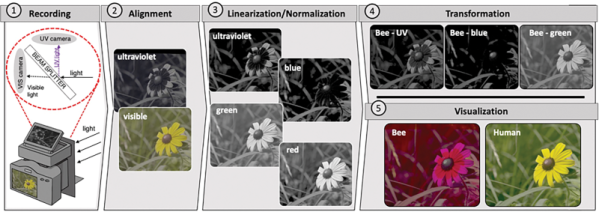
If you think about it, you can’t be sure that what you see for the color red, for example, is what anyone else in the world actually sees. All you can be sure of is that we’ve all been trained to identify whatever we do see as red just like everyone else. Now, think about animal vision. Most people know that dogs don’t see as many colors as we do. On the other hand, the birds and the bees can see into ultraviolet. What would the world look like with extra colors? That’s the question researchers want to answer with this system for duplicating different animals’ views of the world.

Of course, this would be easy if you were thinking about dogs or cats. They can’t see the difference between red and green, making them effectively colorblind by human standards. Researchers are using modified commercial cameras and sophisticated video processing to produce images that sense blue, green, red, and UV light. Then they modify the image based on knowledge of different animal photoreceptors.

We were somewhat surprised that the system didn’t pick up IR. As we know snakes, for example, can sense IR. You’d think more sophisticated animals would have better color vision, but that seems to be untrue. The mantis shrimp, for example, has 12-16 types of photoreceptors. Even male and female humans have different vision systems that make them see colors differently.

Maybe you need a photospectrometer. You wonder if animals dream in color, too.