
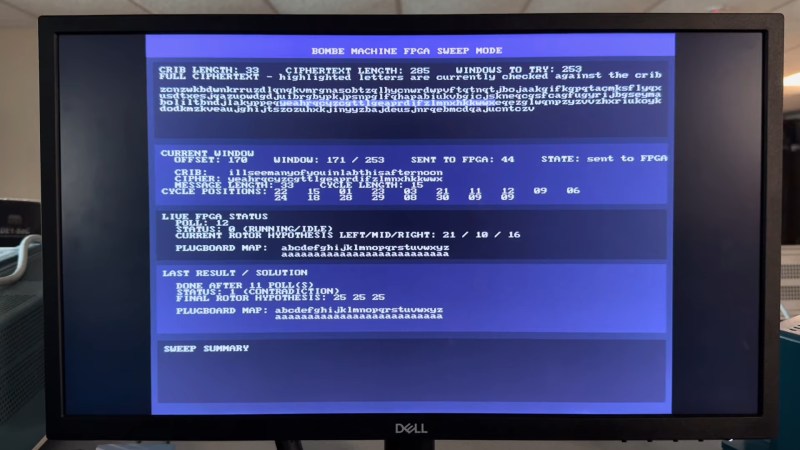
The pioneering work done by Alan Turing and others at Bletchley Park in England was perhaps as important in the history of technology as it was the history of the war. Given the last 80-odd years of technological development, their revolutionary work should be within the realms of a student project — which it was, specifically in ECE 5760 at Cornell University. The work was done by [Erica Jiang], [Kelvin Resch], and [Isabella Frank].
Nowadays if someone told you there was a code to be broken, you wouldn’t be reaching for electromechanical devices, but you just might think of trying an FPGA. After all, the programmable gate arrays allow for much faster execution of fixed logic than software running on a traditional CPU. That won’t help much with modern RSA schemes, and for Enigma, it’s massively overkill, but doing it that way was a great learning opportunity for the students.
Their project emulates the whole Bletchley Park cryptography apparatus, not just the Bombe Machine, and if you’re interested in learning about this piece of history you could absolutely do worse than to examine their documentation. If you’re into video, you can check out the final presentation and demo video below. Meanwhile if you’re wondering what the opposition was up to, we have good explainer of the enigma machine here.
Thanks to [Hunter Adams] for the tip!









Bletchley
At least we know the title was human-made unlike the rest.
What, precisely in this prose makes you think “clanker”? There are plenty of guides on how to ID LLM-generated text; you might want to review one. So far your false-positive rate, at least on this website, is about 100%.
Just behind the scourge of AI-generated slop is the new scourge of internet commenters who now believe everything they see is AI slop and will comment & argue to that effect at every opportunity.
gesundheit!
Also, thanks for picking that out.
the title still says BLETCHLY …
Glad to see they’re using my Virtual Enigma simulation! You can find it at https://enigma.virtualcolossus.co.uk as well as a working Bombe machine, Colossus, Lorenz SZ42 cipher machine and many others.
The way the enigma works is wrongly / partially understood by the project makers. Each machine had 5 diferent rotors (but soon after the war started there were 3 more added) out of which 3 were choosed for current day settings. Also not mentioned (as the bombe kinda ignores them) are the ring settings for the rotors (the position in which the current rotor forced the next one to make a step). While the first 5 rotors had only one position, the rotors 6, 7 and 8 had two.
All of these applies to the army enigma, the navy had more complicated settings and codebooks that made decryption close to impossible. For instance, one uboot report had only 22 or 23 letters, including position, wheather report, ships sightings and more.
Because of backward compatibility, all new features and devices for enigma had to have “weak” settings. There was a programmable rotor (you could set the letter pairings and all 26 ring settings), there was a more complex plugboard, and so on.
Marjan Rejewski actually broke the first enigma model. And the was already at the time, before the beginning of ww2, automated. Turing participated at the best greatly at the decryption of the second enigma version, which entered in service at the beginning of the war. And consisted in adding a coding wheel and some subsidiary element. Without the help of a special naval commando operation, to capture a working version of enigma v2, and the great work of the GCHQ, Alan Turing himself would barely be mentioned in books… For those interested, I recommend “The book of code”, from Simon Singh, which covers a lot of historical encryption systems. A fascinating book.
Also not mentioned was Poland code crackers’ results given to the UK before all the Bombe activity.
Too bad they used naive approach and their calculations wouldn’t work in practice. But you know what they say, everything looks like differential equation when all you have is
ode23().Indeed, even if actually, it was given to France first, and Rejewski along with part of his team went there as well to continue their work on deciphering Enigma V2. All the work was sent to the UK, when France felt, obviously to avoid it to be discovered.
https://github.com/VE3NEA/enigma-cuda
https://web.archive.org/web/20170421024918/https://cryptocellar.org/pubs/Enigma_ModernBreaking.pdf
In case you needed a rabbit hole.
Been there. Got frequencees for German language’s single, double, triple and quad group of letters, various emulators and enigma solving programs modified. The lot. Then finnaly decrypted grandma’s secret sausage recipe. Grandpa secret beer recipe still holding for the next thirsty generation.