Breaking Enigma With An FPGA, Just Like At Bletchley Park

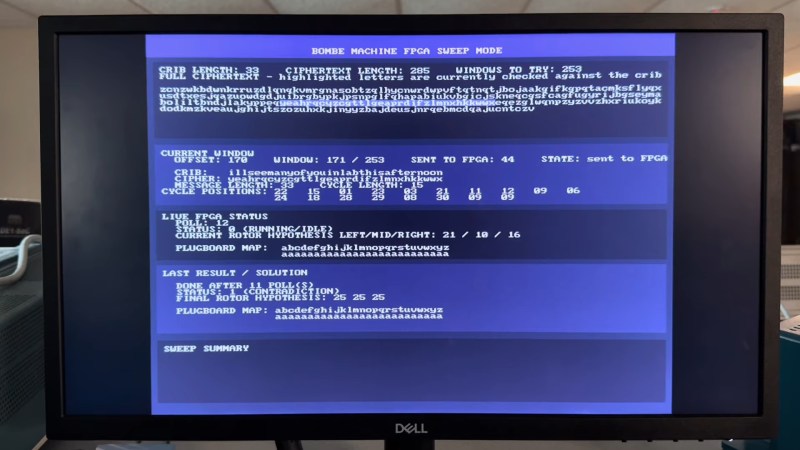
The pioneering work done by Alan Turing and others at Bletchley Park in England was perhaps as important in the history of technology as it was the history of the war. Given the last 80-odd years of technological development, their revolutionary work should be within the realms of a student project — which it was, specifically in ECE 5760 at Cornell University. The work was done by [Erica Jiang], [Kelvin Resch], and [Isabella Frank].

Nowadays if someone told you there was a code to be broken, you wouldn’t be reaching for electromechanical devices, but you just might think of trying an FPGA. After all, the programmable gate arrays allow for much faster execution of fixed logic than software running on a traditional CPU. That won’t help much with modern RSA schemes, and for Enigma, it’s massively overkill, but doing it that way was a great learning opportunity for the students.

Their project emulates the whole Bletchley Park cryptography apparatus, not just the Bombe Machine, and if you’re interested in learning about this piece of history you could absolutely do worse than to examine their documentation. If you’re into video, you can check out the final presentation and demo video below. Meanwhile if you’re wondering what the opposition was up to, we have good explainer of the enigma machine here.

Continue reading “Breaking Enigma With An FPGA, Just Like At Bletchley Park”
EPROM-based Enigma Machine

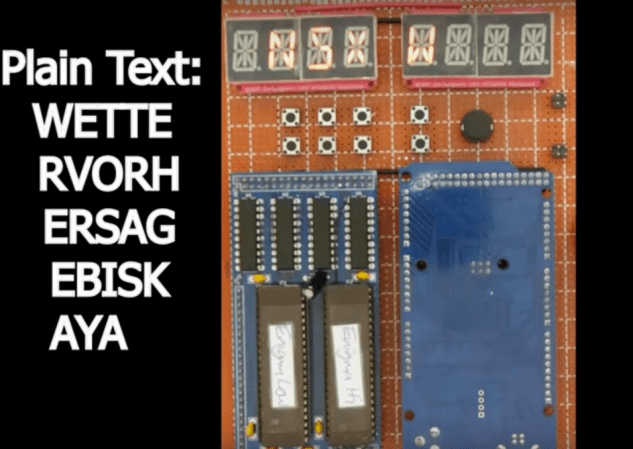
The Enigma machine is perhaps one of the most legendary devices to come out of World War II. The Germans used the ingenious cryptographic device to hide their communications from the Allies, who in turn spent an incredible amount of time and energy in finding a way to break it. While the original Enigma was a complicated electromechanical contraption, [DrMattRegan] recently set out to show how its operation can be replicated with an EPROM.

The German Enigma machine was, for the time, an extremely robust way of coding messages. Earlier versions proved somewhat easy to crack, but subsequent machines added more and more complexity rendering them almost impenetrable. The basis of the system was a set of rotors which encrypted each typed letter to a different one based on the settings and then advanced one place in their rotation, ensuring each letter was encrypted differently than the last. Essentially this is a finite-state machine, something perfectly suited for an EPROM. With all of the possible combinations programmed in advance, an initial rotor setting can be inputted, and then each key press is sent through the Enigma emulator which encrypts the letter, virtually advances the rotors, and then moves to the next letter with each clock cycle.

[DrMattRegan]’s video, also linked below, goes into much more historical and technical detail on how these machines worked, as well as some background on the British bombe, an electromechanical device used for decoding encrypted German messages. The first programmable, electronic, digital computer called Colossus was also developed to break encrypted Enigma messages as well, demonstrating yet another technology that came to the forefront during WWII.

Continue reading “EPROM-based Enigma Machine”

Help Keep The Bombe At Bletchley

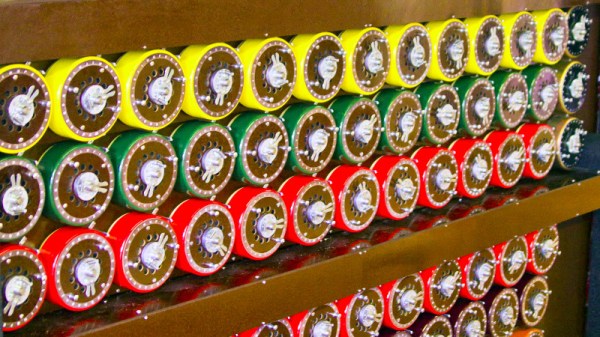
Fans of vintage codebreaking machinery might be interested to hear that the only working reconstruction of a Turing-Welchman Bombe is likely to soon be on the move. The electromechanical device, a replica of those used on the Second World War Enigma codes, is housed at Bletchley Park, the former codebreaking center established before the outbreak of war to house British and Polish codebreakers.

Bletchley Park itself is now a tourist attraction. The news is that a display reorganization has caused the Turing Welchman Bombe Rebuild Trust that owns the Bombe to approach the neighboring National Museum Of Computing with a view to housing it alongside their reconstruction of the Colossus electronic computer. The Colossus was famously used on the Lorenz cipher. This is an exciting development for the museum, but as an organization reliant on donations they face the task of finding the resources to create a new gallery for the arrival. To that end, they have launched a crowdfunding campaign with a target of £50000 ($69358.50), and they need your donations to it for the project to succeed. They have raised over £4500 in the few days it has already been open and there is most of a month still to go, so we hope they achieve their goal.

The Bletchley Park site is now surrounded by the post-war new town of Milton Keynes, and is easy enough to get to should you find yourself in the UK. We visited The National Museum Of Computing a couple of years ago and spent a very happy day touring its extensive and fascinating collection. If you want to read more about the Bombe you might like to read our review, and also our impression of Colossus.

As part of their campaign, the museum has produced a promotional video, which we have placed after the break.

Continue reading “Help Keep The Bombe At Bletchley”