
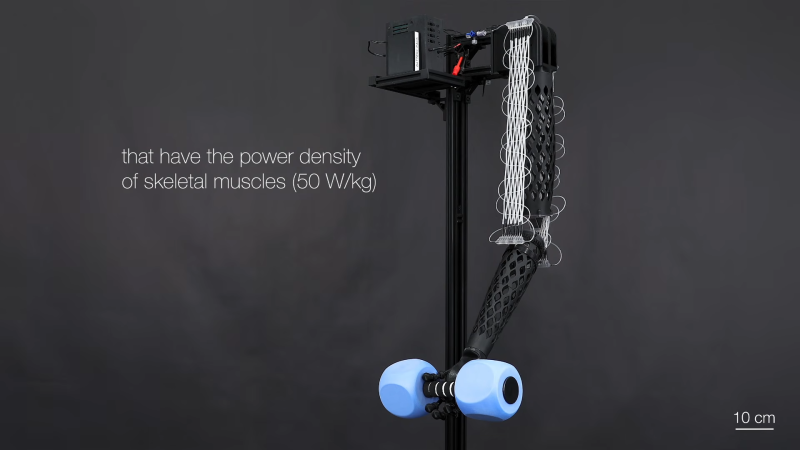
At the current rate of robotics development, you might assume that we’re close to Skynet taking over. However, while we likely wouldn’t do well in a physical fight against a robot, we can at least keep the bragging rights of having the cooler actuators. Or at least, that was the case before a new actuator came into town — introducing “Electrofluidic Fiber Muscles”.
Traditional robotic actuators use motors of some kind with a variety of gearboxes or linkages to turn rotational movement into usable movement. This isn’t always the most effective way to run some robotics movements, especially when modeling humans. This is why many have turned to pressurized modes of actuation. Though most don’t show quite the promise of the new player.
Electrofluidic Fiber Muscles use pressure to shorten muscle strands, similar to past actuators. However, these are a tad different, taking advantage of electrofluidic pressure. A small current under high voltage is able to drive a pressure gradient in a long tube. This tube can then be connected to both an extensor and flexor portion of an actuating circuit, similar to a biological mechanical system. Better yet, this driving pressure pump can be spun around the fibers themselves, making a tight package.
Unfortunately, it will probably be a bit till we see this inside a hobbyist robot. Until then, make sure to check out some other actuator feats!












Micro McKibben Musles? pretty cool.
Ive played with larger homebrew McKibbens, and Festo fluidic muscles a bit. Its pretty impressive the level of strength and control you can get with them. We were able to get a single leg on a test stand to do squats while supporting 200 pounds using an opposing pair of DMSP-40’s. Unfortunately, when we tried to switch from air driven to fluid driven the actuators failed. Had we read the included paperwork we would have saved ourselves a huge headache and $1500.
Festo themselves have some impressive displays of McKibbens – race car simulators and the like. Motion creation can be easy but modulating pressure to get road-texture feel out of some tubing is pretty impressive.
Finally, the myomers have arrived. The old shape-alloy version was kinda lame. This one even works the way it does in the Tech Manual if you squint.
I knew I’d find a BattleTech reference in the comments. Now its only 400 plus years until we get the Mackie and 650 until we get the Urbanmech… In the mean time I’ll settle for better prosthetics and exoskeletons.
Not sure I understand how the pumps work. Pressure is generated by current running through a fluid. The fluid is negatively or positively charged so running a current through it forces it to move. Is that right?
Dielectric fluid does not have a positive nor a negative charge. It reacts to an electrical field through dielectric polarization. When exposed to a voltage or electric field, the positive atomic nuclei and negative electron clouds within the fluid’s molecules slightly stretch or rotate. At this point the molecules act like tiny magnets. The ions or charges within the fluid move toward the electrodes, physically dragging the liquid along with them to create bulk fluid movement
After some link following and research
“Electrohydrodynamic (EHD) fiber pumps are mm-scale, soft, flexible fluidic devices that generate pressure and flow by converting electrical energy directly into fluid motion, without moving parts. They operate via charge-injection EHD, where a high voltage applied between helical electrodes inside a dielectric fluid ionizes and accelerates the liquid, producing net flow”
A dielectric fluid is a liquid that does not conduct electricity and is used primarily to insulate and cool electrical equipment such as transformers, capacitors, high-voltage cables, and switchgear.
https://www.media.mit.edu/projects/electrofluidicmuscle/overview/
This could be handy for non-robotic uses.
automated masturbators ARE robots.
Hey you said it, I only thought about it
Hey you said it, I just thought about it
So how long before we see submersibles and small aircraft driven by theses systems? Not going to lie it’d be pretty slick to have a sea scooter based off a marlin or short fin mako shark. We might get a condor sized ultralight into the air but I think it would need a boost get airborne.
This seems nearly identical to Peano-HASEL actuators.
we need more diesel engines per muscle strand if we ever want to make anything really cool.