This Week In Security: Critical DNS Keys Rotated, Hacking Freezers Isn’t Cool, OpenAI Spies On Itself, And Advanced Hardware Wallet Hacks

Critical Internet keys changed this week. Did you notice?  The keys behind DNSSEC, the system for cryptographically validating DNS responses, rolled over on October 11 2026. This is the second time the DNSSEC keys have rotated since the system was implemented, and the first time in 2018 didn’t exactly go entirely smoothly.

DNS is what resolves a host name and turns it into an IP address. It underpins web browsing, email, and just about every other connection. It’s also a very early Internet protocol, written in both a simpler, less paranoid era, and an era where encryption was computationally expensive and legally problematic. DNS offers little protection against malicious actors spoofing responses, and the impacts range from phishing to redirecting email to just about any other manipulation of connections you can image.

DNSSEC addresses this by creating a chain of trust between DNS resolvers — the servers that forward the DNS query into the DNS infrastructure and return the results — and the global DNS servers. Part of this chain of trust is the root key that each resolver must have and trust, and this key is what changed this week.  DNSSEC resolvers automatically watch for a new root of trust key, but the key must be signed by the previous root of trust, and is checked for at least 30 days before it is trusted.  If someone were able to issue a bogus certificate, they would have to maintain control of the infrastructure for over a month before DNS resolvers would trust it.

The process of distributing the new key actually began more than a year ago, on January 11, 2025, to give DNSSEC resolvers time to get the new key. DNSSEC services should have had plenty of time to obtain and trust the new key, and unless DNS stopped working for you this week, they did their job.

The next major change for DNSSEC will require more profound changes to deploy a new signing algorithm that will be post-quantum secure.
Continue reading “This Week In Security: Critical DNS Keys Rotated, Hacking Freezers Isn’t Cool, OpenAI Spies On Itself, And Advanced Hardware Wallet Hacks” →

Disposing Of PLA And Why Composting Is Not An Option

The ‘biofriendly’ nature of poly(lactic acid) (PLA) filament often gets touted as one of its main advantages over alternatives like PETG, but even a modicum of research ought to inform a person that the biodegrading feature of PLA is only true for pure PLA without additives and at temperatures at or above its glass transition temperature (Tg). Thus the results of a year-long experiment by [I built a thing] shouldn’t be too surprising.

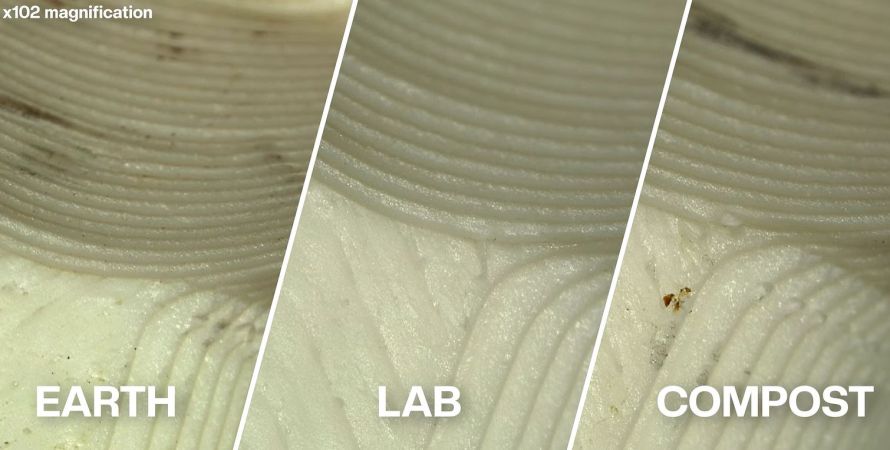
After burying said PLA in the garden like any self-respecting person does who tries to dispose of some evidence, the PLA suffered through a European winter and very hot, dry summer, before being dug up again recently for inspection and testing. Although not the first time that someone has tested this, it’s a good reminder considering just how much PLA filament is used each year.

In total three sample sets were used, one being the control, the other two buried in soil and compost respectively. A visual inspection showed no major difference, and a tensile strength test also showed no statistically significant change among all three sample sets. The experiment could have been concluded here, but instead calorimetry was used in a laboratory setting to see whether exposure to microbes as commonly found in soil does anything significant.

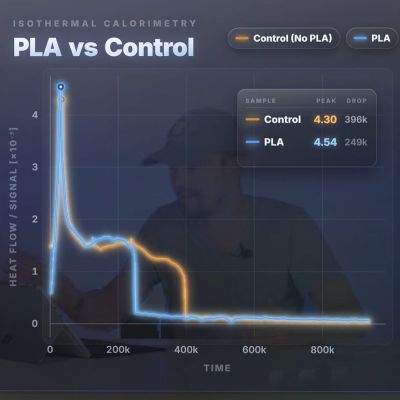
This isothermal microcalorimetry test was performed at the University of Basel, effectively to answer the question whether there’s anything in the PLA samples that can feed said microbes. As it turns out, the answer is a resounding ‘no’, with microbial activity within the presence of PLA dropping off even quicker presumably due to there being less volume available for nutrients.

When [I built a thing] contacted a large number of commercial biodegrading facilities in Switzerland, Germany and the USA, many would happily take PLA, but none of them would accepted 3D-printed PLA parts, which says a lot. The primary reason for this appears to be that even under industrial composting conditions it simply takes too long for these facilities to consider these to be economical to compost.

With PLA primarily degrading via hydrolysis, it needs to be exposed to the right conditions for this process to not take an eternity. You can of course use something like PHA instead, which doesn’t require this hydrolysis step to be biodegradable. Overall PLA is quite a crummy material, with it also suffering from embrittlement due to crystallization that will happily turn a spool of PLA into lots of sad fragments. This makes PETG into a very common and very attractive alternative to PLA.

Continue reading “Disposing Of PLA And Why Composting Is Not An Option” →

Running DOOM (Sort Of) On A Sonoff Smart Switch

It’s often said in this community that DOOM can be made to run on anything, and as time goes on, that’s becoming more and more accurate. We’re at the point now that every “normal” device seems to have some version of the iconic 1993 shooter, so now there’s nothing left but to start working on the more oddball targets.

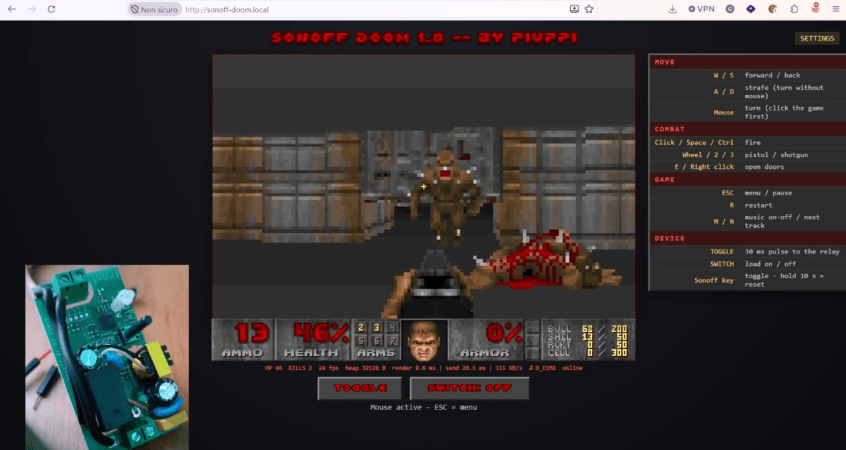
As a perfect example, [piuppi] recently wrote in to share their efforts to get DOOM — or at least something that looks like it — running on the Sonoff Basic R2 smart switch. We say something that looks like it because the game you’re seeing in the video below isn’t actually DOOM. In fact, it’s not even really a full game. It’s essentially a tech demo that’s capable of rendering graphical data pulled from the game, but only within the confines of simplistic map. Still, not bad for something designed to turn lamps on and off.

The GitHub repo includes excellent documentation should you want to rip and tear on your own Sonoff device. As you might expect the process is a bit involved, and does require you to provide your own copy of DOOM for the script to extract the necessary data from. After it’s setup, you can hit the switch from any browser on the local network and take out your frustrations on the state of modern home automation on some imps. The best part is, even after the game is installed and running on the switch, the device still actually works as a switch.

But don’t worry. Even in the unlikely event that we run out of devices that can be hacked to run DOOM, there’s still a whole world of gadgets out there that need their own port of Duke Nukem 3D.

Continue reading “Running DOOM (Sort Of) On A Sonoff Smart Switch” →