Onde Magnetique Will Wow And Flutter Your Ears

[Scott Campbell] built a cassette-based synthesizer that sounds exactly like everything you’ve heard before. The sound generation comes straight off cassettes, but the brainbox of this synth varies the volume and pitch. It’s called the Onde Magnetique, and it is what you would get if you combined a Mellotron and Ondes Martenot.

The key component for the Onde Magnetique is a Sony cassette recorder that conveniently and inexplicably comes with a ‘tape speed input’ mini jack. By varying the voltage sent to this input jack, the speed of the tape, and thus the pitch of the sound being played, is changed. Build a box with a touch-sensitive button for volume, and a few tact switches for different speeds, and you have an electromechanical bastard child of a Mellotron and an Ondes Martenot.

By itself, the Onde Magnetique produces no sound – it only controls the pitch and volume of whatever is on the cassette. [Scott] produced a few single-note cassettes for his instrument, with ‘voice patches’ including a flute, choir, and a synth. With the CV and Gate input, these sounds can be sequenced with outboard gear, producing the wonderful sounds heard in the video after the break.

Continue reading “Onde Magnetique Will Wow And Flutter Your Ears”
Hackaday Prize Entry: Let Your Muscles Do The Work

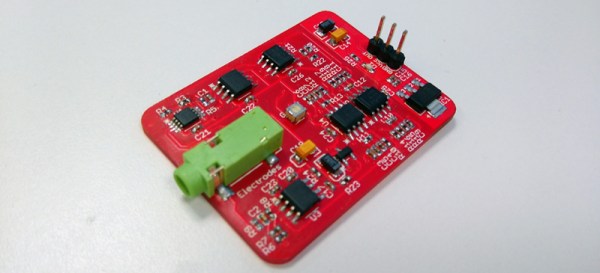
Electromyography is a technique used to study and record the electrical signals generated when a muscle contracts. It’s used for medical diagnosis, rehab, kinesiological studies, and is the preferred method of control for robotic prosthetics and exoskeletons. There are a few companies out there with myoelectric products, and the use case for those products is flipping the slides on a PowerPoint presentation. Lucky for us, this project in the Hackaday Prize isn’t encumbered by such trivialities. It’s an open, expandable platform to turn muscle contractions into anything.

As you would expect, reading the electrical signals from muscles requires a little more technical expertise than plugging a cable into an Arduino. This project has opamps in spades, and is more than sensitive enough to serve as a useful sensor platform. Already this project is being used to monitor bruxism – inadvertent clenching or grinding of the jaw – and the results are great.

While it’s doubtful this device will ever be used in a medical context, it is a great little board to add muscle control to a robot arm, or build a very cool suit of power armor. All in all, a very cool entry for The Hackaday Prize.

Hackaday Prize Entry: Piezo Gait Analysis

Go into a fancy drug store, and you might just find one of the most amazing sales demonstrations you’ll ever see. Step right up, take your shoes off, and place your feet onto the magical Dr. Scholl’s machine, and you’ll get a customized readout of how your feet touch the ground. As an added bonus, you’ll also get a recommendation for a shoe insert that will make your feet feel better and your shoes fit better.

There is, of course, one problem with this setup. You don’t stand on a footprint measuring device all day. A better solution to the problem of measuring how your feet hit the ground is doing it while you walk. That’s where [chiprobot]’s Alli-Gait-Or Analysis comes in. It’s that Dr. Scholl’s machine tucked into the sole of a shoe. It can be worn while you walk, and it can tell you exactly how your feet work.

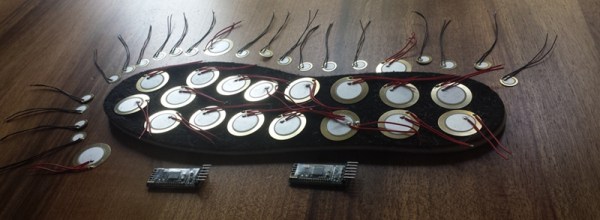
[chiprobot]’s robotic shoes consist of a 3D printed insert that holds eighteen piezo transducers per shoe. These are connected to ADCs, which feed into a microcontroller which sends the data out to a computer. That’s simple enough, but making sense of the data is the real problem.

To turn this data into something that could be used for selecting orthotics or simply finding a better shoe, [chiprobot] is plugging this data into Blender and creating some very cool visualizations. It’s good enough to get some serious data off a shoe, and since this Alli-Gait-Or is wearable, the data is much more valid than a machine sitting in a drug store.

Hackaday Prize Entry: A Simple Spectrophotometer

Building on the work of other Citizen Science efforts, [doctek]’s entry for the Hackaday Prize promises to detect pollution, identify chemicals, and perform other analyses with a simple handheld device. It’s a spectrophotometer, and [doctek] is putting some real engineering into this build.

A spectrophotometer is one of the simplest devices able to perform spectroscopy, requiring only a light source, a photoresistor, and some means of producing monochromatic light. By putting a sample in front of the photoresistor, the absorption spectrum of the sample can be measured. With this data, it’s a simple matter to identify the sample.

A light and a photoresistor are simple enough, but as with every precision measurement device, the devil is in the details. [doctec] is using new, low-noise, low-offset opamps, and precision references to get his data. Some of the parts in the schematic were actually designed in this century – a far cry from the ‘plug the photoresistor into the analog input’ projects we see so often.

[doctec] is using a Teensy 3.0 to drive the electronics and collect the data, and he already has the mechanics of this build pretty much figured out. It’s a great project that shows off some engineering skill, making it a great entry for The Hackaday Prize.

The Onion Omega2: The Latest Router Dev Board

A few years ago, the best way to put a device or project online was by hacking a router. With an inconspicuous Linksys WRT54G held onto a project with baling wire, anything can connect to the Internet. A lot has changed in a few years, and now those routers are development boards themselves. The latest of these is the Onion Omega2, a follow-up crowdfunding campaign to the very popular original Omega. Now, this tiny dev board is faster, more capable, and now it’s giving the Raspberry Pi Zero a run for its money.

The original Onion Omega was released last year with specs you would expect from an Internet of Things development board designed upon a chip for a cheap router. The original Onion used an Atheros AR9331 SOC running at 400 MHZ, had 64MB of RAM and 16MB of storage – enough to run a lightweight Linux distro – and also included USB, 802.11b/g/n, and a handful of GPIOs and a single UART. The Omega2 is a vast improvement over the original Omega, featuring a CPU that is 45% faster. The upgraded version of the Omega sports twice as much RAM, twice as much storage, and a MicroSD slot. This enables some Linux distros with a little more oomph behind them, and of course the SD card allows for local storage.

The original Onion Omega was funded through a crowdfunding campaign, with a single Onion Omega and dock available for a pledge of $19. Taking a lesson from the C.H.I.P. and the Pi Zero, the team at Onion have slashed the price. The Omega2 is only five dollars. If you want more RAM, storage, and an SD card socket, that price goes up to $9 USD. That’s amazing, and just goes to show how far hardware designed to service the Internet of Things has come in just a few short years.

Hackaday Prize Entry: An Internet Of Things Microscope

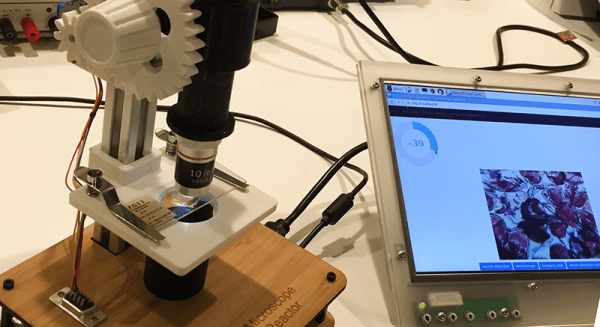
For their entry into the Citizen Scientist portion of the Hackaday Prize, the folks at Arch Reactor, the St. Louis hackerspace, are building a microscope. Not just any microscope – this one is low-cost, digital, and has a surprisingly high magnification and pretty good optics. It’s the Internet of Things Microscope, and like all good apparatus for Citizen Scientist, it’s a remarkable tool for classrooms and developing countries.

When you think of ‘classroom microscope’, you’re probably thinking about a pile of old optics sitting in the back of a storage closet. These microscopes are purely optical, without the ability to take digital pictures. The glass is good, but you’re not going to get a scanning stage when you’re dealing with 30-year-old gear made for a classroom full of sticky-handed eighth graders.

The Internet of Things Microscope includes a scanning stage that moves across the specimen on the X and Y axes, stitching digital images together to create a very large image. That’s a killer feature for a cheap digital microscope, and the folks at Arch Reactor are doing this with a few cheap stepper motors and stepper motor drivers.

The rest of the electronics are built around a Raspberry Pi, Raspberry Pi camera (which recently got a nice resolution upgrade), and a some microscope eyepieces and objectives. Everything else is 3D printed, making this a very cheap and very accessible microscope that has some killer features.

Hackaday Prize Entry: The Cheapest Logic Analyzer

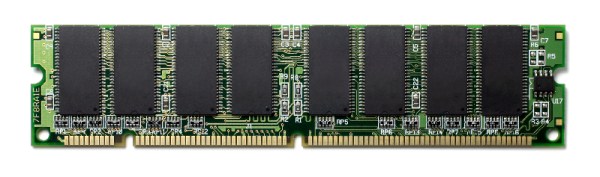
There are piles of old 128MB and 256MB sticks of RAM sitting around in supply closets and in parts bins. For his Hackaday Prize project, [esot.eric] is turning these obsolete sticks of RAM into something useful – a big, fast logic analyzer. It’s cheap, and simple enough that it can be built on a breadboard.

If using old SDRAM in strange configurations seems familiar, you’re correct. This project is based on [esot.eric]’s earlier AVR logic analyzer project that used a slow AVR to measure 32 channels of logic at 30 megasamples per second. The only way this build was possible was by hacking an old stick of RAM to ‘free run’, automatically logging data to the RAM and reading it out with an AVR later.

This project expands on the earlier projects by using bigger sticks of RAM faster, with the ultimate goal being a 32-bit, 133MS/s logic analyzer that is more of a peripheral than a single, monolithic project. With a Raspberry Pi Zero, a stick of RAM, and a few miscellaneous logic chips, this project can become anything from a logic analyzer to a data logger to an oscilloscope. It’s weird, yes, but the parts to make this very handy tool can be found in any hackerspace or workshop, making it a great trick for the enterprising hardware hacker.