Hackaday Prize Entry: A Suite Of Lab Instruments

For their Hackaday Prize entry, [Jithin], [Praveen], [Varunbluboy], and [Georges] are working on SEELablet, a device that will equip budding citizen scientists with control and measurement equipment.

One of the best ‘all-in-one’ lab devices is National Instruments’ VirtualBench, a device that’s an oscilloscope, logic analyzer, function generator, multimeter, and power supply, all crammed into one box. There’s a lot you can do with a device like this, but as you would expect, the name-brand version of this isn’t meant for middle school students.

In an effort to bring the cost of an all-in-one lab tool down to a price mere mortals can afford, the team behind the SEELablet have combined a single board computer with the capability of an oscilloscope, frequency counter, logic analyser, waveform generator, and a programmable power supply.

This has been a multi-year project for the team, beginning with a Python-powered instrumentation tool, and later a device running this code that’s also a versatile lab tool. If the latest iteration of the project turns out to be all it promises, we can’t wait to see the data this box will produce. There’s a lot you can measure in a fully stocked electronics lab, and this project makes the whole setup much easier to obtain.


Hackaday Prize Entry: A Cheap Robotic Microscope

The microscope is one of the most useful instruments for the biological sciences, but they are expensive. Lucky for us, a factory in China can turn out webcams and plastic lenses and sell them for pennies. That’s the idea behind Flypi – a cheap microscope for scientific experiments and diagnostics that’s based on the ever-popular Raspberry Pi.

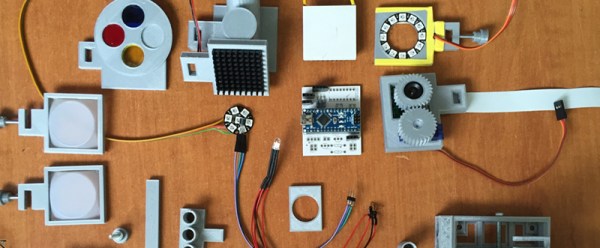
Flypi is designed to be a simple scientific tool and educational device. With that comes the challenges of being very cheap and very capable. It’s based around a Raspberry Pi and the Pi camera, with the relevant software for taking snapshots, recording movies, and controlling a few different modules that extend the capabilities of this machine. These modules include a Peltier element to heat or cool the sample, a temperature sensor, RGB LED, LED ring, LED matrix, and a special blue LED for activating fluorescent molecules in a sample.

The brains behind the Flypi, [Andre Chagas], designed the Flypi to be cheap. He’s certainly managed that with a frame that is mostly 3D printed, and some surprisingly inexpensive electronics. Already the Flypi is doing real science, including tracking bugs wandering around a petri dish and fluorescence microscopy of a zebrafish’s heart. Not bad for a relatively simple tool, and a great entry for the Hackaday Prize.

Mergers And Acquisitions: Analog And Linear

Analog Devices and Linear Technology have announced today they will combine forces to create a semiconductor company worth $30 Billion.

This news follows the very recent acquisition of ARM Holdings by Japan’s SoftBank, and the later mergers, purchases or acquisitions of On and Fairchild, Avago and Broadcom, NXP and Freescale, and Microchip and AtmelIntel and Altera, and a few more we’re forgetting at the moment.

Both Analog and Linear address similar markets; Analog Devices is best known for amps, interface, and power management ICs. Linear, likewise, isn’t known for ‘fun’ devices, but without their products the ‘fun’ components wouldn’t work. Because the product lines are so complimentary, the resulting company will stand to save $150 Million annually after the deal closes.

Analog and Linear are only the latest in a long line of semiconductor mergers and acquisitions, but it will certainly not be the last. The entire industry is consolidating, and the only way to grow is by teaming up with other companies. This leads the question if there will eventually only be one gigantic semiconductor company in the future. You’ll get different answers to that question from different people. Hughes, Fairchild, Convair, Douglas, McDonnell Douglas, North American, Grumman, Northrop, Northrop Grumman, Bell, Cessna, Schweizer and Sikorsky would say yes. Lockheed Martin and Boeing would say no. It’s the same thing.

Hackaday Prize Entry: An AI Robot

For her Hackaday Prize entry, [ThunderSqueak] is building an artificial intelligence. P.A.L., the Self-Programming AI Robot, is building on the intelligence displayed by Amazon’s Alexa, Apple’s Siri, and whatever the Google thing is called, to build a robot that’s able to learn from its environment, track objects, judge distances, and perform simple tasks.

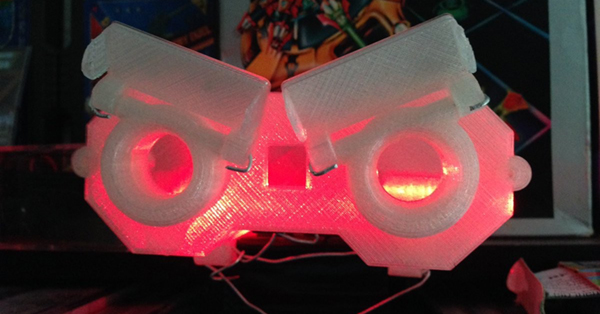
As with any robotic intelligence, the first question that comes to mind is, ‘what does it look like’. The answer here is, ‘a little bit like Johnny Five.’ [ThunderSqueak] has designed a robotic chassis using treads for locomotion and a head that can emote by moving its eyebrows. Those treads are not a trivial engineering task – the tracks are 3D printed and bolted onto a chain – and building them has been a very, very annoying part of the build.

But no advanced intelligent robot is based on how it moves. The real trick here is the software, and for this [ThunderSqueak] has a few tricks up her sleeve. She’s doing voice recognition through a microcontroller, correlating phonemes to the spectral signature without using much power.

The purpose of P.A.L. isn’t to have a conversation with a robotic friend in a weird 80s escapade. The purpose of P.A.L. is to build a machine that can learn from its mistakes and learn just a little bit about its environment. This is where the really cool stuff happens in artificial intelligence and makes for an excellent entry for the Hackaday Prize.

Hackaday Prize Entry: Augmented Reality For Firefighters

Augmented reality is all the rage right now, and it’s all because of Pokemon. Of course, this means the entire idea of augmented reality is now wrapped up in taking pictures of Pidgeys in their unnatural setting. There are more useful applications of augmented reality, as [vijayvictory]’s Hackaday Prize entry shows us. He’s built an augmented reality helmet for firefighters that will detect temperature, gasses, smoke and the user’s own vital signs, displaying the readings on a heads up display.

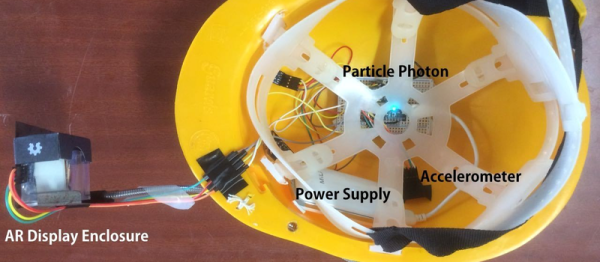
The core of the build is a Particle Photon, a WiFi-enabled microcontroller that also gives this helmet the ability to relay data back to a base station, ostensibly one that’s not on fire. To this, [vijayvictory] has added an accelerometer, gas sensor, and a beautiful OLED display mounted just behind a prism. This display overlays the relevant data to the firefighter without obstructing their field of vision.

Right now, this system is fairly basic, but [vijayvictory] has a few more tricks up his sleeve. By expanding this system to include a FLIR thermal imaging sensor, this augmented reality helmet will have the ability to see through smoke. By integrating this system into an existing network and adding a few cool WiFi tricks, this system will be able to located a downed firefighter using signal trilateralization. It’s a very cool device, and one that should be very useful, making it a great entry for The Hackaday Prize.

Hackaday Links: July 24, 2016

Right now HOPE is dying down, and most of the Hackaday crew will be filtering out of NYC. It was a great weekend. The first weekend in August will be even better. We’re going to DEF CON, we’ll have people at VCF West, and a contingent at EMF Camp. If you’re going to EMF Camp, drop a line here. There will be Hackaday peeps wandering around a field in England, so if you see someone flying the Hackaday or Tindie flag, stop and say hi.

Raspberry Pi’s stuffed into things? Not all of them are terrible. The Apple Extended keyboard is possibly the best keyboard Apple ever produced. It’s mechanical (Alps), the layout is almost completely modern, and they’re actually cheap for something that compares well to a Model M. There’s also enough space inside the plastic to fit a Pi and still have enough room left over for holes for the Ethernet and USB ports. [ezrahilyer] plopped a Pi in this old keyboard, and the results look great. Thanks [Burkistana] for sending this one in.

We’ve been chronicling [Arsenijs] Raspberry Pi project for months now, but this is big news. The Raspberry Pi project has cracked 10k views on Hackaday.io, and is well on track to be the most popular project of all time, on any platform. Congrats, [Arsenijs]; it couldn’t happen to a better project.

A few months ago, [Sébastien] released SLAcer.js, a slicer for resin printers that works in the browser. You can’t test a slicer without a printer, so for the last few months, [Sébastien] has been building his own resin printer. He’s looking for beta testers. If you have experience with resin printers, this could be a very cool (and very cheap) build.

Anyone going to DEF CON? For reasons unknown to me, I’m arriving in Vegas at nine in the morning on Wednesday. This means I have a day to kill in Vegas. I was thinking about a Hackaday meetup at the grave of James T. Kirk on Veridian III. It’s about an hour north of Vegas in the Valley of Fire State Park. Yes, driving out to the middle of the desert in August is a great idea. If anyone likes this idea, leave a note in the comments and I’ll organize something.

Super Cheap Super Simple DRO

If you have an old manual lathe, mill, or even a drill press, a digital readout (DRO) is a very handy tool to have. A DRO gives you a readout of how far you’ve cut, milled, or drilled into a piece of work without having to stoop to caveman levels and look down at a dial. Here’s a stupidly cheap DRO for all your machine tools. It should only cost five bucks or so, and if you need it, you already have the tools to manufacture it.

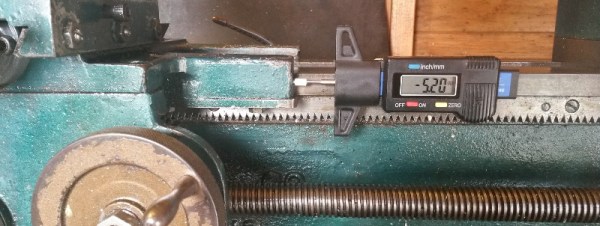
This build is inspired by an earlier build using the same single component – a digital tread depth gauge. This digital tread depth gauge is commonly found in countries that don’t use the US penny as currency to measure the depth of tread on a tire. The throw isn’t that large – only about 27mm – but with a few modifications it can fit on any machine tool.

The modifications include a small bit of metal glued to the back and four tiny neodymium magnets.  For the ‘tool head’ of this DRO, only a tiny plastic collar and another deo magnet are needed.

This digital tire depth gauge looks like – and probably is – the same mechanism found in those super cheap calipers from the far east. In theory, it should be possible to extend this modification to those digital calipers, making for a simple DRO with a much larger throw.

Thanks [Ben] for sending this one in.