Microchip To Acquire Atmel For $3.56 Billion

Just last week, there was considerable speculation that Microchip would buy Atmel. The deal wasn’t done, and there was precedent that this deal wouldn’t happen – earlier this year, Dialog made an approach at Atmel. Now, though, the deal is done: Microchip will acquire Atmel for $3.56 Billion.

There are three main companies out there making microcontrollers that are neither ancient 8051 clones or ARM devices: TI’s MSP430 series, Microchip and Atmel. Microchip has the very, very popular PIC series microcontrollers, which can be found in everything. Atmel’s portfolio includes the AVR line of microcontrollers, which are also found in everything. From phones to computers to toasters, there’s a very high probablitiy you’re going to find something produced by either Atmel or Microchip somewhere within 15 feet of your person right now.

For the hobbyist electronic enthusiast, this has led to the closest thing we have to a holy war. Atmel chips were a little easier (and cheaper) to program, but were a little more expensive. Microchip’s chips have a very long history and proportionally more proper engineers who are advocates. PIC isn’t Arduino, though, a community that has built a large and widely used code base around the AVR family.

Microchip’s acquisition of Atmel follows several mergers and acquisitions in recent months: NXP and Freescale, Intel and Altera, Avago and Broadcom, and On Semiconductor and Fairchild. The semiconductor industry has cash and wants to spend it. What this means for the Atmel product line is left to be seen. The most popular micros probably won’t be discontinued, but if you’re using unpopular Atmel micros such as the ATtiny10 you might want to grab a reel or two before they’re EOL’d.

 

Shmoocon 2016: Efficient Debugging For OS X

Developers love their macs, and if you look at the software that comes with it, it’s easy to see why. OS X is a very capable Unix-ey environment that usually comes on very capable hardware. There is one, huge, unbelievable shortcoming in OS X: the debugger sucks. GDB, the standard for every other platform, doesn’t come with OS X and Apple’s replacement, LLDB is very bad. After crashing Safari one too many times, [Brandon Edwards] and [Tyler Bohan] decided they needed their own debugger, so they built one, and presented their work at last weekend’s Shmoocon.

Building a proper tool starts with a survey of existing tools, and after determining that GDB was apparently uninstallable and LLDB sucked, their lit review took a turn for the more esoteric. Bit Slicer is what they landed on. It’s a ‘game trainer’ or something that allows people to modify memory. It sort of works like a debugger, but not really. VDB was another option, but again this was rough around the edges and didn’t really work.

The problems with the current OS X debuggers is that the tools used by debuggers don’t really exist. ptrace is neutered, and the system integrity protection in OS X El Capitan has introduced protected locations that can not be written to by root. Good luck modifying anything in /Applications if you have any recent Mac.

With the goal of an easy-to-use debugger that was readily scriptable, [Brandon] and [Tyler] decided to write their own debugger. They ended up writing the only debugger they’ve seen that is built around kqueue instead of ptrace. This allows the debugger to be non-invasive to the debugged process, inject code, and attach to multiple processes at once.

For anyone who has every stared blankly at the ‘where is GDB’ Stack Overflow answers, it’s a big deal. [Brandon] and [Tyler] have the beginnings of a very nice tool for a very nice machine.

Hackaday At SCaLE 14x

Next weekend we’ll be at the fourteenth annual Southern California Linux Expo, a fantastic four-day event that covers everything from Apache to PHP, installing Ubuntu on old laptops, people who have their control key just to the right of their left hand pinky as god intended, and something about how much Linux sucks.

The event will feature 150 exhibitors, 130 sessions, tutorials, amateur radio tests, and features keynotes from Mark Shuttleworth, Cory Doctorow, and Sarah Sharp. It is the largest community-run open source and free software conference in North America.

The Hackaday crew will be there makin’ it rain stickers, but that’s not all: Supplyframe, the Hackaday overlords, is sponsoring Game Night at SCaLE. Saturday night will be filled with vintage video games, Nerf artillery, Settlers of Catan, Fireball Island (if someone can find it), and a hacker show and tell. This year is the inaugural SCaLE museum. The theme is Rise of the Machines: A Living Timeline, and will display historic engineering, computing devices, and clever gadgets.

If you’re in the area on Thursday, We’ll also be having a meet and greet at the soon-to-be-finished Supplyframe Design Lab in Pasadena. We only recently got the paperwork to have people in the space, so if you’d like to have a few drinks, have a few snacks, and look at a Tormach, come on over.

Shmoocon 2016: Reverse Engineering Cheap Chinese Radio Firmware

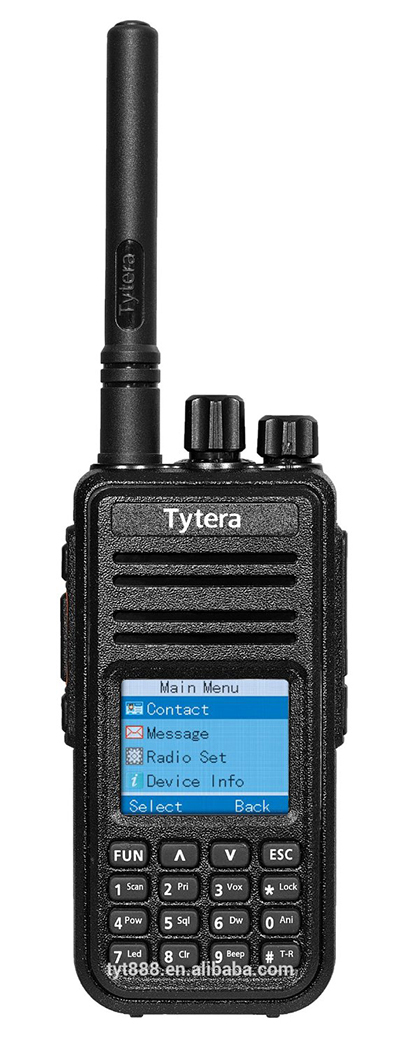
Every once in a great while, a piece of radio gear catches the attention of a prolific hardware guru and is reverse engineered. A few years ago, it was the RTL-SDR, and since then, software defined radios became the next big thing. Last weekend at Shmoocon, [Travis Goodspeed] presented his reverse engineering of the Tytera MD380 digital handheld radio. The hack has since been published in PoC||GTFO 0x10 (56MB PDF, mirrored) with all the gory details that turn a $140 radio into the first hardware scanner for digital mobile radio.

Tytera
The Tytera MD-380 digital radio

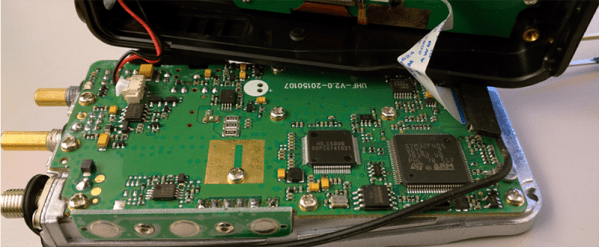
The Tytera MD380 is a fairly basic radio with two main chips: an STM32F405 with a megabyte of Flash and 192k of RAM, and an HR C5000 baseband. The STM32 has both JTAG and a ROM bootloader, but both of these are protected by the Readout Device Protection (RDP). Getting around the RDP is the very definition of a jailbreak, and thanks to a few forgetful or lazy Chinese engineers, it is most certainly possible.

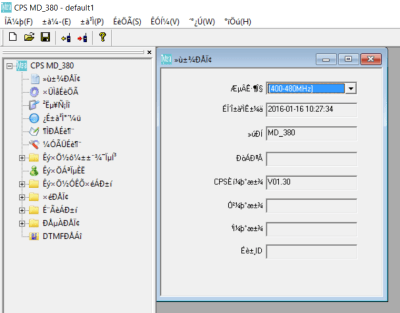
The STM32 in the radio implements a USB Device Firmware Upgrade (DFU), probably because of some example code from ST. Dumping the memory from the standard DFU protocol just repeated the same binary string, but with a little bit of coaxing and investigating the terrible Windows-only official client application, [Travis] was able to find non-standard DFU commands, write a custom DFU client, and read and write the ‘codeplug’, an SPI Flash chip that stores radio settings, frequencies, and talk groups.

Further efforts to dump all the firmware on the radio were a success, and with that began the actual reverse engineering of the radio. It runs an ARM port of MicroC/OS-II, a real-time embedded operating system. This OS is very well documented, with slightly more effort new functions and patches can be written.

In Digital Mobile Radio, audio is sent through either a public talk group or a private contact. The radio is usually set to only one talk group, and so it’s not really possible to listen in on other talk groups without changing settings. A patch for promiscuous mode – a mode that puts all talk groups through the speaker – is just setting one JNE in the firmware to a NOP.

The Tytera MD-830 ships with a terrible Windows app used for programming the radio
The Tytera MD-380 ships with a terrible Windows app used for programming the radio

With the help of [DD4CR] and [W7PCH], the entire radio has been reverse engineered with rewritten firmware that works with the official tools, the first attempts of scratch-built firmware built around FreeRTOS, and the beginnings of a very active development community for a $140 radio. [Travis] is looking for people who can add support for P25, D-Star, System Fusion, a proper scanner, or the ability to send and receive DMR frames over USB. All these things are possible, making this one of the most exciting radio hacks in recent memory.

Before [Travis] presented this hack at the Shmoocon fire talks, intuition guided me to look up this radio on Amazon. It was $140 with Prime, and the top vendor had 18 in stock. Immediately after the talk – 20 minutes later – the same vendor had 14 in stock. [Travis] sold four radios to members of the audience, and there weren’t that many people in attendance. Two hours later, the same vendor had four in stock. If you’re looking for the best hardware hack of the con, this is the one.

Emulating And Cloning Smart Cards

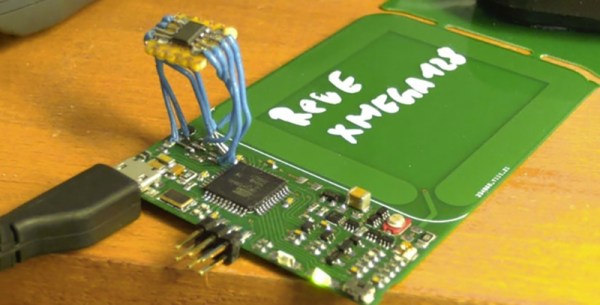
A few years ago, we saw a project from a few researchers in Germany who built a device to clone contactless smart cards. These contactless smart cards can be found in everything from subway cards to passports, and a tool to investigate and emulate these cards has exceptionally interesting implications. [David] and [Tino], the researchers behind the first iteration of this hardware have been working on an improved version for a few years, and they’re finally ready to release it. They’re behind a Kickstarter campaign for the ChameleonMini, a device for NFC security analysis that can also clone and emulate contactless cards.

While the original Chameleon smart card emulator could handle many of the contactless smart cards you could throw at it, there at a lot of different contactless protocols. The new card can emulate just about every contactless card that operates on 13.56 MHz.

The board itself is mostly a PCB antenna, with the electronics based on an ATXMega128A4U microcontroller. This micro has AES and DES encryption engines, meaning if your contactless card has encryption and you have the cryptographic key, you can emulate that card with this device. They’re also making a more expensive version that also has a built-in reader that makes the ChameleonMini a one-stop card cloning tool.

Hackaday Links: January 17, 2016

The BBC has commissioned a new series of Robot Wars. This is not Battlebots; that show was revived last year, and a second season will air again this summer. Robot Wars is the one with the ‘house’ robots. We would like to take this opportunity to remind the BBC that Robot Wars is neither Scrapheap Challenge nor Junkyard Wars, and by virtue of that fact alone is an inferior show.

[Fran] is a favorite around these parts. She’s taken apart a Saturn V Launch Vehicle Digital Computer, visited the Smithsonian Air and Space Museum warehouse, and is the occasional host of the Dinosaur Den with [Bil Herd]. Now, she’s relaunching her line of guitar pedals. ‘Boutique’ pedals are a weird market, but with the help of a few manufacturers, [Fran] is bringing her Peachfuzz pedal back to life through Kickstarter.

Want to be an astronaut? Here’s the application.

Here’s your monthly, ‘WTF is this thing on eBay’ link. It’s a clamshell/toilet seat iBook (c.2000), loaded up with an Intel i5 Broadwell CPU, 128 GB of Flash storage, 4 GB of RAM, a 12″ 1024×768 LCD, Gigabit Ethernet, WiFi, Bluetooth, and runs OS X El Capitan. I might be mistaken, but it looks like someone took the motherboard out of a 2015 MacBook Air, crammed it into a sixteen year old computer, and put it up on eBay. I’m not saying that’s what it is; this is from China, and there are people over there making new improved motherboards for a Thinkpad x61. Weirder stuff has already happened.

In the last installment of the Travelling Hacker Box, I asked if anyone can receive mail in Antarctica. A person with friends in the British survey team emailed me, but nothing came of that. It’s summer, so if Antarctica is going to happen, it needs to happen soon.

Shmoocon 2016: The Best Conference Booth You’ll Ever See

Shmoocon is here, and that means a dozen or so security companies have bought a booth and are out to promote themselves. Some are giving out shot glasses. One is giving out quadcopters. It is exceedingly difficult to stand out in the crowd.

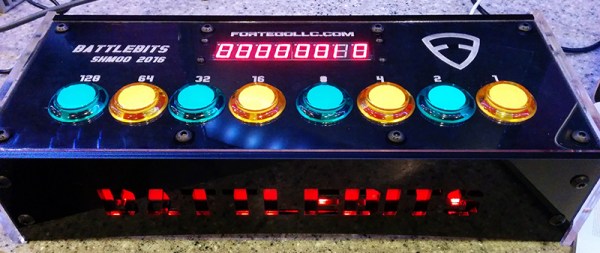
At least one company figured it out. They’ve built a game so perfect for the computer literate crowd, so novel, and so interesting it guarantees a line in front of their booth. Who are they? Fortego, but that’s not important right now. The game they’ve created, BattleBits, is the perfect conference booth.

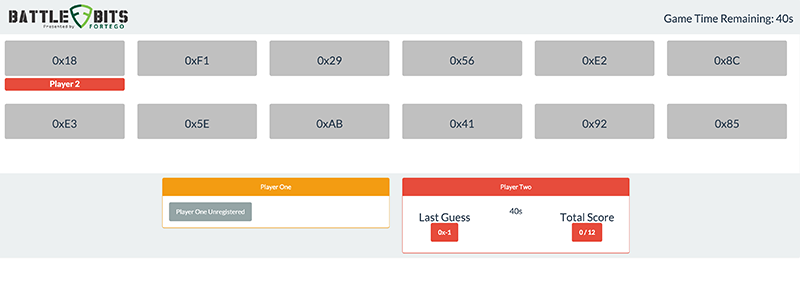
The game play for BattleBits is as simple as counting to two. You’re presented with an eight-bit hexidecimal number, and the goal is to key them into a controller with eight buttons for 1, 2, 4, 8, 16, 32, 64, and 128. The answer for 0x56 is 01010110, and the answer for 0xFF is mashing all the buttons.

BattleBits Screenshot

To anyone not familiar with hex, there’s actually a rather handy trick to the game: you only need to memorize 16 different numbers. Hexadecimal numbers are easily broken up into nibbles, or groups of four bits. All you need to do is solve one hexadecimal digit at a time.

The controllers, or ‘decks’ as they’re, are built around a BeagleBone and a custom cape running a mishmash of Javascript and Python. When the game starts the player or players are presented with random bytes in hexadecimal format. Input the right bits in the shortest amount of time and you’ll work your way up the leader board.

This is by far the best conference booth I’ve ever seen. The creator of the BattleBits hardware, [Riley Porter], says he’ll be releasing the design files and code for this game so anyone can make one, something we really look forward to.

[Riley] also got a video of someone entering nibbles super, super fast.