Using Arduino For Quadcopter Spectrum Analyzers

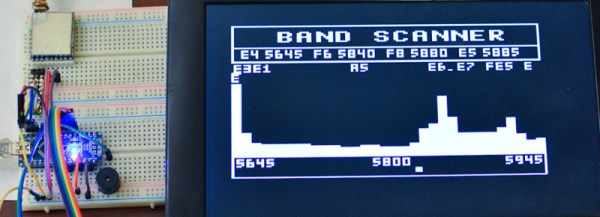
First-person-view (FPV) flying, by adding a camera, video transmitter, and video goggles to the meat on the ground, is one of the best ways to experience remote-controlled flight. For just a few hundred dollars, it’s the closest thing you’re going to get to growing wings and flying through the trees of your local park. One of the most popular and cheapest ways to go about this is the Boscam RX5808 wireless receiver – a $9 module able to pull down video from an aircraft over 5.8GHz radio. Stock, this radio module is just okay, but with a few modifications, it can be turned into a very good receiver with a spectrum analyzer and autoscan.

The Boscam RX5808 has three DIP switches to allow for eight different channels for receiving video, and this is where most RC hobbyists stop. But the module also has a very capable SPI interface, and by adding a simple Arduino, the complete capabilities of this receiver can be unlocked.

The core software for the build is [markohoepken]’s rx5808-pro and rx5808_pro_osd, and [crazyheea]’s rx5808-pro-diversity to enable all the capabilities available in the RX5808 receiver. With an off-the-shelf LCD, this mess of wires and boards turns into an auto-scanning spectrum analyzer that’s also able to put video from a drone onto a screen.

[garagedrone] put together a very complete demo video of the entire build. You can check that out below.

Continue reading “Using Arduino For Quadcopter Spectrum Analyzers”

Hackaday Links: January 24, 2016

The RepRap wiki was spammed this week. Everything is fine now, but I feel I should call attention to the fact that the RepRap wiki needs some people to contribute, organize, and maintain everything. The wikis for obscure anime shows are better than the RepRap wiki, so if you’re looking to contribute to an important open source project, there ‘ya go.

The 200cc, 5.5HP, 4-stroke OHV Honda GX200 engine is found in a whole lot of tools, and is a fantastic power plant to build a go-kart around. It also costs about $350. There are clones of this engine available direct from China for about $100. Here’s how you add a turbo to one of these clone engines.

Freescale makes some pretty cool sensors and [Juan Ignacio Cerrudo] figured they needed breakout boards. He has some boards for a low-power three-axis accelerometer, an accelerometer and magnetometer, and a pressure sensor.

The Tektronix TDS744A is an older but still extremely capable 500MHz, 2Gsps, 4-channel scope. You can upgrade it to the 1GHz TDS784A by desoldering a few resistors. Very cool if you’re looking for a cheap-ish 1GHz scope.

[TheBackyardScientist] hung out with some cub scouts a few weekends ago and launched a high altitude balloon over Florida. The payload included a game camera, APRS tracker, GoPro, and a few other bits and bobs. The balloon reached 106,000 feet and landed only a few miles from Cape Canaveral.

Big RC planes – UAVs especially – are a pain to launch. Flying wings above a certain size are just dangerous to launch by hand, and landing gear is heavy and for the most part unnecessary. What’s the next best solution? A trebuchet, of course. It mounts on a car and is able to give a UAV a little bit of altitude and some speed. A pretty good idea that could be easily implemented with some load-bearing PVC pipe.

Everybody likes the Game of Life, so here’s one built with a 6502. It’s built around a Western Design Center 65c816 board we’ve seen before, nine MAX7219 LED controllers mapped to the VIA, and nine 8×8 LED matrix displays. Here’s a video of it in action.

About a month ago, a search of AliExpress turned up Apple’s A8 CPU. I bought one. Here’s what I got. It’s a stupidly small pitch BGA, and I don’t have a datasheet. What am I going to do with it? Make a non-functioning board with a few ports, resistors, no traces, and the A8 chip planted square in the middle.

Using RealSense Cameras With OS X And Linux

The original Microsoft Kinect was a revolution in computer vision. For less than one hundred dollars, the Kinect gave everyone a webcam with a depth sensor. If you’re doing anything with robots, 3D scanning, or anything else where a computer needs to know where it is in 3D space, it’s awesome. These depth-mapping cameras have improved over the years, with the latest and most capable hardware being Intel’s RealSense 3D camera.

Despite being a very capable depth camera, support for Linux and OS X doesn’t exist. Researchers, roboticists and IoT developers are slightly miffed about this, and it seems like Intel doesn’t care about people using their hardware on platforms that aren’t Windows.

Now, finally, that’s changed. A few developers have taken it upon themselves to build a cross-platform library for the F200, SR300, and R200 Intel RealSense depth cameras.

The librealsense library features proper RealSense camera support for Linux, OS X, and Windows and provides all the functionality of the official Intel SDK. This functionality includes native depth, color, and infrared streams, synthetic streams for rectified images, calibration information, and the most interesting feature: multi-camera capture.

The hardware required to use the RealSense camera is somewhat lightweight – any recent laptop should be able to capture depth images with a RealSense camera. The camera itself requires USB 3, though, so you won’t be building a 3D scanner with a RealSense camera and a Raspberry Pi quite yet. Still, it’s the latest advancement for giving robots 3D vision and building cheap, portable 3D scanners.

Fixing Broken Monitors By Shining A Flashlight

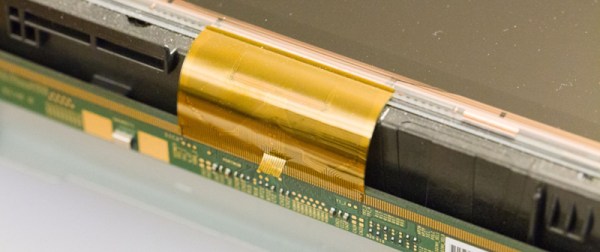
[dyril] over on the EEVblog has a broken LED TV. It’s a fairly standard Samsung TV from 2012 that unfortunately had a little bit of corrosion on the flexible circuit boards thanks to excessive humidity. One day, [dyril] turned on his TV and found about one-third of the screen was glitchy. After [dyril] took the TV apart, an extremely strange fix was found: shining a light on the corroded flexible circuit board fixed the TV.

The fix, obviously, was to solder a USB light to a power rail on the TV and hot glue the light so it shines on the offending circuit. Solving a problem is one thing, though, understanding why you’ve solved the problem is another thing entirely. [dyril] has no idea why this fix works, and it’s doubtful anyone can give him a complete explanation.

The TV is fixed, and although you can’t argue with results, there is a burning question: how on Earth does shining a light on a broken circuit board fix a TV? Speculation on the EEVblog thread seems to have settled on something similar to the photonic reset of the Raspberry Pi 2. In the Raspberry Pi 2, a small chip scale package (CSP) used in the power supply section would fail when exposed to light. This reset the Pi, and turned out to be a very educational introduction to photons and energy levels for thousands of people with a Pi.

The best guess from the EEVblog is that a chip on the offending board handles a differential signal going to the flex circuit. This chip is sensitive to light, and shutting it down with photons allows the other half of the differential signal to take over. It’s a hand-wavy explanation, but then again this is a very, very weird problem.

You can check out [dyril]’s video demonstration of the problem and solution below. Thanks [Rasz] for sending this one in.

Continue reading “Fixing Broken Monitors By Shining A Flashlight”

The Trouble With Intel’s Management Engine

Something is rotten in the state of Intel. Over the last decade or so, Intel has dedicated enormous efforts to the security of their microcontrollers. For Intel, this is the only logical thing to do; you really, really want to know if the firmware running on a device is the firmware you want to run on a device. Anything else, and the device is wide open to balaclava-wearing hackers.

Intel’s first efforts toward cryptographically signed firmware began in the early 2000s with embedded security subsystems using Trusted Platform Modules (TPM). These small crypto chips, along with the BIOS, form the root of trust for modern computers. If the TPM is secure, the rest of the computer can be secure, or so the theory goes.

The TPM model has been shown to be vulnerable to attack, though. Intel’s solution was to add another layer of security: the (Intel) Management Engine (ME). Extremely little is known about the ME, except for some of its capabilities. The ME has complete access to all of a computer’s memory, its network connections, and every peripheral connected to a computer. It runs when the computer is hibernating, and can intercept TCP/IP traffic. Own the ME and you own the computer.

There are no known vulnerabilities in the ME to exploit right now: we’re all locked out of the ME. But that is security through obscurity. Once the ME falls, everything with an Intel chip will fall. It is, by far, the scariest security threat today, and it’s one that’s made even worse by our own ignorance of how the ME works.

Continue reading “The Trouble With Intel’s Management Engine”

Screen Printing Electroluminescent T-Shirts From Tron

Travel around to enough security conferences, faires, and festivals, and you’ll see some crazy wearable electronics. Most of them blink, and most of them use LEDs. Electroluminescent panels are used for wearables, but that’s a niche – the panels are a little expensive, and you have to deal with high frequency AC instead of the much simpler, ‘plug in a LiPo here’ circuit LED-based wearables have to contend with.

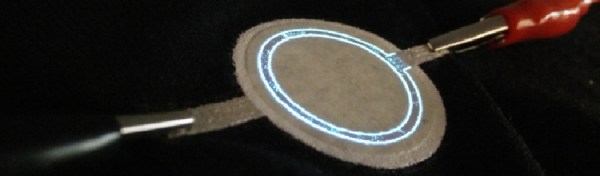
Still, electroluminescent panels are cool, and thanks to how EL panels are made, you can screen print EL displays. That’s what some of the guys at AMBRO Manufacturing did recently: screen printing electroluminescent lights directly onto garments. It’s t-shirts from Tron made real.

EL panels and EL wire are really only three separate parts: a conductor of some sort, a phosphor, and another conductor. Pass a high-frequency AC current through the conductors, and the phosphor lights up. With EL wire, it’s a thick copper wire clad in phosphor and wrapped in a very fine copper wire. EL displays are made with conductive ITO-coated glass or plastic. It’s a relatively simple construction, and one that is perfectly suited for screen printing. In fact, one of the first EL displays – the DSKY, the user interface for the Apollo Guidance Computer – used screen printed seven-segment EL displays.

The folks at AMBRO only have a proof of concept right now, but it is a completely screen printed electroluminescent design on fabric. To light it up, the t-shirt will need an inverter, but this is the beginnings of t-shirts from Tron.

Video below.

Continue reading “Screen Printing Electroluminescent T-Shirts From Tron”

Lady Ada Turns NeXT Equipment Into Something Useful

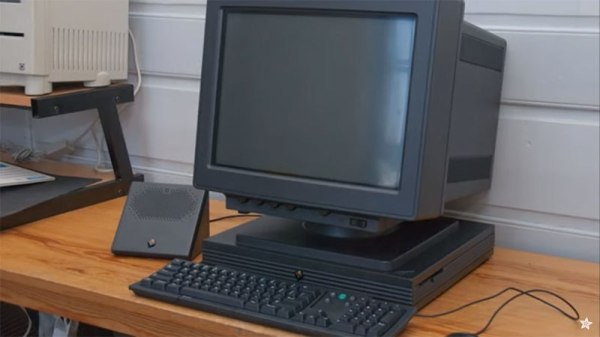
From the late 80s to the early 90s, [Steve Jobs] wasn’t at Apple. He built another company in the meantime, NeXT Computer, a company that introduced jet black workstations to universities and institutions, developed an incredible emphasis on object-oriented programming, and laid the groundwork for the Unix-ey flavor of Apple’s OS X. Coincidently, there is a lot of old NeXT gear at the Adafruit clubhouse – not that there’s anything wrong with that, we all have our own strange affectations and proclivities. Recently, [Lady Ada] turned one of the strangest components of the NeXT computer ecosystem into something useful: a computer speaker.

The item in question for this build is the NeXT ‘sound box’. When not using the very special NeXT monitor, the NeXT computer connects the monitor, keyboard, and speakers through this odd little box. There are two versions of the NeXT sound box, and peripherals from either version are incompatible with each other. ([Jobs] was known for his sense of design and a desire for a simplified user experience, you know.)

In [Lady Ada]’s initial teardown of the sound box, she discovers a few interesting things about this peripheral. There’s an I2S DAC inside there, connected to an unobtanium DB19 connector. Theoretically, that I2S device could be used to drive the speaker with digital audio. The only problem is the DB19 connector – they’re rare, and [Steve] from Big Mess o’ Wires bought the world’s supply.

Without these connectors, and since it’s only an hour-long show, [Lady Ada] went with the most effective hack. She grabbed a USB audio dongle/card, added a small amplifier, and soldered a few wires onto the power and ground pins of an IC. It’s simple, effective, fast, and turns an awesome looking 30-year-old peripheral into a useful device.