Shmoocon 2016: Computing In A Post Quantum World

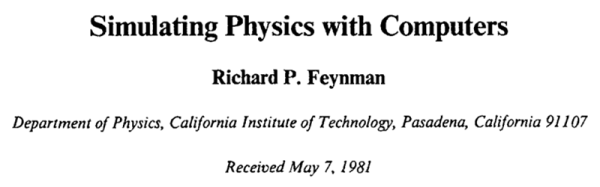
There’s nothing more dangerous, so the cryptoheads say, than quantum computing. Instead of using the state of a transistor to hold the value of a bit as in traditional computers, quantum computers use qubits, or quantum information like the polarization of a photon. According to people who know nothing about quantum computers, they are the beginning of the end, the breaking of all cryptography, and the Rise of the Machines. Lucky for us, [Jean-Philippe Aumasson] actually knows a thing or two about quantum computers and was able to teach us a few things at his Shmoocon talk this weekend, “Crypto and Quantum and Post Quantum”

This talk is the continuation of [Jean-Philippe]’s DEF CON 23 talk that covered the basics of quantum computing (PDF) In short, quantum computers are not fast – they’re just coprocessors for very, very specialized algorithms. Quantum computers do not say P=NP, and can not be used on NP-hard problems, anyway. The only thing quantum computers have going for them is the ability to completely destroy public key cryptography. Any form of cryptography that uses RSA, Diffie-Hellman, Elliptic curves is completely and totally broken. With quantum computers, we’re doomed. That’s okay, according to the DEF CON talk – true quantum computers may never be built.

The astute reader would question the fact that quantum computers may never be built. After all, D-Wave is selling quantum computers to Google, Lockheed, and NASA. These are not true quantum computers. Even if they’re 100 Million times faster than a PC, they’re only faster for one very specific algorithm. These computers cannot simulate a universal quantum computer. They cannot execute Shor’s algorithm, an algorithm that finds the prime factors of an integer. They are not scalable, they are not fault-tolerant, and they are not universal quantum computers.

As far as true quantum computers go, the largest that has every been manufactured only contain a handful of qubits. To crack RSA and the rest of cryptography, millions of qubits are needed. Some algorithms require quantum RAM, which nobody knows how to build. Why then is quantum computing so scary? RSA, ECC, Diffie-Hellman, PGP, SSH and Bitcoin would die overnight if quantum computers existed. That’s a far scarier proposition to someone hijacking your self-driving car or changing the display on a smart, Internet-connected thermostat from Fahrenheit to Celsius.

What is the verdict on quantum computers? Not too great, if you ask [Jean-Philippe]. In his opinion, it will be 100 years until we have a quantum computer. Until then, crypto is safe, and the NSA isn’t going to break your codez if you use a long-enough key.


Microchip’s Proposal To Acquire Atmel

A proposal from Microchip to acquire Atmel has been deemed a ‘superior proposal’ by Atmel’s board of directors (PDF). This is the first step in the acquisition of a merger between Microchip and Atmel, both leading semiconductor companies that have had a tremendous impact in the electronics industry.

Microchip is a leading manufacturer of microcontrollers, most famously the PIC series of micros that can be found in any and every type of electronic device. Atmel, likewise, also has a large portfolio of microcontrollers and memory devices that are found in every type of electronic device. Engineers, hackers, and electronic hobbyists are frequently sided with Microchip’s PIC line or Atmel’s AVR line of microcontrollers. It’s the closest thing we have to a holy war in electronics.

Last September, Dialog acquired announced plans to acquire Atmel for $4.6 Billion. Today’s news of a possible acquisition of Atmel by Microchip follows even larger mergers such as NXP and Freescale, Intel and Altera, Avago and Broadcom, On Semiconductor and Fairchild, and TI and Maxim. The semiconductor industry has cash on hand and costs to cut, these mergers and acquisitions are the natural order of things.

While the deal is not done, the money is on the table, and Atmel’s board is apparently interested.

The Best Projects That Fit In A Square Inch

A few years ago, we started Hackaday.io as a project hosting site for The People Who Actually Make Stuff™, and since then we’ve been amazed by what the community can put together. We have well over 100,000 hackers on board in an awesome community. Sometime around September, a few members of the Hackaday.io community decided to follow in the footsteps of the very successful contests we’ve had on Hackaday.io. This led to the Square Inch Contest, a challenge to put the coolest electronics inside a square inch PCB. An inch the distance light travels in 1/11802852665.12644 of a second for those of you without freedom units.

quad
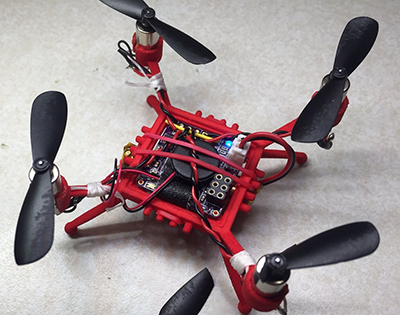
The winner, Quadcopter In One Inch

With almost eighty entries, the judges had a very difficult task ahead of them. In the end, only one project would be the best. The winner of Hackaday.io’s first user-created contest is Quadcopter In One Inch from [jeff]. This wins the grand prize of a $100 credit for the Hackaday Store and a $50 gift certificate to OSHPark.

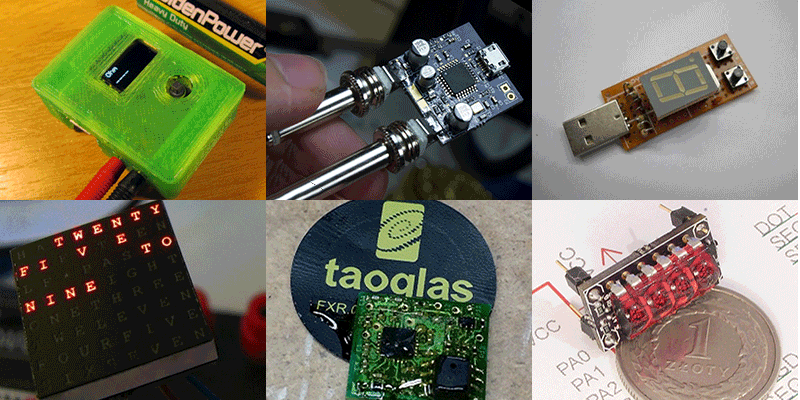
There are six other prizes, each receiving a $50 credit to the Hackaday Store and $25 for OSHPark:

Winners

The judges for the Square Inch Project would like to give an honorable mention to Twiz and the blinktronicator. The judges would also like to express amazement in how much work actually goes into judging a contest on Hackaday.io. Spending a few weeks working on the judging for a contest with eighty entries imbues a sort of respect for people who can judge a contest with one thousand entries in three days, as the Hackaday crew has done with two Hackaday Prizes so far. While they were doing that, I was sitting back and cracking jokes about Fleiss’ Kappa.

This was the first community-created contest on Hackaday.io, but it is surely not the last. We don’t know what the next contest will be – that will be up to someone on Hackaday.io – but there will be one, and like the Square Inch Project, it will be awesome.

Stallman’s One Mistake

We all owe [Richard Stallman] a large debt for his contributions to computing. With a career that began in MIT’s AI lab, [Stallman] was there for the creation of some of the most cutting edge technology of the time. He was there for some of the earliest Lisp machines, the birth of the Internet, and was a necessary contributor for Emacs, GCC, and was foundational in the creation of GPL, the license that made a toy OS from a Finnish CS student the most popular operating system on the planet. It’s not an exaggeration to say that without [Stallman], open source software wouldn’t exist.

Linux, Apache, PHP, Blender, Wikipedia and MySQL simply wouldn’t exist without open and permissive licenses, and we are all richer for [Stallman]’s insight that software should be free. Hardware, on the other hand, isn’t. Perhaps it was just a function of the time [Stallman] fomented his views, but until very recently open hardware has been a kludge of different licenses for different aspects of the design. Even in the most open devices, firmware uses GPLv3, hardware documentation uses the CERN license, and Creative Commons is sprinkled about various assets.

If [Stallman] made one mistake, it was his inability to anticipate everything would happen in hardware eventually. The first battle on this front was the Tivoization of hardware a decade ago, leading to the creation of GPLv3. Still, this license does not cover hardware, leading to an interesting thought experiment: what would it take to build a completely open source computer? Is it even possible?

Continue reading “Stallman’s One Mistake”

Crappy Robots And Even Crappier Electronics Kits

Robots and DIY electronics kits have a long history together. There probably isn’t anyone under the age of forty that hasn’t had some experience with kit-based robots like wall-hugging mouse robots, a weird walking robot on stilts, or something else from the 1987 American Science and Surplus catalog. DIY robot kits are still big business, and walking through the sales booths of any big Maker Faire will show the same ideas reinvented again and again.

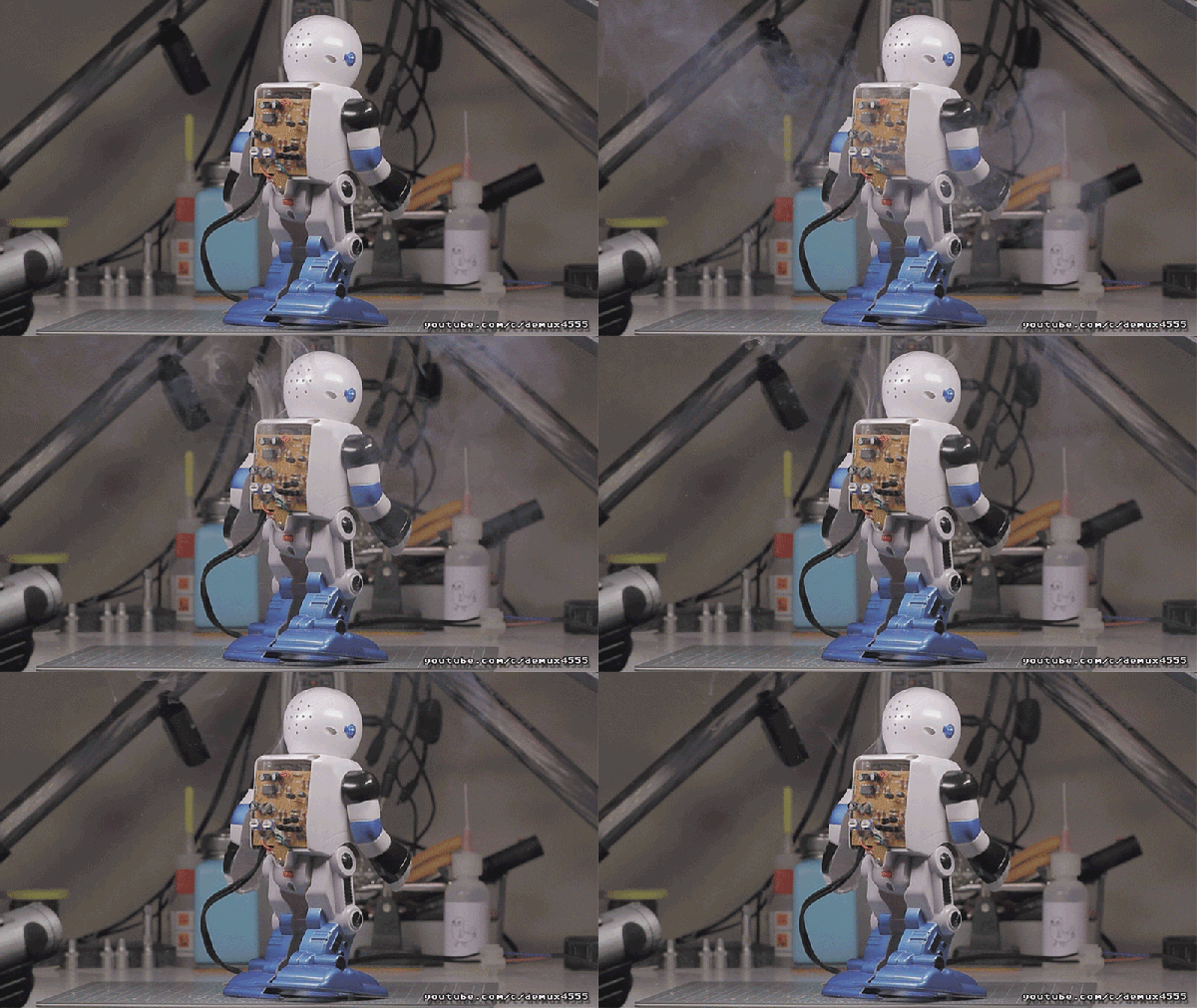
[demux] got his hands on what is possibly the worst DIY electronics kit in existence. It’s so incredibly bad that it ends up being extremely educational; pick up one of these ‘introduction to electronics’ kits, and you’ll end up learning advanced concepts like PCB rework, reverse engineering, and Mandarin.

Continue reading “Crappy Robots And Even Crappier Electronics Kits”

Even Easier Toner Transfer PCBs

One of the most popular methods of homebrew PCB fabrication is the toner transfer process. Compared to UV-sensitive films and CNC mills, the toner transfer process is fantastically simple and only requires a laser printer. Being simple doesn’t mean it’s easy, though, and successful toner transfer depends on melting the toner to transfer it from a piece of paper to a copper clad board.

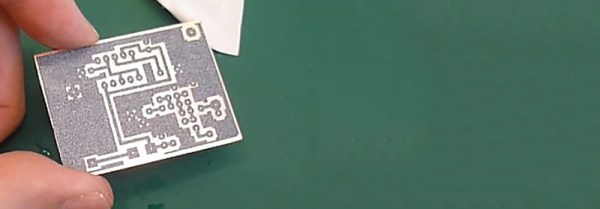
This is heatless toner transfer for PCB fabrication. Instead of using a clothes iron or laminator to transfer toner from a paper to board, [simpletronic] is doing it chemically using acetone and alcohol.

Acetone usually dissolves laser printer toner, and while this is useful for transferring a PCB from paper to board, it alone is insufficient. By using a mixture of eight parts alcohol to three parts acetone, [simpletronic] can make the toner on a piece of paper stick, but not enough to dissolve the toner or make it blur.

From there, it’s a simple matter of putting a piece of paper down on copper clad board. After waiting a few minutes, the paper peels off revealing perfectly transferred board art. All the usual etching techniques can be used to remove copper and fabricate a PCB.

This is an entirely novel method of PCB fabrication, but it’s not exactly original. A few days ago, we saw a very similar method of transferring laser printed graphics to cloth, wood, and metal. While these are probably independent discoveries, it is great evidence there are still new techniques and new ways of doing things left to be discovered.

Thanks [fridgefire] for the tip.

Hacking Chipped 3D Printer Filament On The Da Vinci Printer

XYZ Printing has been selling 3D printers for years now with one very special feature not found in more mainstream printers. They’re using a chipped filament cartridge with a small chip inside each of their proprietary filament cartridges, meaning you can only use their filament. It’s the Gillette and ink jet model – sell the printer cheap, and make their money back on filament cartridges.

Last week at CES, XYZ Printing introduced their cheapest printer yet. It’s called the da Vinci Mini, a printer with a 15x15x15 cm build volume that costs only $269. Needless to say, a lot of these will be sold. A lot of people will also be disappointed with chipped filament cartridges in the coming months, so here’s how you defeat the latest version of chipped filament.

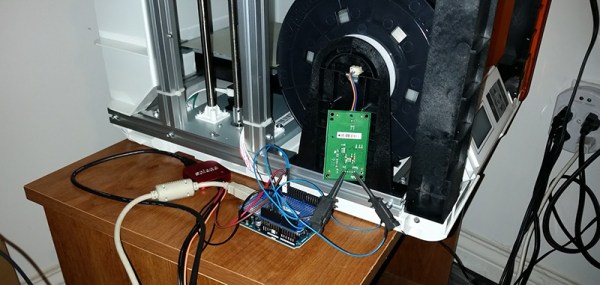
A little bit of research showed [WB6CQA] the latest versions of XYZ Printing’s filament uses an NFC chip. Just like the earlier EEPROM version, the latest spools of filament just store a value in memory without any encryption. [WB6CQA] pulled a board from the printer, connected it up to a logic analyzer, and checked out the data sheet for the NFC chip, giving him access to the data on the filament chip.

After running a few prints and comparing the data before and after, [WB6CQA] found a few values that changed. These values could be written back to their previous values, effectively resetting the chip in the filament and allowing third party filament to be used in this printer. It’s a kludge, but it works. More effort will be needed to remove the need to capture data with logic analyzers, but we’re well on our way to chipless filament on da Vinci printers.