Mergers And Acquisitions: Dialog Buys Atmel

Dialog Semiconductor has announced their acquisition of Atmel for $4.6 Billion.

In recent years, semiconductor companies have been flush with cash, and this inevitably means consolidation. NXP and Freescale merged in March. In June, Intel bought Altera for $16.7 Billion just a week after Avago bought Broadcom in the largest semiconductor deal ever – $37 Billion.

The deal between Dialog and Atmel is not very big; the combined revenue of both companies should be $2.7 Billion, not even in the top-20 semiconductor companies by revenue. However, Atmel is an extremely big player in the Internet of Things and the nebulous ‘maker’ market. Dialog’s portfolio is complementary to Atmel’s, focusing on mobile platforms such as smartphones, e-readers, and tablets. The future is in the Internet of Things, and Dialog wants to get in on the ground floor.

Dialog’s current portfolio is focused mainly on mobile devices, with Bluetooth wearables-on-a-chip, CODEC chips for smartphones, and power management ICs for every type of portable electronics. Atmel’s portfolio is well-established in automotive, smart energy metering, and the maker movement. While the Arduino may be Atmel’s most visible contribution to the industry, the Arduino itself is just a fraction of Atmel’s sales in this space. Atmel parts can already be found Internet of Things products like the LightBlue Bean (an 8-bit AVR), and the Tessel 2 Internet of Things board (a 32-bit Atmel ARM).

Curiously, neither Dialog nor Atmel have many sensor or MEMS products, and the future of wearables, portable electronics, and the Internet of Things will depend on these sensors. STMicroelectronic produces both the microcontrollers and sensors that are packed into phones. TI is nearly a full-stack hardware company, able to produce everything that will go into a wearable or Internet of Things device, all the way from the power regulator to the microcontroller. Although this may be seen as a shortcoming for Dialog and Atmel, both companies combined are still many times smaller than the likes of Avago/Broadcom or NXP/Freescale there’s plenty of room for more acquisitions to round out their future needs.

As for what changes will come to Dialog and Atmel’s portfolio, don’t expect much. Unlike the NXP and Freescale merger where both companies have a lot products that do pretty much the same thing, the portfolios of Dialog and Atmel build on each other’s strengths. You’ll have your 8-bit AVRs for a few more decades, and with Dialog’s focus on connectivity, we can expect even more tools for building the Internet of Things.


Open Source Hardware Certification Announced

Last weekend was the Open Hardware Summit in Philadelphia, and the attendees were nearly entirely people who build Open Source Hardware. The definition of Open Source Hardware has been around for a while, but without a certification process, the Open Hardware movement has lacked the social proof required of such a movement; there is no official process to go through that will certify hardware as open hardware, and there technically isn’t a logo you can slap on a silkscreen layer that says your project is open hardware.

Now, the time has come for an Open Hardware Certification. At OHSummit this weekend, the Open Source Hardware Association (OSHWA) announced the creation of a certification process for Open Source Hardware.

Continue reading “Open Source Hardware Certification Announced”

Hackaday Links: September 20, 2015

Here’s an offer from Intel and the guy behind all of reality TV [Mark Burnett]: win a million dollars for making something. Pitch an idea for wearable electronics to the producers by October 2, and you might be on a reality TV show about building electronics which they’re calling America’s Greatest Makers. With this, Intel is promoting the Curie module a tiny, tiny SoC with Bluetooth, IMU, and DSP functions. We’re of the opinion that a Hackaday reader should win this contest, or at the very least be featured prominently in the show. No, it’s not Junkyard Wars, but it’s still a million dollar prize.

[Jeremy] builds bombs clocks, and he has a Kickstarter for an interesting Nixie clock. Most Nixie tubes have digits, but [Jeremy] is using the IN-9 ‘bar’ tubes for the hour and minute hand.

The Luka EV is a semifinalist for the Hackaday Prize, and a completely open, road legal electric vehicle powered by hub motors. It also looks really, really cool.  Now, they’re selling them. It’s €20,000 for a complete car. Did I mention how cool it looks?

Boca Bearings is having a ‘Show Us Your Workshop’ contest, with the best (or should it be worst?) workshop winning tool cabinets, tool kits, a work mat, and calipers.

The EMU Drumulator is a classic drum machine that featured dirty 12-bit drum sounds in ROM. Now, it’s a single chip thanks to [Jan]. He’s done a lot of great work putting synths in single chips, and it’s great to see him move on to classic drum machines.

Offered without comment, here’s a ride through a PCB.

Hackaday Prize Semifinalist: Sharing Pollution Analytics

A while ago, [Joshua Young] had a conversation with an environmental scientist. There aren’t many government-funded pollution monitoring stations around Texas, but there are a lot of well-off home owners associations in Houston that have the sensors to collect the data. Air quality monitoring is important, and more data is usually better, and without these HOA’s providing the data for free, these environmental scientists wouldn’t have the data to do their job.

[Joshua]’s project is taking the idea a few members of those HOA’s had and expanding it to the entire world. For his entry to the Hackaday Prize, he’s creating a system to share local pollution data with the entire Internet.

The system [Joshua] is building uses a suite of air quality sensors to measure sulfur dioxide, carbon monoxide, nitrogen oxides, ozone and particulate matter. These sensors connect to the Internet through either an ESP8266 WiFi module or a LoRa radio module, push the data onto the cloud, and let the entire world know what the air quality is.

Using tens of thousands of individual base stations to gather data has been done before; Weather Underground uses ten times as many weather stations than the National Weather Service to get better weather tracking resolution. Pollution sensors aren’t normally a part of a weather station, and with [Joshua]’s project, the environmental scientists tracking this data will hopefully get the data they need.

The 2015 Hackaday Prize is sponsored by:

Live From Open Hardware Summit 2015

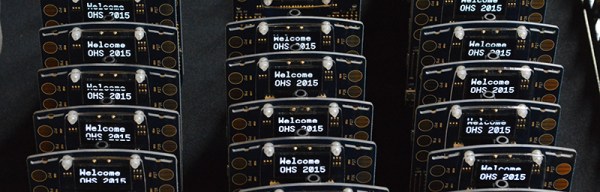
Right now Hackaday and Tindie are in Philadelphia at the Open Hardware Summit 2015. These are the conferences I love; there aren’t many attendees – only a few hundred – but absolute everyone here is awesome. In the crowd is [Mitch Altman], [Johnny] of RAMPS fame, the guys from Parallax (busy programming badges), [Harris Kenny] from Lulzbot, [Joshua Pearce] from Michigan Tech, and pretty much everyone else that’s responsible for all open source hardware.

The talks? They’re great. You’re going to see a lot of reaffirming that tinkering and hacking on electronics and mechanics is a valuable and worthy pursuit, but there’s something for everyone, ranging from open source lab equipment to building true open hardware chips. Here’s a link to the livestream of the conference.

Continue reading “Live From Open Hardware Summit 2015”

Hackaday Prize Semifinalist: Helping Out In The ER

[Moldovanu] and [Radu] are out to fix emergency medical care in their native Romania. They’re developing a very inexpensive bracelet that keeps track of heartbeat, blood oxygen, and temperature of a patient, either in an ER or in the waiting room.

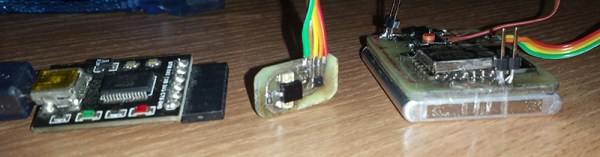
The Health Mate, as the guys are calling it, is a small bracelet loaded up with IR LEDs, photodiodes, a temperature sensor, and a WiFi module. They’ve wired all these parts up on a home made board, connected a battery, and are starting to measure their vitals.

It’s a simple device, but it’s simple for a reason: heart rate and blood oxygen saturation are some of the most important indicators doctors and nurses look at when triaging patients. By making their health monitor cheap and good enough, it eventually makes its way onto the wrists of more patients, and will hopefully save more lives

The 2015 Hackaday Prize is sponsored by:

Hackaday Prize Semifinalist: Walking Robots From Scratch

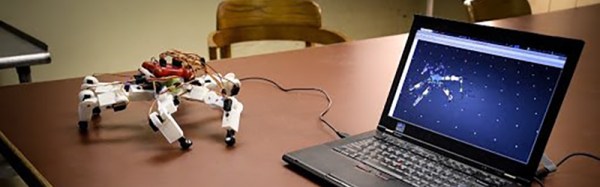
The usual way robotics is taught – and nearly everything, for that matter – is simple. A teacher gets a pre-built module or kit, teaches the students how to use the kit, and class is adjourned. There are significant and obvious drawbacks to this. [Kevin Harrington]’s entry for the Hackaday Prize turns that pedagogy on its head. It’s a robotics development platform that encourages everyone to create their own robots from scratch, starting with the question, ‘how many legs do you want your robot to have’.

Bowler Studio uses OpenCV for image processing, a kinematics engine, a JCSG-based CAD and 3D modeling engine to interface with motors, create 3D models according to kinematic models, feed imaging data to a robot, and create graphical interfaces for robots. It’s an entire robotics creation studio in a single package, and of course everything can be backed up to the cloud.

The electronic backbone is another one of [Kevin] and Neuron Robotics’ projects, DyIO, a USB peripheral that makes for a great robotics platform. The DyIO can control up to 24 servos, enough for a very, very complex robot, and also has the ability to control motors, read encoders, or just blink pins.

These two projects together make for a great way to learn the ins and outs of robots that are a little more complex than a simple wheeled robot, and expandable enough to make some really, really cool projects

The 2015 Hackaday Prize is sponsored by: