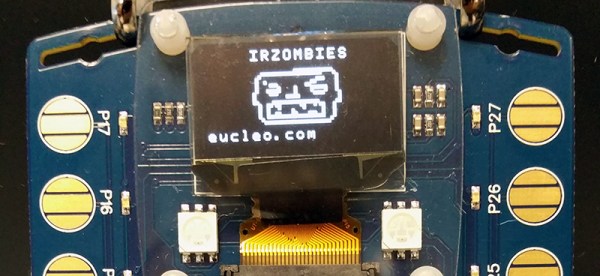
Last week, Parallax released an open hackable electronic badge that will eventually be used at dozens of conferences. It’s a great idea that allows badge hacks developed during one conference to be used at a later conference.
[Mark] was at the Hackable Electronics Badge premier at the 2015 Open Hardware Summit last weekend, and he just finished up the first interactive hack for this badge. It’s the zombie apocalypse in badge form, pitting humans and zombies against each other at your next con.
The zombie survival game works with the IR transmitter and receiver on the badge normally used to exchange contact information. Upon receiving the badge, the user chooses to be either a zombie or survivor. Pressing the resistive buttons attacks, heals, or infects others over IR. The game is your standard zombie apocalypse affair: zombies infect survivors, survivors attack zombies and heal the infected, and the infected turn into zombies.
Yes, a zombie apocalypse is a simple game for a wearable with IR communications, but for the Hackable Electronics Badge, it’s a great development. There will eventually be tens of thousands of these badges floating around at cons, and having this game available on day-one of a conference will make for a lot of fun.
Robots of the future will be in the home, and ready to do whatever job we tell them to do. But they’ll need to know where they are within the house. Dead reckoning with accelerometers and gyroscopes are just a sufficient solution; what we really need is an indoor location service. For his Hackaday Prize entry, [Göran] is doing just that. He’s building a small device that will find its position with 10 cm precision, indoors.
[Göran]’s LPS Mini is built around a very interesting part – the Decawave DWM100. It’s a module that uses an 802.15 radio to trilaterate the distance from several ‘anchors’ to a tag. This, by itself, gives the LPS Mini a navigation system with 10 cm precision. Even higher precision can be accomplished with an IMU gathering accelerometer, gyro, and compass data, and even further with a tiny altimeter. The result is a tiny board that knows exactly where it is.
As far as practical uses go, these LPS Mini boards were used to move beds around an art exhibit at Hayward Gallery in London. While moving beds around an art gallery doesn’t sound like a game-changing invention, think about the uses for GPS in the 1980s – no one could have imagined a chip that would tell you where you are or that could keep a quadcopter on the right heading.
You can check out [Göran]’s video for the LPS Mini below.
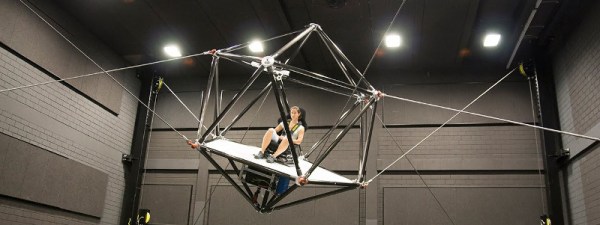
Straight from the Max Planck Institute for Biological Cybernetics, and displayed at this year’s Driving Simulation Conference & Exhibition is the coolest looking simulation platform we’ve ever seen. It’s a spherical (or icosahedral) roll cage, attached to the corners of a building by cables. With the right kinematics and some very heavy-duty hardware, this simulation platform has three degrees of translation, three degrees of rotation, and thousands of people that want to drive a virtual car or pilot a virtual plane with this gigantic robot.
The Cable Robot Simulator uses electric winches attached to the corners of a giant room to propel a platform with 1.5g of acceleration. The platform can move back and forth, up and down, and to and fro, simulating what a race car driver would feel going around the track, or what a fighter pilot would feel barreling through the canyons of the Mojave. All you need for a true virtual reality system is an Oculus Rift, which the team has already tested with driving and flight simulation programs
An earlier project by the same research group accomplished a similar feat in 2013, but this full-motion robotic simulator was not made of cable-based robotics. The CyberMotion Simulator used a robotic arm with a cockpit of sorts attached to the end of the arm. Inside the cockpit, stereo projectors displayed a wide-angle view, much like what a VR display does. In terms of capability and ability to simulate different environments, the CyberMotion Simulator may be a little more advanced; the Cable Robot Simulator cannot rotate more than about sixty degrees, while the CyberMotion Simulator can turn you upside down.
The Cable Robot Simulator takes up a very large room, and requires some serious engineering – the cables are huge and the winches are very powerful. These facts don’t preclude this technology being used in the future, though, and hopefully this sort of tech will make its way into a few larger arcades.
What do you get when you take a flight case from Harbor Freight, fill it up with random electronics junk, and send it off to a stranger on the Internet? The travelling hacker box. It’s a project I’m putting together on hackaday.io to emulate a swap meet through the mail.
The idea is simple – take a box of random electronics junk, and send it off to a random person on hackaday.io. This person will take a few items out of the box, replace those items with something sitting on their workbench, and send it off to the next person. This is repeated until the box is stolen.
Has something like this been done before? Yes, yes it has. The Great Internet Migratory Box of Electronics Junk was a thing back in the ‘aughts, with Hackaday (via Eliot) receiving a box (code name: Rangoon) from [John Park], before sending it off to [Bre Pettis]. The box subsequently disappeared. There were many migratory boxes of electronics junk, but most didn’t travel very far. Already the Travelling Hacker Box has 2,525 miles on its odometer, and plans are in the works for travelling 25,000 miles – the circumference of the Earth – before heading out of the United States.
If you’re wondering what’s in the box, here’s a mostly complete inventory. With the exception of a few items from the swag bag from the Open Hardware Summit last weekend, it’s mostly random electronics stuff I’ve had sitting around on my workbench and desk. The first recipient grabbed a few dev boards and replaced them with a Teensy LC and enough tubes to make a small amplifier.
The current plan for the Travelling Hacker Box is to bounce across the United States for the circumference of the Earth until departing for more exotic lands. There are people queued up to receive the box from across the world, and the box will eventually be hitting Europe, India, Africa, Asia, and Australia. Everyone is welcome to participate as it is passed from hacker to hacker as a migratory box of electronic toys.
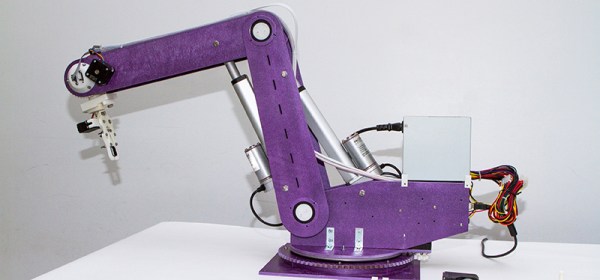
Industrial robot arms are curious devices, found everywhere from the back of old engineering classrooms where they taught kinematics in the 90s, to the factory floor where they do the same thing over and over again while contemplating their existence. For his Hackaday Prize entry, [Dan] is building a big robot arm. It’s not big enough to ride on, but it is large enough to automate a few processes in a reasonably well-equipped lab.
This is not a tiny robotic arm powered by 9 gram hobby servos. For the bicep and tricep of [Dan]’s arm, he’s using linear actuators – they’re high precision and powerful. A few months ago, [Dan] tried to design a hypocycloid gear but couldn’t get a $3000 prototype to work. Although the hypocycloid is out, he did manage to build a strange differential pan/roll mechanism for the wrist of the arm. It really is a thing of beauty, and with the engineering [Dan] has put into it, it’s a very useful tool.
If you’d like to meet [Dan]’s robot arm in person, he’ll be at the 2015 NYC Maker Faire this weekend. Check out [Dan]’s Hackaday Prize video for his robot arm below.
Every so often – and usually not under the best of circumstance – the field of engineering as a whole is presented with a teaching moment. Volkswagen is currently embroiled in a huge scandal involving emissions testing of 11 Million diesel cars sold in recent years. It’s a problem that could cost VW dearly, to the tune of eighteen Billion dollars in the US alone, and will, without a doubt, end the careers of more than a few Volkswagen employees. In terms of automotive scandals, this is bigger than Unsafe at Any Speed. This is a bigger scandal than the Ford Pinto’s proclivity to explode. This is engineering history in the making, and an enormously teachable moment for ethics in engineering.
GPS-based location services will be around with us forever. If you’re in the outback, in the middle of the ocean, or even just in a neighborhood that doesn’t have good cell coverage, there’s no better way to figure out where you are than GPS. Using satellites orbiting thousands of miles above the Earth as a location service is an idea that breaks down at some very inopportune times. If you’re in a parking garage, you’re not using GPS to find your car. If you’re in a shopping mall, the best way to find your way to a store is still a map. Anyone every tried to use GPS and Google Maps in the hotel/casino labyrinth that is the Las Vegas strip?
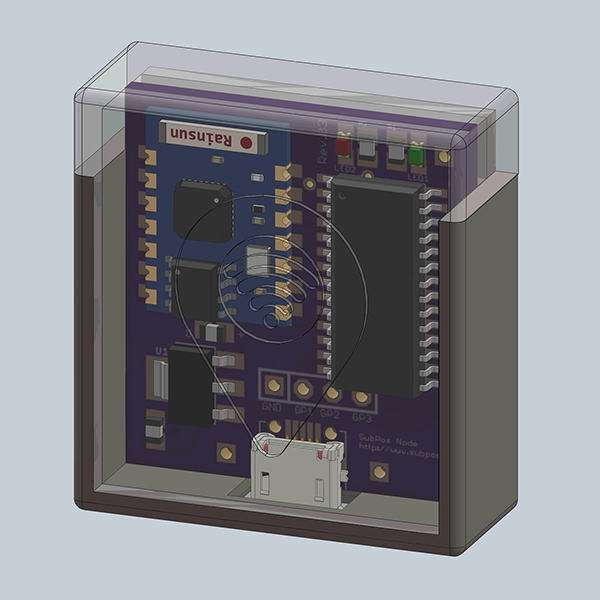
[Blecky]’s entry for the Best Product competition of the Hackaday Prize aims to solve this problem. It’s an indoor location service using only cheap WiFi modules called SubPos. With just a few ESP8266 modules, [Blecky] can set up a WiFi positioning system, accurate to half a meter, that can be used wherever GPS isn’t.
The idea for a GPS-less positioning system came to [Blecky] after a caving expedition and finding navigation though subterranean structures was difficult without the aid of cell coverage and GPS. This got [Blecky] thinking what would be required to build a positioning service in a subterranian environment.
A SubPos node, equipped with an ESP8266 WiFi module
The answer to this question came in the form of a cheap WiFi module. Each of the SubPos nodes are encoded with the GPS coordinates of where they’re placed. By transmitting this location through the WiFi Beacon Frame, along with the transmitted power, any cell phone can use three or more nodes to determine its true location, down to a few centimeters. All of this is done without connecting to a specific WiFi network; it’s a complete hack of the WiFi standard to allow positioning data.
The most shallow comparison to an existing geolocation system would be a WiFi positioning system (WPS), but there are several key differences. In WPS, the WiFi APs don’t transmit their own location; the AP is simply cross-referenced with GPS coordinates in a database. Secondly, APs do not transmit their own transmit power – important if you’re using RSSI to determine how far you are from an Access Point.
The best comparison to an indoor location service comes from a new Decawave module that sets up ‘base stations’ and figures out a sensor’s location based on time of flight. This, however, requires additional radios for each device receiving location data. SubPos only requires WiFi, and you don’t even need to connect to an AP to get this location data; everything is broadcast as a beacon frame, and every device with WiFi detects a SubPos node automatically.
As an entry to the Hackaday Prize Best Product competition, there is an inevitable consideration as to how this product will be marketed. The applications for businesses are obvious; shopping malls could easily build a smartphone app showing a user exactly where in the mall they are, and provide directions to The Gap or one of the dozens of GameStops in the building. Because the SubPos nodes also work in 3D space, parking garage owners could set up a dozen or so SubPos nodes to direct you to your exact parking spot. Disney, I’m sure, would pay through the nose to get this technology in their parks.
Already [Blecky] is in talks with one company that would like to license his technology, but he’s not focused only on the high-dollar business accounts. He already has a product that needs manufacturing, and if he wins the Best Product competition, he will be working on something for the hacker/homebrew market. The price point [Blecky] sees is around $15 a node. The economics of this work with the ESP WiFi module, but [Blecky] is also looking at alternative chip sets that would allow for more than just RSSI position finding; an improved version of the SubPos node not based on the ESP-8266 could bring time of flight into the mix, providing better position accuracy while still being cheaper to manufacture than the current ESP-based solution.
[Blecky] has a great project on his hands here, and something we will, undoubtedly, see more of in the future. The idea of using WiFi beacon frames to transmit location data, and received signal strength to suss out a position is groundbreaking and applicable to everything from spelunking to finding your car in a parking garage. Since the SubPos system isn’t tied to any specific hardware, this could even be implemented in commercial routers, giving any device with WiFi true location data, inside or out. It’s also one of the top ten finalists for the Hackaday Prize Best Product competition, and like the others, it’s the cream of the crop.