Hardware Virtualization In Microcontrollers

Look at any sufficiently advanced CNC machine or robot, and you’ll notice something peculiar. On one hand, you have a computer running a true operating system for higher-level processing, be it vision or speech recognition, or just connecting to the Internet. On the other hand, you have another computer responsible only for semi-real-time tasks, like moving motors, servos, and reading sensors and switches. You won’t be doing the heavy-lifting tasks with a microcontroller, and the Raspberry Pi is proof enough that real-time functions aren’t meant for a chip running Linux. There are many builds that would be best served with two processors, but that may be changing soon.

Microchip recently announced an addition to the PIC32 family of microcontrollers that will support hardware virtualization. This addition comes thanks to the MIPS M5150 Warrior-M processor, the first microcontroller to support hardware visualization.

Continue reading “Hardware Virtualization In Microcontrollers”

Hackaday Prize Semifinalist: Artificial Muscles And Supercapacitors

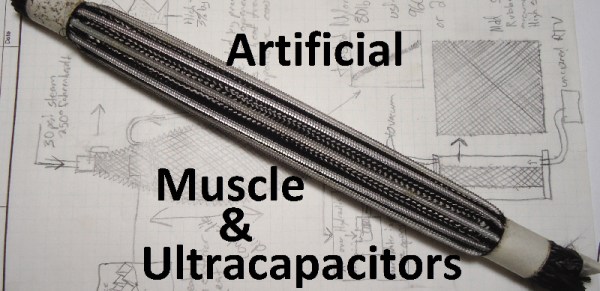
For [Lloyd T Cannon III]’s entry to the Hackaday Prize, he’s doing nothing less than changing the way everything moves. For the last 100 years, internal combustion engines have powered planes, trains, and automobiles, and only recently have people started looking at batteries and electric motors. With his supercapacitors and artificial muscles, [Lloyd] is a few decades ahead of everyone else.

There are two parts to [Lloyd]’s project, the first being the energy storage device. He’s building a Lithium Sulfur Silicon hybrid battery. Li-S-Si batteries have the promise to deliver up to 2000 Watt hours per kilogram of battery. For comparison, even advanced Lithium batteries top out around 2-300 Wh/kg. That’s nearly an order of magnitude difference, and while it’s a far way off from fossil fuels, it would vastly increase the range of electric vehicles and make many more technologies possible.

The other part of [Lloyd]’s project is artificial muscles. Engines aren’t terribly efficient, and electric motors are only good if you want to spin things. For robotics, muscles are needed, and [Lloyd] is building them out of fishing line. These muscles contract because of the resistive heating of a carbon fiber filament embedded in the muscle. It’s been done before, but this is the first project we’ve seen that replicates the technique in a garage lab.

Both parts of [Lloyd]’s project are worthy of a Hackaday Prize entry alone, but putting them together as one project more than meets the goal: to build something that matters.

The 2015 Hackaday Prize is sponsored by:

A DIY Mobile Soldering Iron

Cordless soldering irons are, as a rule, terrible. A few months ago, you could pick up a cordless soldering iron from Radio Shack that was powered by AAA batteries. You can guess how well those worked. There are butane-fueled soldering irons out there that will heat up, but then you’re left without the requisite degree of temperature control.

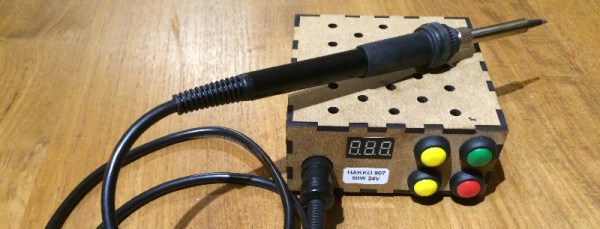
[Xavier] didn’t want to compromise on a mobile soldering iron, so he made a desktop version portable. His mobile temperature controlled soldering iron uses the same electronics that are found in inexpensive Hakko clones, and is powered by a LiPo battery.

The soldering station controller comes directly from eBay, and a DC/DC boost converter accepts just about any DC power supply – including an XT60 connector for LiPo cells. A standard Hakko 907 iron plugs into the front, and a laser cut MDF enclosure makes everything look great. There were a few modifications to the soldering station controller that involved moving the buttons and temperature display, but this build really is as simple as wiring a few modules together.

With an off-the-shelf LiPo battery, the iron heats up fast, and it doesn’t have a long extension cord to trip over. With the right adapter, [Xavier] can use this soldering station directly from a car’s cigarette power port, a great feature that will be welcomed by anyone who has ever worked on the wiring in a car.

Continue reading “A DIY Mobile Soldering Iron”

Hackaday Prize Semifinalist: A Full-Stack IoT Platform

There are millions of devices and sensors connected to the Internet, and the next decade will bring billions more. How will anyone keep track of all these sensors? With analog.io, a platform for IoT devices, and [Luke]’s entry for The Hackaday Prize.

The problem of aggregating data from an Internet of things has been tackled before. Last year, Sparkfun released data.sparkfun.com, built on Phant, a tool for collecting data from the Internet of Things. Even though Phant can collect the data, it only does this in neat columns with values and time stamps. To turn this into something a little more visual, analog.io was born. In the future, [Luke] will add support for thingspeak and Xively data streams; the entire project is intended to be backend agnostic, allowing anyone to get their data from any thing, store it on any server, and connect it to analog.io for visualization and sharing.

Graphing data provides for some interesting opportunities, like when [Luke] found his Internet-connected water meter was logging far, far too much water consumption. A fitting on a garden hose came loose, and the hose started pouring water onto the ground, a foot away from his basement wall. That’s a swimming pool’s worth of water on [Luke]’s foundation, easily and readily graphed. He’s now adding an alert feature to analog.io.

Graphing data does present its own problems, like when a sensor sends a single erroneous data point. [Luke] is calling this a ‘burr’, and analog.io can filter out these small spikes that make data unreadable as a graph. There’s a lot of work that goes into making a usable graph, and [Luke] is crossing all his ‘t’s and dotting all his lowercase ‘j’s.

While many of the entries for the Hackaday Prize are running at the ground level with individual sensors connected to the Internet, [Luke]’s project tackles the Internet of Things problem from the other end, providing everyone a way to easily visualize their data. It’s a great Hackaday Prize entry, and will surely come in useful for a number of other prize entries as well.


The 2015 Hackaday Prize is sponsored by:

Reverse Engineering An Obsolete Security System

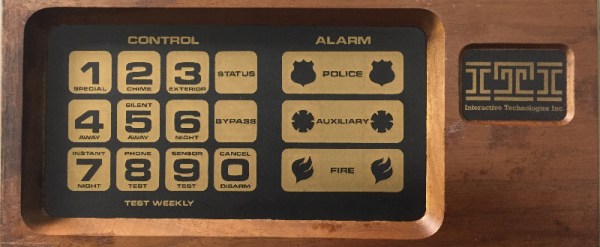
[Veghead] recently went to a surplus warehouse filled with VHS editing studios, IBM keyboards, electronic paraphernalia from 40 years ago, and a lot of useless crap. His haul included a wooden keypad from an old alarm system that exuded 1980s futurism, and he figured it would be cool to hook this up to an alarm system from 2015. How did he do that? With software defined radio.

After pulling apart the alarm panel, [Veghead] found only a single-sided board with a 9V battery connector. There were no screw terminals for an alarm loop, meaning this entire system was wireless – an impressive achievement for the mid-80s hardware. A quick search of the FCC website showed this alarm panel was registered to two bands, 319MHz and 340MHz, well within the range of an RTL-SDR USB TV tuner dongle.

After capturing some of the raw data and playing it back in Audacity, [Veghead] found a simple OOK protocol that sends two identical binary patterns for each key. A simple program takes the raw bit patterns for each key press and codes them into a map for each of the twelve buttons.

Although the radio still works, [Veghead] found the waveforms captured by his RTL-SDR were an abomination to RF. All the components in this security system are more than 30 years old at this point, and surely some of the components must be out of spec by now. Still, [Veghead] was able to get the thing working again, a testament to the usefulness of a $20 USB TV tuner.

Thanks [Jose] for sending this one in

Mythical Game Boy Advance Colors Hacked Into Reality

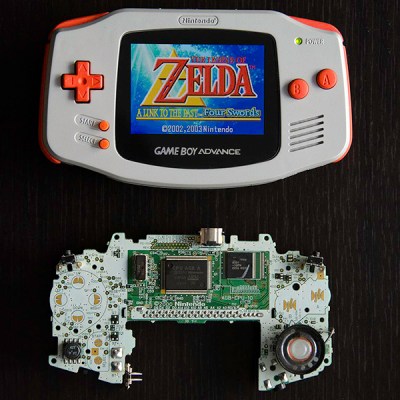
When it was announced in 2000 at a Nintendo trade show, the Game Boy Advance was clad in beautiful silver plastic, accented with brilliant orange buttons. As is usually the case with product introductions, the first color and style displayed to be public became the most popular. There was one problem with this silver and orange GBA; Nintendo never put it into production. Fast forward fifteen years, and [Michael Choi] decided it was time to make his own silver and orange Game Boy. It’s a great introduction to mold making and very detailed painting, and a useful guide for turning engineering prototypes into beautiful objects.

[Michael]’s build began with an aftermarket shell, painted with Tamiya spray paints. The color is remarkably accurate, considering the only pictures for the silver and orange Game Boy are fifteen years old, and with the right painting technique, these colors are indistinguishable from a properly colored, injection molded piece of plastic.

GBAsquareThe buttons were not as easy as the shell. [Michael] originally decided casting would be the best solution, but after multiple attempts, he couldn’t get the color right. Even with opaque dyes in the resin, the buttons would still come out slightly translucent. In the end, [Michael] decided to paint the original buttons.



This casemod isn’t just about changing the color of the enclosure. [Michael] also wanted is Game Boy to have the backlight found in the second revision clamshell GBA. This was easily acquired on eBay, and with a few slight hardware modifications and a beautiful glass lens to replace the plastic occupying the bezel, [Michael] has a gorgeous Game Boy Advance, taken straight from a press event fifteen years ago.

Hackaday Prize Semifinalist: Balancing Humanoid Robots

A few years after we all tire of our remote control BB-8 droids we’ll all have personal human robots designed specifically for human interaction. We’re not there yet, but [Poh Hou Shun] out of Singapore is working on a robot like this for the Hackaday Prize. It’s called OSCAR, the Omni Service Cooperative Assistance Robot.

As with any robotics platform, the use case defines the drive system; you’ll want knobby tires or treads if you’re building a sumo bot, and a strange articulating suspension if you’re driving over alien terrain. OSCAR is built for humans, and this means a humanoid chassis is required. Legs, however, aren’t. Instead of a complex system of motors and joints, OSCAR is balancing on a ball. No, it won’t go up stairs, but neither will many other robots either.

So far, [Poh Hou Shun] has built the basics of a drive system, and it’s surprisingly similar to the BB-8 droids we’re still not tired of yet. On the bottom is a large ball held in place with a spring-loaded retainer. On top of this are three stepper motors, each holding an omni wheel. It will work, there’s no doubt about that, and with the right humanoid chassis, some sensors, and a lot of software, this could be a very cool social robot.

The 2015 Hackaday Prize is sponsored by: