Electronica 2014 Wrap-Up

Make no mistake about it, Electronica is a real trade show, with suits everywhere, meeting rooms packed to the gills, and €4 bottles of soda. If you dig around long enough, you will find some interesting things, as I did on my excursions to the Messe with [Chris Gammell] and [Sprite_TM].

Actual cool booths

This isn’t a show and tell. The purpose of the booths are for sales people to meet with other sales people, and people who have the letter ‘C’ somewhere in their title to be concerned about things you’ll never understand. Booth displays are a plastic case with a few components in them. If you’re lucky, you’ll have some units running on a table somewhere.

This isn’t the case for all booths, though. The Linear booth wanted to demo some custom sensors, so they built the most primitive thermocouple in existence. It’s a piece of copper pipe and some barbed wire, brazed together. It won’t be an accurate thermocouple when the torch is still hot, but by calibrating it against a known temperatures and values, they can get pretty reliable temperature readings. Oh, the displays are Nixies.

Raspberries

raspberrypi_logo No, Raspberry Pi didn’t have a booth, but RS Components did, and this is where you could find Raspberries and Raspberry-related projects. I hun around the booth after [Eben] gave a talk, and this is what the future of the Raspberry Pi ecosystem will look like:

  • There will be no more form factor changes. Until the next hardware update, we’ll have the B+ and A+ form factor.
  • When is the next hardware update? Some time in 2017 or 2018. They don’t have a chip selected yet.
  • Four million units shipped. I told [Eben] the Commodore 64 shipped 25 Million, [Eben] told me [Jack Tramiel] was running his mouth when he said that. German tank problem with serial numbers and all that.
  • Lots of industrial applications. There are real, legitimate uses of a Pi in controlling million dollar machines.
  • No one has built a cluster of Pi compute modules. I believe the problem is finding vertical SO-DIMM connectors.

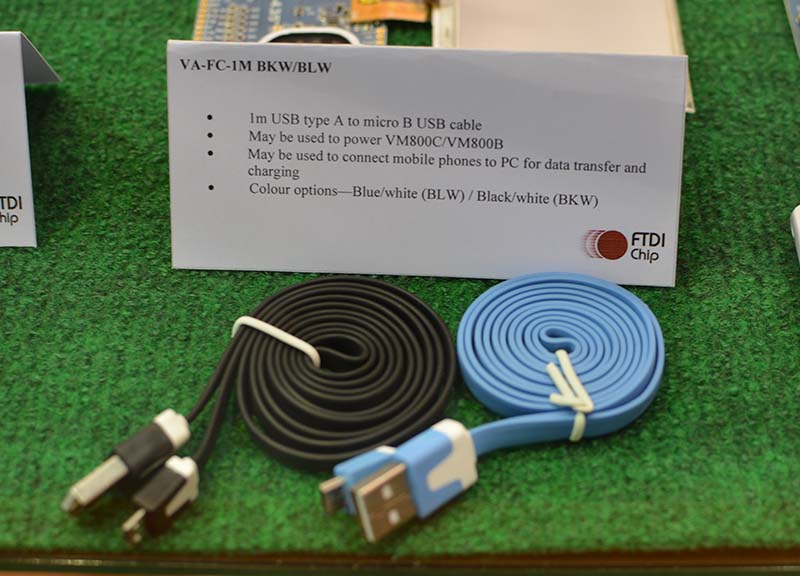
The latest from the FTDI display case
DSC_0031

Free Stuff

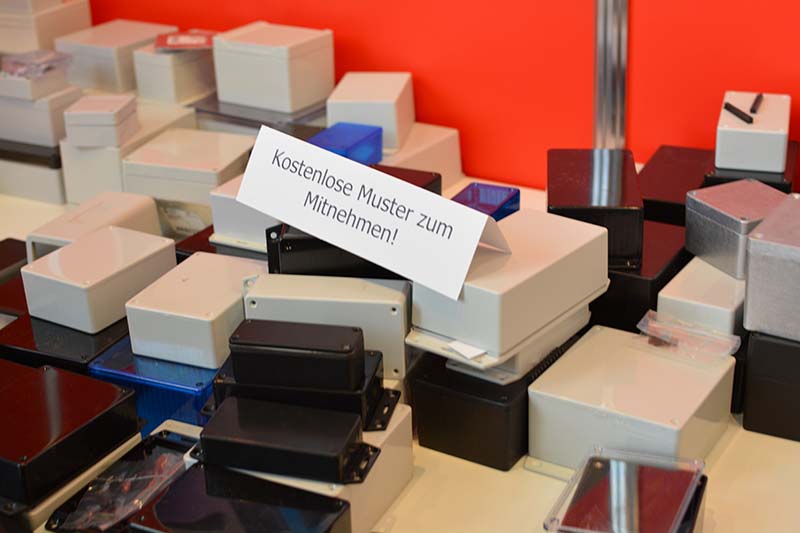
Show up at the end of Electronica, and you’ll quickly figure out the people at booths don’t want to ship their stuff home. This was the Hammond Enclosures booth:
DSC_0033

What did I grab? Just some Raspi cases, and one of the wooden Hammond enclosures used for tube amps. Also picked up a sample of unreleased Kailh switches for mechanical keyboards. Data coming sometime.

If someone is at the Munich airport in a few days, I might have a wooden Hammond enclosure for you.

Powering Your F-16 With An Arduino

What do you do when you have an F-16 sitting around, and want to have some blinking navigation lights? We know of exactly one way to blink a light, and apparently so does [Dr. Craig Hollabaugh]. When asked to help restore an F-16 for the National Museum of Nuclear Science and History in New Mexico, [Craig] pulled out the only tool that should ever be used to blink navigation lights on an air superiority fighter.

[Craig]’s friend was working on getting an F-16 restored for the Nuclear Museum, and like anyone with sufficient curiosity, asked how hard it would be to get the navigation lights working again. [Craig] figured an Arduino would do the trick, and with the addition of a shield loaded up with a few mosfets, the nav lights on an old F-16 would come to life once again.

The board doesn’t just blink lights on and off. Since [Craig] is using LEDs, the isn’t the nice dimming glow you’d see turning a normal incandescent light off and on repeatedly. To emulate that, [Craig] is copying Newton’s law of cooling with a PWM pin. The results are fantastic – at the unveiling with both New Mexico senators and a Brigadier General, everything went off without a hitch. You can see the unveiling video below, along with a few videos from [Craig]’s build log.

Continue reading “Powering Your F-16 With An Arduino”

Phoenard, A Prototyping Gadget

The Hackaday Prize party wasn’t just about the five finalists; actually, there were more THP entries in attendance – All Yarns Are Beautiful, OpenExposer, M.A.R.S., a 3D scanner, and a few more that I’m forgetting – than actual finalists. In addition, a number of people brought projects that had never seen the light of day, like [Ralf] and [Pamungkas]’ Phoenard.

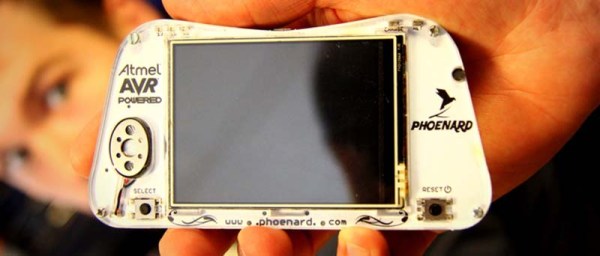
Phoenard is a Kickstarter project the guys launched at the prize party, something they could attend as a little side trip after manning the ‘maker’ part of the Atmel booth at Electronica. They’ve come up with a tiny handheld device that can only be described as a ‘gadget’. It has a touchscreen, a battery, an MegaAVR, a few connectors, and not much else. What makes this project cool is how they’re running their applications. A bootloader sits on the AVR, but all the applications – everything from a GSM phone to an MP3 player – lives on a microSD card.

The Phoenard guys have come up with a few expansion modules for Bluetooth LE, GSM, GPS, and all the usual cool modules. Plugging one of these modules into the back of the device adds capability, and if that isn’t enough, there’s an old 30-pin iPhone connector on the bottom ready to accept a prototyping board.

Video of these guys below.

Continue reading “Phoenard, A Prototyping Gadget”

Video Spiel Kultur

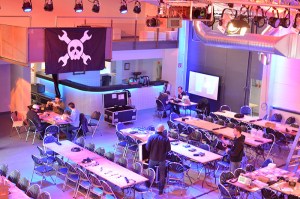
Somehow, and don’t ask us how, the venue we chose for the Hackaday Prize party was perfect for Hackaday-related shenanigans. There was a Hackerspace right around the corner, a computer history museum in a warehouse nearby, and an amazing video game archive barely 100 meters away from our venue.

The VideoGamingArchive is an amazing collection of video games from the era where video games came in boxes with real manuals, and you needed to be sure you bought the game compatible with your system. Inside, one wall is dedicated to the old cardboard computer boxes, indexed partly by system and partly by how cool they look, while the other wall was dedicated to games from the previous five generations of consoles.

[Nils] was kind enough to give me a tour. You can check that video out below, with some more pics below that. If you’re wondering, yes, that is a sealed copy of Chrono Trigger, and no, I have no idea what it’s worth.

Continue reading “Video Spiel Kultur”

The Hackaday Prize Judge’s Recap

With the Intertubes atwitter about the finalist – and winner – of the Hackaday Prize, it’s only fitting the rest of you get to hear what the judges thought about the finalists.

We had some amazing judges combing over these projects, ranging from people who have told Congress they could shut down the Internet at will to a Dutch guy that just figured out how to order a plain hamburger in the Munich train station. Really, really smart people. Here’s what they had to say about each project:

Continue reading “The Hackaday Prize Judge’s Recap”

Hacking Werkstatts And Other Workshops

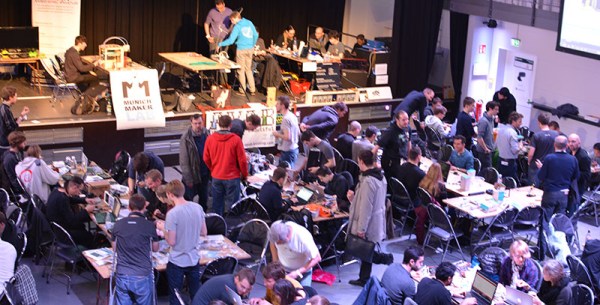
We had a few very cool workshops at our party in Munich today, with Moog synths, robotic arms, Linksys routers splayed open on a table, and Club Mate flowing like water. We’re wrapping the workshops up right now and the kegs are being tapped. Before that, though, it might be a good idea to show off all the other Hackaday Prize projects that showed up today.

The M.A.R.S. Rover, a 3D-printed rocker-bogie robot showed up around noon. I didn’t see it driving around, but there will probably be video up later.

Also shown was the AutoCut robotic lawn mower. No blood was shed today.

[Mario] was cool enough to fly in and show off the OpenExposer, a laser resin printer that is heavily inspired by the RepRap project.

Pictures below.

T Minus Several Hours Until The Hackaday Prize

We’re only a few hours away until we announce the winner of The Hackaday Prize. Until then, we have a huge workshop and party to put together. It’s only noon here in Munich, and we’ve been up since the crack of dawn putting stuff together.

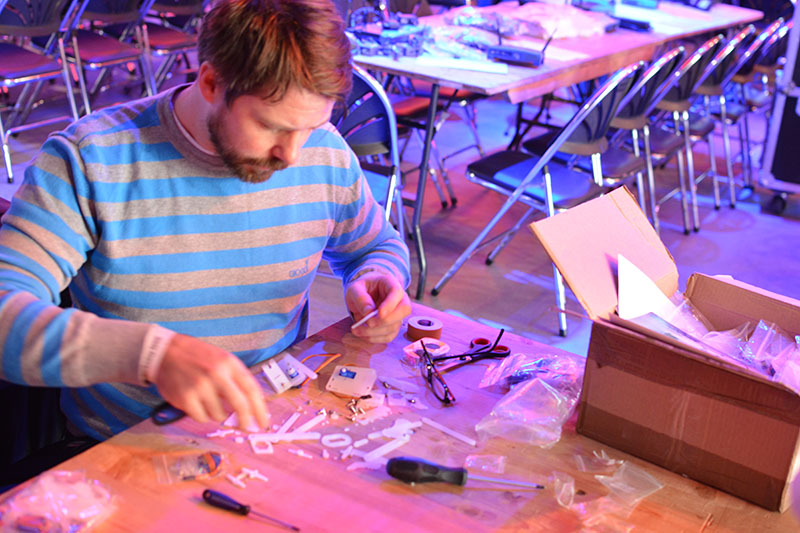
The doors open in a little bit, but so far we have people putting together the workshops. [Ben Gray] from Phenoptix is busy putting together a few MeArm robots for a workshop. They take one person 45 minutes to put together. There’s kinda something resembling an assembly line going on:

DSC_0102
[Ben Gray] @phenoptix working on a MeArm

DSC_0097
[Sprite_TM] shows off soldering skills
Hackaday Prize judge [Sprite_TM] made it out to the workshop/party. He’s working on soldering up some Teensy 3.1s for the Moog workshop. There are a ton of parts for this, everything from extremely expensive slide pots to opamps, audio caps, pressure and pulse sensors, and a vintage wah pedal that also has +5v CV expression output. Really cool.

DSC_0101
Parts!
DSC_0103
Setting up the venue


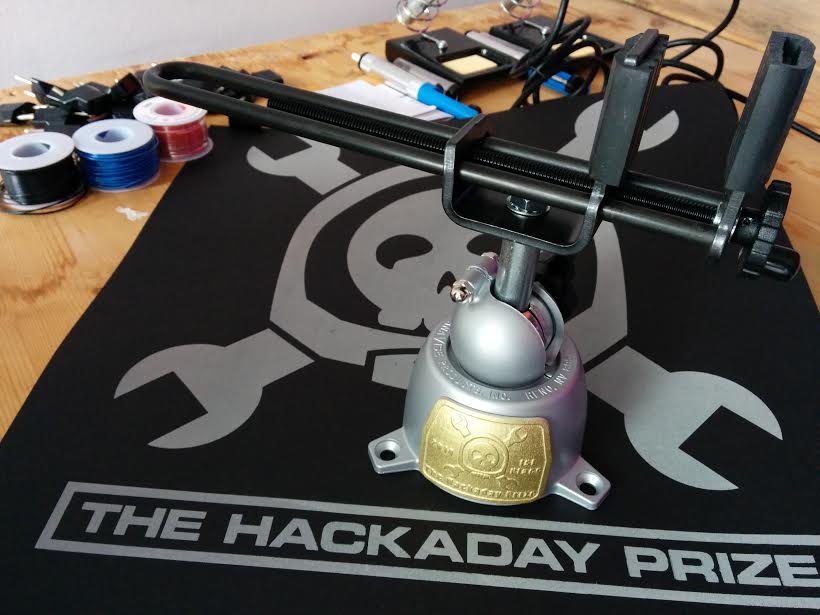
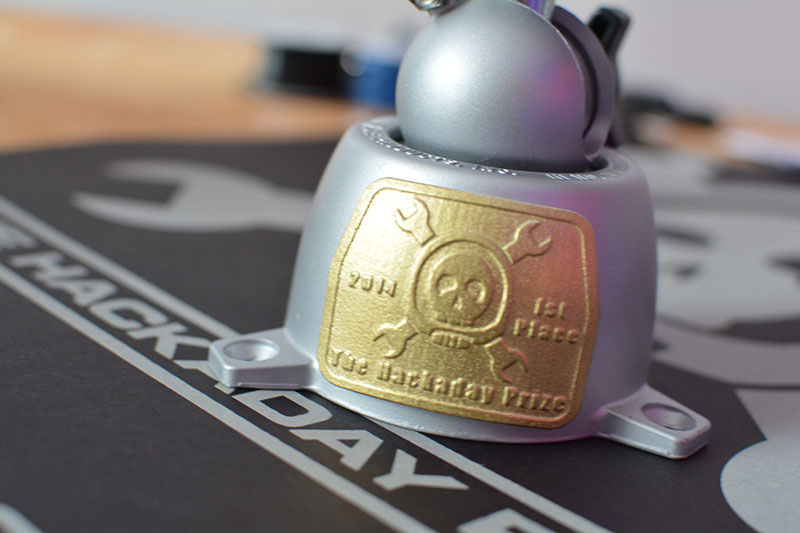
Since we’re announcing the winner of The Hackaday Prize, there was the question of what the trophy should be. Trophies are not utilitarian in any way, so we thought we would put our own spin on this. It’s a PanaVise, emblazoned with a 3D printed plaque.

unnamed


DSC_0105

Doors open in a few minutes. More updates to follow