Seeing The World Through Depth Sensing Cameras

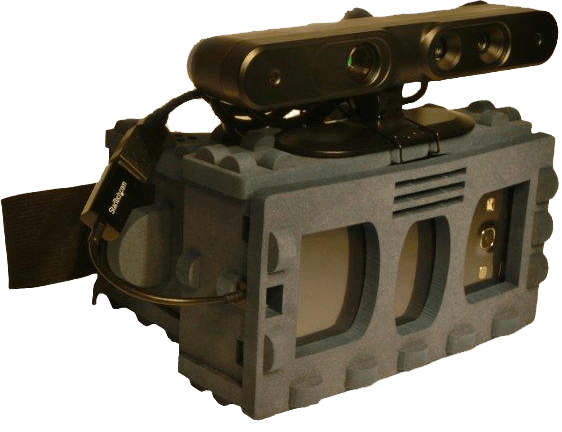
The Oculus Rift and all the other 3D video goggle solutions out there are great if you want to explore virtual worlds with stereoscopic vision, but until now we haven’t seen anyone exploring real life with digital stereoscopic viewers. [pabr] combined the Kinect-like sensor in an ASUS Xtion with a smartphone in a Google Cardboard-like setup for 3D views the human eye can’t naturally experience like a third-person view, a radar-like display, and seeing what the world would look like with your eyes 20 inches apart.

[pabr] is using an ASUS Xtion depth sensor connected to a Galaxy SIII via the USB OTG port. With a little bit of code, the output from the depth sensor can be pushed to the phone’s display. The hardware setup consists of a VR-Spective, a rather expensive bit of plastic, but with the right mechanical considerations, a piece of cardboard or some foam board and hot glue would do quite nicely.

[pabr] put together a video demo of his build, along with a few examples of what this project can do. It’s rather odd, and surprisingly not a superfluous way to see in 3D. You can check out that video below.

Continue reading “Seeing The World Through Depth Sensing Cameras”
Teensys And Old Synth Chips, Together At Last

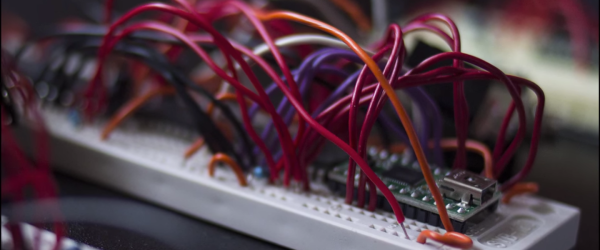
The ancient computers of yesteryear had hardware that’s hard to conceive of today; who would want a synthesizer on a chip when every computer made in the last 15 years has enough horsepower to synthesize sounds in software and output everything with CD quality audio? [Brian Peters] loves these old synth chips and decided to make them all work with a modern microcontroller.

Every major sound chip from the 80s is included in this roundup. The Commodore SID is there with a chip that includes working filters. The SN76489, the sound chip from the TI99 and BBC Micro are there, as is the TIA from the Atari consoles. Also featured is the Atari POKEY, found in the 8-bit Atari computers. The POKEY isn’t as popular as the SID, but it should be.

[Brian] connected all these chips up with Teensy 2.0 microcontrollers, and with the right software, was able to control these via MIDI. It’s a great way to listen to chiptunes the way they’re meant to be heard. You can check out some sound samples in the videos below.

Thanks [Wybren] for the tip.

Continue reading “Teensys And Old Synth Chips, Together At Last”

Hackaday Prize Finalist: An Un-noodly Spectrometer

And so we come to the final finalist bio for The Hackaday Prize. In only three days, we’ll know whether [fl@C@]’s RamanPi Spectrometer or one of the four other projects to make it into the finals round will be making it to space, or only Japan.

There are a surprising number of spectrometer projects out there on the Intertubes, but most of these setups only measure the absorption spectrum – literally what wavelengths of light are absorbed by the material being measured. A Raman spectrometer is completely different, using a laser to illuminate the sample, and measuring the scattering of light from the material. It’s work that has won a Nobel prize, and [fl@C@] built one with a 3D printer.

Bio below, along with the final video that was sent around to the judges. If you’re wondering who the winner of The Hackaday Prize is, even I don’t know. [Mike] and a few Hackaday overlords do, but the rest of us will remain in ignorance until we announce the winner at the party we’re having in Munich next Thursday.

Continue reading “Hackaday Prize Finalist: An Un-noodly Spectrometer”

An MSP430 Clone Of The Canon RC-1 Remote

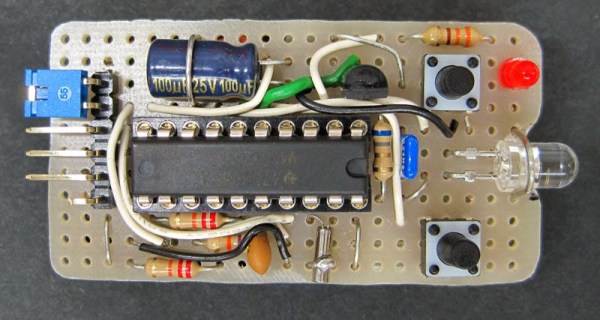
For reasons we both agree with and can’t comprehend, most ‘prosumer’ SLR cameras don’t have mechanical shutter releases. Instead, IR LEDs are brought into the mix, the Canon RC-1 remote trigger being the shutter release of choice for people who didn’t choose Nikon. [Vicente] cloned the Canon RC-1, but he didn’t do it to save money; there’s a lot to learn with this project, and making his own allows him to expand it with more features in the future.

Studying the function of the Canon RC-1, [Vicente] found that some compromises needed to be made. The total power emitted by an IR LED is usually a function of its beamwidth; a smaller beamwidth means more photons reaching the IR receiver in the camera. This also means the remote must be aimed at the camera more accurately. In the end, [Vicente] decided on a higher power LED with a tighter beamwidth that’s just slightly below the optimum wavelength for the receiver. It’s all an exercise in compromise, but other components could see similar performance.

With the LED selected, [Vicente] moved on to building the actual controller. He chose an MSP430 microcontroller for its low power consumption, driving the LED with a watch battery and a transistor. Put together on a piece of protoboard, it’s actually pretty close to a TV-B-Gone. With everything soldered up, it’s good enough to trigger his camera’s shutter from about 5 meters away. Future improvements include cleaning up the code, making the timing more accurate with a crystal, and implementing low power mode on the MSP430.

The Raspberry Pi Model A+

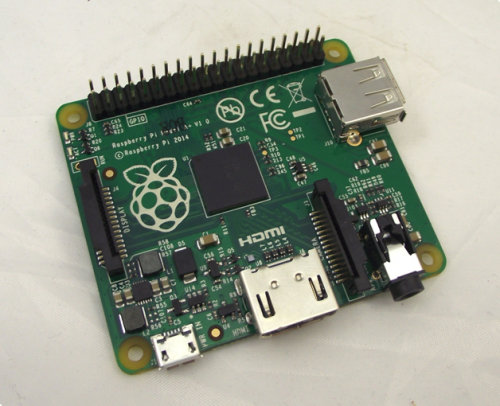
A few months ago we were lucky to get the scoop on a new Raspberry Pi a few days before it was officially announced. This model ended up being the Raspberry Pi Model B+, with improvements that included more USB ports, not-dumb mounting holes, more GPIOs, and a decent microSD card connector. Today, we’re proud to leak another revision to the Raspberry Pi ecosystem – the Raspberry Pi Model A+

There really aren’t many details for this new revision of the Raspi, but we can make some educated guesses. The new model features the same not-dumb mounting holes as the B+, 58mm wide by 49mm wide. All the ports are moved to two sides of the board, and the analog audio and video are combined into one 3.5mm jack. Like the normal Model A, this one doesn’t have Ethernet and only one USB port, but the improvements seen from the B to the B+ are still there: a good microSD card socket is on the back, and the 40-pin GPIO header replaces the old 26-pin header. There’s no word if the A+ will feature a RAM upgrade – when the Model B was ramping up production The Foundation decided to bump the RAM up to 512MB. This could happen with the A+, but we’re not holding our breath.

There’s no word when the A+ will be announced, or when it will start shipping. The educated guess would say tomorrow morning, with an analysis of how much power this thing consumes a week after it starts shipping.

Hackaday Links Column Banner

Hackaday Links: November 9, 2014

After many years of searching, [Dan Wood] finally got his hands on something he’s wanted for the past twenty-two years: an Amiga 4000. No, it’s not the queen bee of Amiga land – that honor would fall to the 68060-equipped 4000T, but [Dan]’s 4000 is decked out. It has a 256MB RAM expansion, Ethernet, USB, and a Picasso IV graphics card that gives it better resolution and color depth than most modern laptops.

[Pistonpedal] has a fully automatic pneumatic can crusher that is far too cool to be wasted on a case of Keystone. A funnel at the top guides the cans in to be crushed one at a time and ejected into a garbage can underneath. Great for recycling.

Coming over from ‘normal’ programming into the world of embedded development? [AndreJ] has the AVR C Macro for you. It’s a great way to get away from all those ~=, |=, and &=s that don’t make any sense at all.

[CNLohr] has a reputation for running Minecraft servers on things that don’t make any sense at all. The latest build is a light up redstone ore block equipped with an ESP8266 WiFi chip.

Oh, the Hackaday overlords and underlings are in Munich for this little shindig we’re doing. If you in town for Electronica come on down. If you have a copy of Neil Young’s Trans, bring it to the party.

Interactive Sound With Glove And Tape

Here’s a way to explore new spaces in untraditional manners: a sonophore, or a glove equipped with a tape heads meant to explore spaces with magnetic tape tracing the walls.

This project is a followup to the analogue tape glove from a few years ago. In that project, aligned strips of magnetic tape cover a canvas, leaving anyone wearing the glove to track their hand horizontally swiping across different tracts, or vertically listening to each track.

This project takes a glove similar to the analogue tape glove, but the tape is spread out along the walls of the installation. There’s no way of knowing what strange voices are contained on the tapes; the only way to know is to explore the space.

Video of the project below. It’s a Vimeo, so you know it’s artistic.

Continue reading “Interactive Sound With Glove And Tape”