RasPiCommPlus, An Expansion Board For Expansion Boards

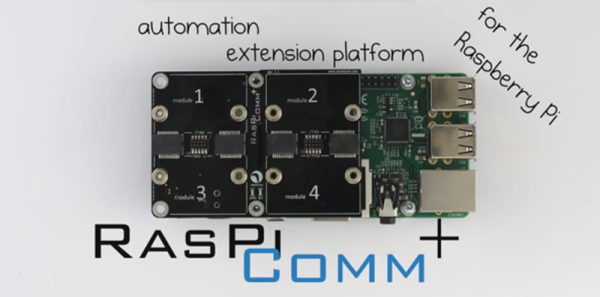
The easiest way to connect a GSM module to a Raspberry Pi would be to buy a breakout module, install some software, and connect to a mobile network with a Pi. Need GPS, too? That’s a whole other module, with different software. The guys behind RasPiCommPlus are working on a better solution – a breakout board for breakout boards that takes care of plugging a ton of modules into a Pi and sorts out the kernel drivers to make interfacing with these modules easy.

Right now, the team has a GPS and GSM module, digital in and out modules, an analog input module, and RS-232 and -485 modules. They’re working on some cool additions to the lineup, including a breakout for Sharp memory displays, a 9-axis IMU, a stepper motor driver, and a 1-wire breakout module.

Some of the RasPiCommPlus team showed up to the Hackaday Munich party and were kind enough to sit down for a demo video. You can check that out below.

Continue reading “RasPiCommPlus, An Expansion Board For Expansion Boards”
Bridging Networks With The Flip Of A Switch

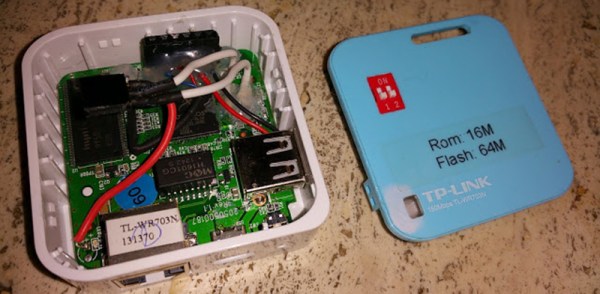
The TP-Link TL-WR703n is the WRT54G for the modern era – extremely hackable, cheap, and available just about everywhere. Loaded up with OpenWRT, it’s capable of bridging networks: turning Ethernet into WiFi and vice versa. This requires reconfiguring the router, and after doing this enough times, [Martin] was looking for a better solution. The SOC inside the WR703n has two exposed GPIO pins, allowing [Martin] to choose between WiFi access point or client and between bridged or NAT/DHCP.

According to the OpenWRT wiki, there are a few GPIOs available, and after connecting these pins to a DIP switch, [Martin] could access these switches through the firmware. The hard part of this build is building the script to change the settings when the system boots. This script looks at the state of the GPIOs and changes the WiFi into client or access point mode and tries not to muck about with the DHCP somewhere off in the cloud. Yes, we just used cloud in its proper context.

The only other hardware to complete this build was a simple USB to serial converter that should be shoved into the corner of everyone’s workbench. Not bad for an extremely minimal soldering and configuration required for a something that’s extremely useful.

Hackaday Links Column Banner

Hackaday Links: November 16, 2014

There have been a few people asking us to do our full teardown of a crowdfunding campaign, this time for Bleen. We’ll get to that, but here’s the TL;DR version: 208 people just threw money away, and right now Indiegogo is ~$3000 richer for doing nothing.

Insipired by a Hacklet, [Chris] documented his retro console build. He started out like most people do with a Raspberry Pi, but found emulating newer consoles like the N64 consumed too much processor time. He moved his build over to custom-assembled hardware with an AMD Micro-ATX board, a drive, and a USB gamepad. It’s beautiful, and much, much more powerful than a Raspberry Pi.

SD card in your Pi died? Of course it did. The problem is you’re not shutting down your Pi correctly. [satya] whipped up a quick project to fix that. One button, a bit of Python, and a shell script is all you need for a one-button shutdown for your Raspberry Pi.

A while ago, [Jan] built an ARM-based modeling MIDI synth that sounds a lot like the old Junos of the 80s. It’s build around the one 8-pin DIP ARM that’s being manufactured, placed between a MIDI jack and a 1/4″ jack. That’s pretty much all the components. [Gritty] plugged it into a Teensy that’s connected to a sequencer. It sounds awesome.

Everyone loves the Spark Core – there are a few floating around the office here. Now there’s a new Spark. It’s called the Photon, and they’re packaging it as a module. There’s an STM32F2 microcontroller and a BCM43362 Wi-Fi transceiver packaged in a nice, FCC certified module. Very cool.

The Computeum, One Of The Biggest Computer Museums In Germany

QWERTZ Everywhere

I cannot say in words how perfect the venue for our Hackaday Munich party was. Not only was there a gigantic collection of vintage video games just around the corner, there was also a freaking warehouse full of mainframes, tubes, transistors, and some of the old retrocomputers you may have used in the 80s and 90s.

It’s called the Computeum, and without a doubt it is one of the most complete computer museums in Germany. There are fantastic computer museums in the states, but these don’t hold a candle to the pure amount of big iron and silicon found at the Computeum.

Continue reading “The Computeum, One Of The Biggest Computer Museums In Germany”

An Extremely Tiny 5.8GHz FPV Transmitter

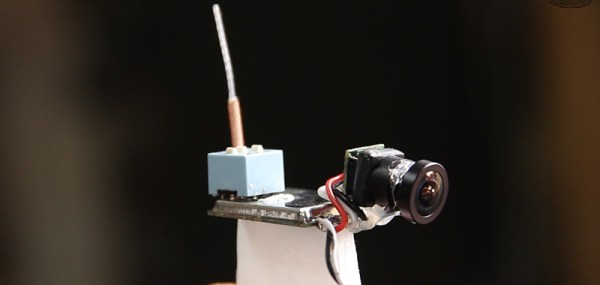
Flying RC aircraft with a first person view is the latest and greatest thing in the hobby. In a fact that I’m sure will be shocking to 90% of people, you don’t need to buy a Phantom quad fly FPV. The guys at Flite Test show how you can build a tiny 5.8GHz FPV transmitter for under $100.

The parts used for this build are pretty much jelly bean parts at this point, but [Peter] at Flite Test is going for extremely lightweight parts for this build. He found an NTSC board camera that only weighs 1g and added a wide-angle lens. The transmitter is a tiny 200mW module that only weighs about 2g.

Why are the Flite Test crew going for small and light FPV setups? They just launched a new line of planes that can be built from a single piece of foam board. If you have a small micro quad, you can easily add FPV to it with this rig.

The Future Of The Internet Of Things

When buying anything, you’re going to have a choice: good, fast, or cheap. Pick any two. A plumber will fix a drain good and fast, but it won’t be cheap. The skeezy guy you can call will fix a drain fast and cheap, but it won’t be good.

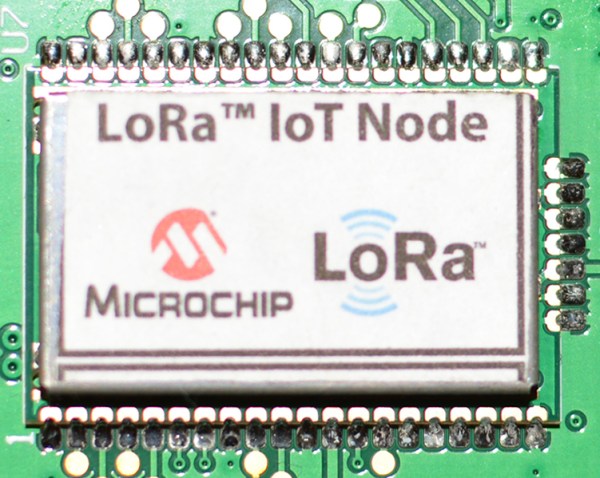
Such it is with radios. You can have long-range (good), high bandwidth (fast), or a low price (cheap). Pick any two. The Internet of Things demands a cheap, long-range radio module, but until now this really hasn’t existed. At Electronica last week, Microchip demoed their IoT solution, the LoRa. This module has a 15km (rural) or ~3km (heavy urban) range, works for a year on two AAA batteries, and is very cheap. Bandwidth? That’s crap, but you’re not streaming videos to your shoe.

Continue reading “The Future Of The Internet Of Things”

Multi-target IDE For 8-Bit CPUs

A long time ago, [Martin] played with old 8-bit computers. Recently, he’s been honing his assembly skills again, and the idea of an IDE for a boatload of old systems came to him. After a year of work, he announced a multitarget IDE for 8-bit computers that works in your browser.

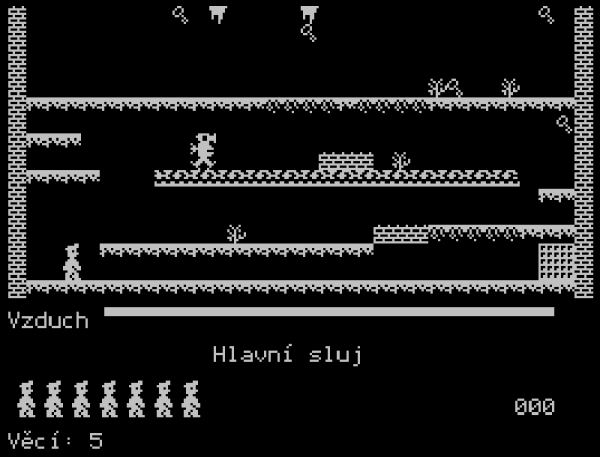
The project is called ASM80, and includes a code editor, a workspace to put all your code, compilers for the 8080/8085, Z80, 6502, 6800 and 6809 CPUs, emulators for all these CPUs, and emulators for a few Czech computers, the ZX Spectrum, and a few of [Grant Searle]’s single board computers.

What makes this project interesting is the syntax for all the different CPUs is pretty much the same. It’s a real, modular code editor that supports macros and everything you would expect for a code editor for ancient computers.

You can check out an assembler description here. [Martin] also has an offline, desktop-based version of ASM80 called IDE80, with a video demo of that below.

Continue reading “Multi-target IDE For 8-Bit CPUs”