PiAware, Automated Airliner Tracking On The Raspberry Pi

FlightAware

For the sufficiently geeky aviation nerd there’s FlightAware, a website that tracks just about every airliner and most private planes currently in flight. The folks at FlightAware compile all the information with the help of a few thousand volunteers around the world that have a bit of hardware to listen to ADS-B transmissions and relay them to the FlightAware servers. Now you can do this with a Raspberry Pi, and as a nice little bonus FlightAware is giving away free enterprise accounts to anyone who does.

Listening in on ADS-B transponders is something Raspberry Pis have been doing for a while, but doing anything useful with the altitude, speed, heading, and registry numbers of various planes flying overhead is pretty much FlightAware’s only reason for existing, and the reason they’ve developed an easy to use software package for the Pi.

Setting everything up requires getting dump1090 running on the Pi, the only hardware required being an RTL-SDR USB TV tuner, a GPS module, and an antenna for 1090 MHz. From there, just send all the data to FlightAware and you get a free enterprise account with them. Not a bad deal for the aviation nerds out there.
Chromecast Is Root

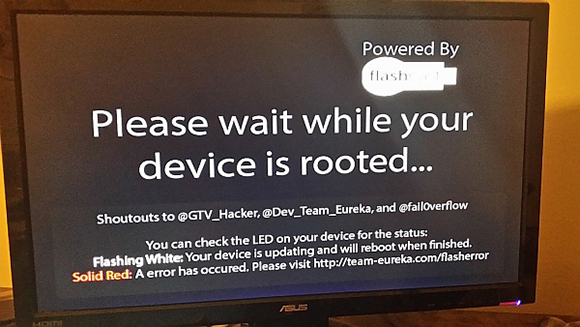
Image from [psouza4] on the xda-developers forum

Chromecast is as close as you’re going to get to a perfect device – plug it in the back of your TV, and instantly you have Netflix, Hulu, Pandora, and a web browser on the largest display in your house. It’s a much simpler device than a Raspi running XBMC, and we’ve already seen a few Chromecast hacks that stream videos from a phone and rickroll everyone around you.

Now the Chromecast has been rooted, allowing anyone to change the DNS settings (Netflix and Hulu users that want to watch content not available in their country rejoice), and loading custom apps for the Chromecast.

The process of rooting the Chromecast should be fairly simple for the regular readers of Hackaday. It requires a Teensy 2 or 2++ dev board, a USB OTG cable, and a USB flash drive. Plug the Teensy into the Chromecast and wait a minute. Remove the Teensy, plug in the USB flash drive, and wait several more minutes. Success is you, and your Chromecast is now rooted.

Member of Team-Eureka [riptidewave93] has put up a demo video of rooting a new in box Chromecast in just a few minutes. You can check that out below.

Continue reading “Chromecast Is Root”

Hackaday Links: August 24, 2014

hackaday-links-chain

Remember those ‘cocktail’ arcade cabinets? The Ikea Lack table has existed for years, so why not make one into an arcade table? Raspberry Pi with RetroPie as the brains,  and an ancient 4:3 monitor as the display.

Old Unixes! Running on PDPs, Novas, and IBMs! Thanks to Simh, you can emulate these old machines. [Matt] put up a guide to getting Simh running on a Pi that includes running Unix V5 on an emulated PDP-11.

Ever wanted to run your own telecom? The folks at Toorcamp did just that, 50 lines, 10,000 feet of 1-pair, and 1,500 feet of 2-pair. There’s a facebook album of all the pics.

Remember last week when Sparkfun said they shipped 2000 Microviews without a bootloader? Make interviewed [Marcus Schappi], the guy behind the MicroView. There’s also a tutorial on how to fix the issue.

Barbie needs an exorcism.

Remember the [Lord Vetinari] clock from way back when? It’s a clock that ticks 86400 times a day, but the interval between each second is just slightly random and enough to drive people insane. Here’s a kit on Tindie that makes it pretty easy to build a Ventinari clock, or a variety of other clocks that are sufficiently weird. There’s also a martian clock that’s 39 minutes and 36 seconds longer than normal, perfect for the folks at JPL.

0x1f 0x000 IZO EMESS 1407981609

Hackaday Retro Edition: Browser Wars On Solaris

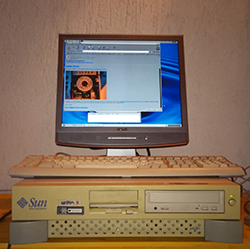
sunn After seeing an earlier Hackaday post on old, old Unix systems loading up our retro edition, [Eugenio] decided he would play out the late 90s browser wars on a few machines of his own. Yes, it’s Internet Explorer vs. Netscape in a fight to the death. No <blink> or <marquee> tags were involved, but a Sun Ultra 5 was. We’re looking at the peak of the workstation world circa 1999 here, and only one browser would emerge victorious (it’s neither IE nor Netscape, btw).

The Solaris 9 system [Eugenio] has supports both Internet Explorer 5 and shipped with Netscape 4. Compared to the functionality of modern browsers, both IE5 and Netscape 4 are ancient and terrible. Remember kids, even the scroll wheel on a mouse is a relatively new invention.

Our retro edition doesn’t have any CSS, Javascript, or any of the new Web weirdness, so everything loaded as it should. One interesting problem [Eugenio] encountered was an inverse color desktop when the IE5 window was in focus. Bringing another window into focus returned the desktop to the right color. I guess Netscape wins the Solaris browser war.

[Eugenio] also dug out an old VT320 terminal and connected it to a Vaio x505 (the same approximate vintage as the Sun Ultra 5). This worked beautifully in both 80 and 132 column mode.

We’re always looking for new submissions of old computers loading up our retro site. We haven’t had many minicomputers loading the site, so dig out those Vaxxen and send something in.

Continue reading “Hackaday Retro Edition: Browser Wars On Solaris”

Defcon Side Trip: Pololu And Robots

PololuDuring our trip out to Vegas for Defcon, we were lucky enough to catch up with a few of the companies that should be of interest to Hackaday readers. One of the companies based out of the area is Pololu, makers and purveyors of fine electronics and robots. In an incredible bit of lucky scheduling, LV Bots, the Las Vegas area robot builders club, was having an event the same weekend we were there. A maze challenge, no less, where builders would compete to build the best robot and write the best code to get a pile of motors and electronics through a line-following maze in the fastest amount of time.

The Bots

The LV Bots events are held in the same building as Pololu, and unsurprisingly there were quite a few Pololu employees making a go at taking the stuff they developed and getting it to run through a maze. At least one bot was based on the Zumo kit, and a few based on the 3pi platform. Interestingly, the Raspberry Pi Model B+ was the brains of quite a few robots; not extremely surprising, but evidence that the LV Bots people take their line-following mazes seriously and are constantly improving their builds.

Each robot and builder ‘team’ was given three runs. For each team, the first run is basically dedicated to mapping the entire maze. A carefully programmed algorithm tries to send the robot around the entire maze, storing all the intersections in memory. For the second and third runs, the bot should – ideally – make it to the end in a very short amount of time. This is the ideal situation and was only representative of one team for that weekend’s event.

Continue reading “Defcon Side Trip: Pololu And Robots”

The Hackaday Prize: Unofficial Statistics

Hackaday Prize entries over time. You people really know how to procrastinate. Click to embiggen.

What is the Hackaday crew doing this weekend? Judging Hackaday Prize entries, of course! We need to pare down the hundreds of entries we received to 50 primo entries for the quarterfinals round. We’re going to be slammed the entire weekend, so don’t expect any news on who’s in and who’s out of the competition until Monday.

Each of us has about 15 hours of video to go through (multiply the number of entries by two minutes. It’s a lot), and of course we need to read each entry and rate them. We’re literally looking at more than a man-month of work here, and yes, we’ve all read the book.

Until then, here’s some totally unofficial statistics, courtesy of [Greg Kennedy] and his web scraping skills. The graph above shows the number of Hackday Prize entries over time, from the first announcement of the contest to the cutoff time. You people really, really like to procrastinate. The day with the most entries was August 20th, the deadline to get your project in. The day with the most validated entries (i.e. meeting the requirements of a video and four project logs) was August 19th. Needless to say, it’s been a busy week on Hackaday.io.

As a side note, the rules for THP say you must upload a video to qualify for the quarterfinals. This video may be uploaded to YouTube or Youku. Only one project uploaded a video to Youku. Now you know what to do next time to get some free publicity.

It’s highly unlikely we’re going to publish this many official stats, especially now that [Greg] has it pretty much covered. We’ll get the list of all the quarterfinalists out on Monday. Until then you can entertain yourself by watching nearly 15 hours of Hackaday Prize entry videos, all embedded below.

Continue reading “The Hackaday Prize: Unofficial Statistics”

Hackerspace Tour: Syn Shop, Las Vegas

While we were at DEFCON, we had the chance to visit a few places in the area that are of interest to the Hackaday readership. We made it over to Syn Shop, the Las Vegas hackerspace.

Years ago, this area of town was home to the Greyhound bus depot, complete with all the adventures associated with that. Since then, Zappos set up their HQ nearby, massive amounts of money flowed in, and gentrification got a big thumbs up from the decaying casinos in the area. Syn Shop is just down the street from the Denny’s with a bar and the twelve story tall slot machine with a zip line, making this space perfect for the community outreach that is lacking in so many other hackerspaces. In the hour or so I was there, no fewer than two groups of people took a gander through the plate glass asking themselves if this was ‘one of those makerspaces or something’. It’s a far cry from hackerspaces found tucked away in business parks, and something that has worked well for the members of the shop.

[Andrew Bogerri] took me around the space, first showing off the PDP-11/23 which you can drive around with a remote control. Yes, it works. No, not Unix. Yes, the entire stack should weigh about 500 pounds, but the guts of the RL02 drives were replaced with something considerably more modern. Just think of it as a 200 pound remote control car, with the momentum that goes along with that.

Syn Shop has a huge space for classes, and the tutors to go along with it. Classes range from CAM design and CNC operation, to tutorials on how to use the huge ShopBot in the space. There’s also a craft night, plenty of help available for running the laser cutter, and enough electronics paraphernalia to work on anything in the sub-Gigahertz range.

Even though most of the Syn Shop members were away at the Rio getting geared up for the con when I went through, you could still tell the space is constantly buzzing with energy and spurious emissions. I caught up with a few of the other regular members at the Hardware Hacking village at the con, but that’s a subject for another post.

Pics below.

Continue reading “Hackerspace Tour: Syn Shop, Las Vegas”