The ChipWhisperer At Defcon

We’ve seen [Colin]’s entry to The Hackaday Prize before. After seeing his lightning talk at Defcon, we had to get an interview with him going over the intricacies of this very impressive piece of hardware.

The ChipWhisperer is a security and research platform for embedded devices that exploits the fact that all security measures must run on real hardware. If you glitch a clock when a microcontroller is processing an instruction, there’s a good probability something will go wrong. If you’re very good at what you do, you can simply route around the code that makes up the important bits of a security system. Power analysis is another trick up the ChipWhisperer’s sleeve, analyzing the power consumption of a microcontroller when it’s running a bit of code to glean a little information on the keys required to access the system. It’s black magic and dark arts, but it does work, and it’s a real threat to embedded security that hasn’t had an open source toolset before now.

Before our interview, [Colin] did a few short and sweet demos of the ChipWhisperer. They were extraordinarily simple demos; glitching the clock when a microcontroller was iterating through nested loops resulted in what can only be described as ‘counter weirdness’. More advanced applications of the ChipWhisperer can supposedly break perfectly implemented security, something we’re sure [Colin] is saving for a followup video.

You can check out [Colin]’s 2-minute video for his Hackaday Prize entry below.

Continue reading “The ChipWhisperer At Defcon”

Open Source GPU Released

GPLGPU

Nearly a year ago, an extremely interesting project hit Kickstarter: an open source GPU, written for an FPGA. For reasons that are obvious in retrospect, the GPL-GPU Kickstarter was not funded, but that doesn’t mean these developers don’t believe in what they’re doing. The first version of this open source graphics processor has now been released, giving anyone with an interest a look at what a late-90s era GPU looks like on the inside, If you’re cool enough, there’s also enough supporting documentation to build your own.

A quick note for the PC Master Race: this thing might run Quake eventually. It’s not a powerhouse. That said, [Bunnie] had a hard time finding an open source GPU for the Novena laptop, and the drivers for the VideoCore IV in the Raspi have only recently been open sourced. A completely open GPU simply doesn’t exist, and short of a few very, very limited thesis projects there hasn’t been anything like this before.

Right now, the GPL-GPU has 3D graphics acceleration working with VGA on a PCI bus. The plan is to update this late-90s setup to interfaces that make a little more sense, and add DVI and HDMI output. Not bad for a failed Kickstarter, right?

The Hackaday Antiduino Browser Plugin

ArduinoArduinoArduino

Hackaday – and the projects featured on Hackaday – get a lot of flak in the comments section simply for mentioning an Arduino. The Arduino complainers are, of course, completely wrong; everyone here is trying to make something, not make something in the most obscure possible way.

The Arduino is a legitimate tool, but still there are those among us who despise anything ending in ~duino. This browser plugin is for them. It’s a Chrome extension that selectively replaces or removes Arduino content from Hackaday depending on the user’s preference.

There are three settings to the plugin: See No Evil replaces images of Arduinos with serious business. Hear No Evil removes all occurrences of the word ‘Arduino’ and replaces them with something of your choosing. Speak No Evil removes all posts in the Arduino Hacks category.The last option also removes the ability to comment on any post in the Arduino Hacks category, so obviously the quality of the comments here will drastically increase by tomorrow.

You can grab the plugin on the gits. It’s Chrome only, but if someone wants to port it to Firefox, we’ll gladly put up another post.

There you go, Internet. You’re free now, and the biggest problem in your life has now been solved. Go give [SickSad] a virtual pat on the back, or tell him he could have done the same thing with a 555. Either of those are pretty much the same thing at this point.

Hackaday Links: August 17, 2014

hackaday-links-chain

[wjlafrance] recently picked up an old NeXTstation, complete with keyboard, mouse, display… and no display cable. The NeXT boxes had one of the weirder D-sub connectors a still weird DB-19 video connector, meaning [wjla] would have to roll his own. It’s basically just modifying a pair of DB-25 connectors with a dremel, but it works. Here’s the flickr set.

The guys at Flite Test put on a their first annual Flite Fest last month – an RC fly-in in the middle of Ohio – and they’re finally getting around to putting up the recap videos. +1 for using wacky waving inflatable arm flailing tube men as an obstacle course.

My phone’s battery is dead and my water pressure is too high.

Stripboard drawing paper, written in [; \LaTeX ;].

Remember the Commodore 16? [Dave] stuck a PicoITX mother board in one. He used the Keyrah interface to get the original keyboard working with USB. While we’re not too keen on sacrificing old computers to build a PC, it is a C16 (sorry [Bil]), and the end result is very, very clean.

A Chromecast picture frame. [philenotfound] had a 17″ LCD panel from an old Powerbook, and with a $30 LVDS to HDMI adapter, he made a pretty classy Chromecast picture frame.


DEFCON 22: The HackRF PortaPack

What do you get when you combine one of the best (and certainly one of the best for the price) software defined radios with the user interface of a 10-year-old iPod? The HackRF PortaPack, developed by [Jared Boone], and demonstrated at DEFCON last weekend.

[Jared] is one of the original developers for the HackRF, a 10MHz to 6GHz software defined radio that can also transmit in half duplex. Since the development of the HackRF has (somewhat) wrapped up, [Jared] has been working on the PortaPack, an add-on for the HackRF that turns it into a portable, ARM Cortex M4-powered software defined radio. No, it’s not as powerful as a full computer running GNU Radio, but it does have the capability to listen in on a surprising amount of radio signals.

Because [Jared] is using a fairly low-power micro for the PortaPack, there’s a lot of tricks he’s using to get everything running smoothly. He gave a lightning talk at the Wireless Village at DEFCON going over the strengths and weaknesses of the chip he’s using, and surprisingly he’s using very little floating point arithmetic in his code. You can check out the video for that talk below.

Continue reading “DEFCON 22: The HackRF PortaPack”

Robotic Scalextrics

scalectrics

At the Volkswagen factory there are two towers – AutoTürme – filled with gigantic robots lifting cars into parking spaces. It’s by far the most efficient way of putting a huge number of cars in a small footprint. Slot cars exist, so how about a completely overwrought yet entirely awesome robotic parking garage for 1:32 scale cars? (.es, Google translatrix)

The project is built around several ‘racks’ to hold cars arranged around a central elevator. An Arduino takes care of moving all the motors and reading all the sensors, with the basic idea behind the project being the ability to select a car and have it appear in the pit of the track a few moments later.

Although this is just one small part of what is already a very impressive slot car track, it is however the most electronic. Other unique additions include a very unique cantilever/suspension bridge and the usual modeling techniques of creating a landscape with little more than cardboard and glue.

The best way to get a sense of how cool the parking garage is through the video. You can check that out below.

Continue reading “Robotic Scalextrics”

THP Entry: A 6502 SBC Robot (On Multiple Boards)

SBC

Robots have always been a wonderful tool for learning electronics, but if you compare the robot kits from today against the robot kits from the 80s and early 90s, there’s a marked difference. There are fairly powerful microcontrollers in the new ones, and you program them in languages, and not straight machine code. Given this community’s propensity to say, ‘you could have just used a 555,’ this is obviously a problem.

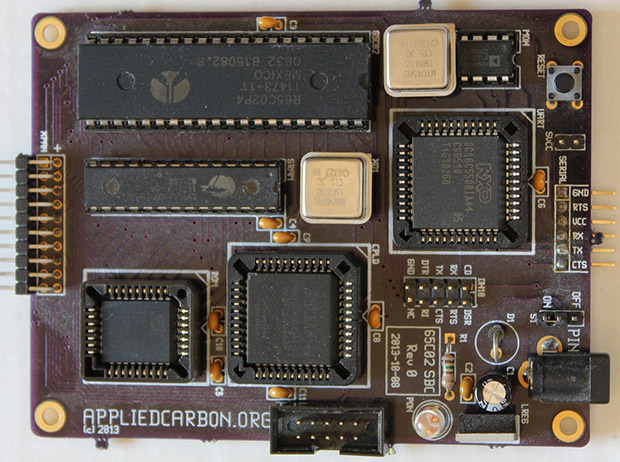
[Carbon]’s entry for The Hackaday Prize is a great retro callback to the Heathkit HERO and robotic arms you can now find tucked away on a shelf in the electronics lab of every major educational institution. It’s a 65C02 single board computer, designed with robotics in mind.

The 6502 board is just what you would expect; a CPU, RAM, ROM, CPLD glue, and a serial port. The second board down on the stack is rather interesting – it’s a dual channel servo board made entirely out of discrete logic. The final board in the stack is an 8-channel ADC meant for a Pololu reflective sensor, making this 6502 in a Boe-bot chassis a proper line-following robot, coded in 6502 assembly.

[Carbon]’s video of his bot below.


SpaceWrencherThe project featured in this post is an entry in The Hackaday Prize. Build something awesome and win a trip to space or hundreds of other prizes.

Continue reading “THP Entry: A 6502 SBC Robot (On Multiple Boards)”