The Analog Swiss Army Knife

11300

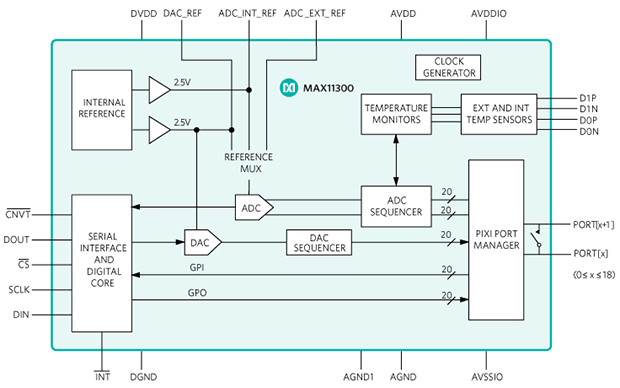
While FPGAs get all the credit for being the hip new thing, they are inherently digital devices. Without a proper ADC and DAC, you won’t be delving into the analog domain with your programmable logic. Maxim has just put out a chip that does just that: an analog swiss army knife with 20 pins that are configurable as analog to digital converter, digital to analog converters, GPIO, or any mix of the above.

The MAX11300 includes twenty IO ports, each capable of becoming an ADC, DAC, or GPIO, with pairs of ports capable of being configured as a logic level translator or an analog switch. The ADCs and DACs are 12-bit, with input and output ranges from -10V to +10V.

As a nice little bonus, the chip is controlled over SPI, making this an interesting device for a small “do anything analog” tool we’re sure will hit Tindie or Seeed Studio before the year is out. Luckily for whoever would create such a device, Maxim has a nice GUI for configuring each of the 20 pins on their chip, Of course Maxim already offers an evaluation kit for the MAX11300. It’s $100 USD and is Windows only.

The MAX11300 is available in either 40-pin TQFN or 48-pin TQFP packages (with the larger, easier to solder TQFP shipping later) for about $5.80 USD in quantity 1000, or $11.37 in quantity one.Video below showing off the MAX11300 reading and writing analog values to a few pins, and a good look at the configuration software.
Continue reading “The Analog Swiss Army Knife”

THP Entry: Etch-A-CNC

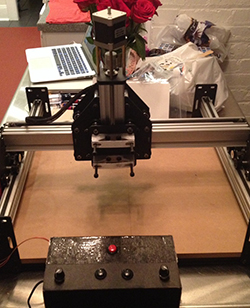
etchacncCNC machines have been around for decades, but only recently have small desktop routers, 3D printers, and laser cutters brought G code to the tabletop. Obviously, this is a teaching opportunity, and if you’re trying to get kids interested in the inner workings of machines that build things, you can’t begin with obtuse codes understood only by machines and CNC operators.

[johnyang] is building his own CNC controller based on something just about every kid is already familiar with: the Etch A Sketch. He’s retrofitted a small, travel size Etch A Sketch with an LCD, buttons, rotary encoders, and a Raspberry Pi to turn this primitive drawing toy into a machine that generates G code for a Shapeoko 2 CNC mill.

The user interface for this CNC controller is as similar to the Etch A Sketch as [johnyang] can make it – two rotary encoders draw a shape on the LCD, and G code is generated from the drawn shape. Adding a third dimension is a bit of a challenge – it looks like two buttons take care of the up and down movement of the spindle. Still, [johnyang] plans to add the definitive Etch A Sketch feature – holding it upside down and shaking it will reset the CNC to its original state.

There are a few videos of [johnyang]’s progress. You can check those out below.


SpaceWrencherThe project featured in this post is an entry in The Hackaday Prize. Build something awesome and win a trip to space or hundreds of other prizes.
Continue reading “THP Entry: Etch-A-CNC”

The Sega Mega Drive Dev Kit

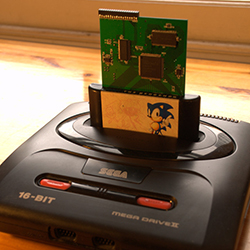
segaWhile most homebrew video game development has focused on the original NES, Atari consoles, and has produced a few SNES games, there is another console out there that hasn’t seen much love. Sega’s classic console, the Genesis or Mega Drive, depending on where you’re from, was an extremely capable machine with amazing capabilities for its time. [Chris] figured the Mega Drive would make a good target for an all-in-one development kit, and with a lot of work he managed to put one together.

The standard cartridge for the Genesis or Mega Drive is just a simple ROM chip wired directly into the console’s address space. [Chris] took a cheap FPGA and some dual port ram to create a seamless interface between the modern world and the inside of this ancient console, allowing him to load every Mega Drive game off an SD card, as well as use modern tools to modify old games, or even create new ones.

To demonstrate his dev kit, [Chris] took a copy of Sonic 1, and using the debugger and GDB, gave himself infinite lives. It’s a very cool demonstration, searching through all the commands executed by the Megadrive CPU with the standard Linux debugging tools.Going through the trace, [Chris] found the instruction that decremented that value representing Sonics lives, replaced it with NOPs, in effect giving himself infinite lives. This is a lot like how the Game Genie works, only using much, much better tools.

Of course a USB dev kit wouldn’t be much use if it could only modify existing games. The real power of [Chris]’ work comes from being able to develop your own demos, games, and homebrew apps.

[Chris] needed to write a small homebrew Mega Drive app for the ROM loader portion of his dev kit using SGDK. Disassembling his own code with the dev kit, he was able to take a look at the instructions, and potentially even modify his loader.

It’s a really impressive technical accomplishment, and something that could be a boon to the extremely small homebrew scene for the Mega Drive. All the boards, code, and everything else are available over on [Chris]’ github, with the entire project written up on hackaday.io. Videos below.

Continue reading “The Sega Mega Drive Dev Kit”

Judge Spotlight: Sprite_TM

Sprite_TM

His friends call him [Jeroen], but everyone else on the Internet knows this god of hacks and mods as [Sprite_TM]. He’s done everything from hacking hard drive controllers to making the best computer ever made even better. As one of the preeminent hardware hackers around, we’re proud to have [Sprite] as a judge in The Hackaday Prize, and happy to interview him on his thoughts on connected devices, the cloud-based Internet of Things, and his process of opening up black box devices for some sometimes subtle modifications.


judge-spotlight-q5You’re well known for your highly technical electronic hacks on your
blog SpritesMods. What about the professional side of your life, what kind
of projects keep you busy there?

judge-spotlight-a5I’m a software developer for a big broadcasting equipment manufacturer. Every now and then a hardware project comes along and I try to grab those too.


Continue reading “Judge Spotlight: Sprite_TM”

Autonomous Plane Flying Across The USA

sky

Somewhere between San Diego and South Carolina is an unmanned aerial vehicle attempting to make the first autonomous flight across the United States. The plane is electric and requires a landing and battery swap every hour or so, however the MyGeekShow guys are so far the only non-military entity to attempt such an ambitious flight.

The plane making the multiple flights is a Raptor 140 capable of cruising at 75 kph for about an hour before requiring a battery swap. Ground control is an RV, loaded up with LCDs and radios; as long as the RV is within a kilometer or so of the plane, the guys should be able to have a constant telemetry link.

Already the guys at MyGeekShow have pulled off a 52 km autonomous flight, following their flying wing in a car. Even though a hard landing required swapping out the carbon fiber spar for an aluminum one, the plane making the truly cross-country flight is still in good condition, ready to land on a South Carolina beach within a week.

You can follow the trip on the MyGeekShow Twitter. The guys are pulling off an incredible amount of updates and even a few live streams from the mobile command station.

UPDATE: It crashed. Tip stalls aren’t your friend, and undercambered wings exist. Good try, though.

The Unity ‘Candle’ With A 30 Foot Flame

candle

[Quinn]’s friends were getting married, and while the couple wanted something like a ‘unity candle’ ceremony, they though simple candles were entirely unimpressive and ultimately not very entertaining for the guests. They decided a unity fireball would be a much better representation of their relationship, and were lucky enough to have a good friend that could build one.

The design of [Quinn]’s unity candle consisted of a control box with two key switches, a giant button, and the gigantic propane fueled candle set well back from the bride, groom, and guests at the ceremony. The candle itself releases the entire contents of an accumulator tank over a hot surface igniter, creating a thirty foot fireball without a visible pilot light, or the loud jet-like sound you would get from a traditional ‘poofer’.

As with all giant fireballs in front of an audience, safety was of the highest concern. [Quinn] didn’t use a full propane tank for this build, instead, a new, purged, and never used tank was used as an accumulator, storing just enough propane for one giant fireball. All the valves, regulators, and plumbing were rated for LP, and [Quinn] even filled out the proper forms and got the local fire department to sign off on it. It’s safer than [Caleb]’s Mario fire flower, but you still shouldn’t try this at home.

Video of the ceremony below.

Continue reading “The Unity ‘Candle’ With A 30 Foot Flame”

THP Entry: Digital Gauges For Everything Automotive

DDAQ

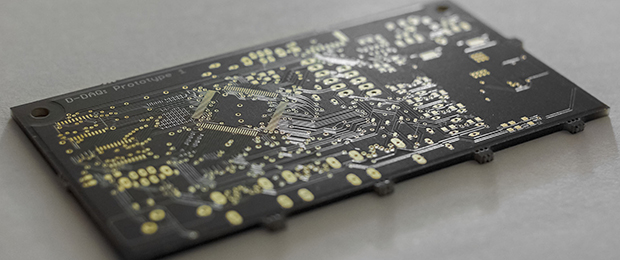
Way back in 2007, someone on a VW TDI forum came up with a new boost gauge project. At the time, it was a remarkable feat of engineering, capable of displaying the manifold pressure on a tiny OLED on the dashboard. No project has yet reached this caliber since. [Digital Corpus] is revisiting the project, making it his own, adding a few upgrades, and entering it into the Hackaday Prize.

The D-DAQ, as [Digital] calls his new project is using an absolute pressure sensor, unlike its predecessor. This gives the turbo gauge a much larger range than the original project, and also allows the D-DAQ to measure partial vacuum in non-diesel turbos.

In addition, the D-DAQ has a much wider scope than the original project, and as such will function as much more than a simple boost gauge. [Digital] sees the D-DAQ as being a complete performance monitor and logger, capable of tracking the exhaust gas temperature, battery voltage, and just about anything else with 10 analog pins. Data will be saved to a MicroSD card, and instead of a single display, the D-DAQ will feature three 160×128 OLEDs.

It’s certainly not what you’d expect from a Hackaday Prize entry, but with these features, it’s very possible the D-DAQ could be a successful product


SpaceWrencherThe project featured in this post is an entry in The Hackaday Prize. Build something awesome and win a trip to space or hundreds of other prizes.