Hackaday Is Going To The NYC Maker Faire!

maker

In just a few short days, the greatest hackers and makers from all around the globe will descend on the Hall of Science in New York City to show off their wares. Our new guy [Adam] and myself will also be there, giving these makers our unending support, putting up a few posts about what they built, and giving out some Hackaday swag.

Continue reading “Hackaday Is Going To The NYC Maker Faire!”

Turning A Raspi Into AdBlock

pi

There’s nothing quite as annoying as seeing bandwidth wasted on unimpressive flash animations, irrelevant ads, and animated GIFs. The bad news is these ads are the sole source of income for a lot of your favorite websites – Hackaday included. The good news is you can turn these ads off with a Raspberry Pi, a WiFi adapter, and a little bit of fun in the terminal.

This build creates a wireless access point with a WiFi adapter plugged in to a Raspberry Pi. With an Ethernet cable plugged in, this effectively turns the Raspi into a wireless router.

To configure the software to block ads, it’s a simple matter of installing dnsmasq from the command line and making sure all the ads on your favorite webpages time out. This means a fairly big hit on the performance of your new DIY router, but with the installation of Pixelserv you can host a 1-pixel transparent GIF image that replaces all the ads and renders them invisible.

It’s a great project if you don’t like watching ads on your PS3, XBox, tablet, or other non-PC Internetting device. If people stealing your wireless connection is a problem, it shouldn’t be hard to make every image upside down or blurry for those rogue WiFi pirates.

The Easy Or Hard Way To Build A PWM Dimmer

From what you would gather from Hackaday’s immense library of builds and projects over several years, the only way to do PWM is with a microcontroller, some code, a full-blown IDE, or even a real-time operating system. To some readers, we’re sure, this comes naturally and with an awesome toolchain it can be as easy as screwing in a light bulb. There is, of course, an easier way.

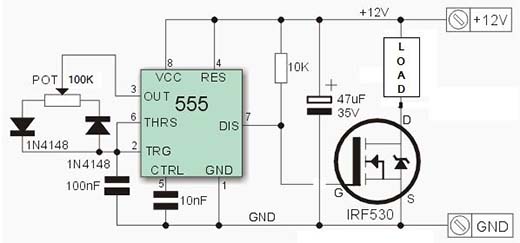
[Jestin] needed to vary the current on a small 12 Volt load. Instead of digging out an in system programmer, he turned to the classic 555 chip. With a single pot, it’s easy to vary the duty cycle of the 555 and connect that to a MOSFET. Put a load in there, and you have a very easy circuit that’s a fully functioning PWM dimmer.

If all you have are a few scraps in your part drawers, this is a very, very easy way to set up a dimmer switch. We’re also loving [Jestin]’s improv aluminum tube enclosure, as seen in the video below.

Continue reading “The Easy Or Hard Way To Build A PWM Dimmer”

A Sublime PVC Cannon

PVC

Not to be outdone with hair spray powered PVC cannons, [William] created an even cooler device: a cannon powered by dry ice.

Once dry ice is loaded into the pressure vessel, a burst disk is placed in the breech and the barrel is screwed on. The trigger isn’t very precise – the entire gun is powered by dry ice turning from a solid into a gas – but the resulting cloudy booms more than make up for any imperfections.

Despite building a cannon and using PVC as a pressure vessel, [Bill]’s project is actually quite safe. The ‘trigger’ is a burst valve made out of a disc of aluminum foil held between two sections of PVC. When the pressure rises, the aluminum foil inevitably tears, shooting whatever is in the barrel out and hopefully not into an eye. The ‘safety’ on the gun is a ball valve connected directly to the pressure vessel, and with a pressure gauge and a release valve. We’re more than confident in saying this is pretty darn safe as far as PVC cannons are concerned.

A Touch Screen Geiger Counter Without A Geiger Tube

geiger

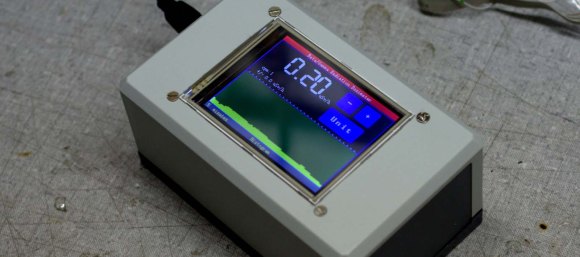
We’re assuming [Toumal] was desperately bored one day, because in the depths of the Internet he found some really cool components to build a solid state Geiger counter.

The Arduino and touchscreen are rather standard fare [Toumal] picked up on eBay for about $30. What really sets this project apart from all the other geiger counter builds we’ve seen is the solid state geiger counter [Toumal] used. This device uses a specially-made photodiode made by First Sensor to detect gamma emissions from 5 to 1000 keV.

[Toumal] put all the software for his Arduino touch screen radiation detector up on github. To be honest, we’re really impressed with the rad sensor [Toumal] used for this project, so if you ever decide to pick one of those up, he’s got your back with an Arduino library for it.

Organizing Transistors

SAMSUNG

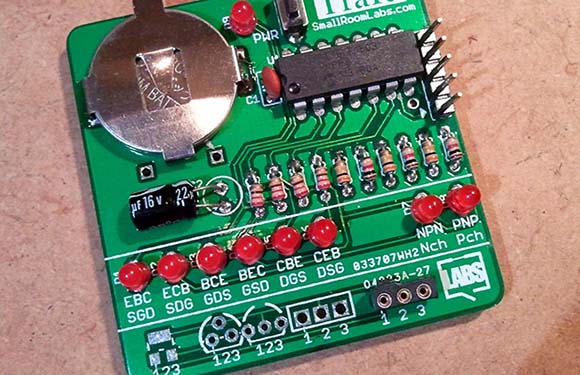
Late last year, [matseng] set up an interesting challenge for himself: design a new PCB every week, send it off to a fab house, and build a new project. It’s a grueling endeavor, but some of these projects are actually very useful and cool. One of the best so far is the TraId – a board that identifies a transistor type and pinout with a nice LED interface.

This build was partly inspired by Dangerous Prototypes’ Part Ninja, a board that determines the pinouts and values of transistors, resistors, caps, and diodes. The TraId is a much more cut down version usable only for transistors, displaying the orientation of the pins and type of transistor on a set of 8 LEDs.

Although the design is very sparse, we could imagine something like this being very useful in a hackerspace, lab, or anywhere else the gremlins of chaos come to reorganize parts drawers. If you’d like to build your own, all the required files are up on the gits.

Digital Camera Becomes Video Transmitter

canon

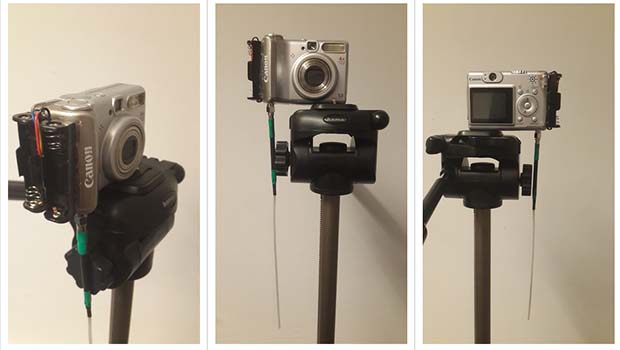
In the arena of high altitude balloons, Canon’s PowerShot series of digicams are the camera du jour for sending high into the stratosphere. There’s a particular reason for this: these cameras can run the very capable CHDK firmware that turns a $100 digicam into a camera with a built-in intervalometer along with a whole bunch of really cool features. It appears this CHDK firmware is much more powerful than we imagined, because [Chris] is now transmitting pictures taken from a Canon a530 to the ground, using only the CHDK firmware and a cheap radio module.

These PowerShot cameras have an ARM processor inside that runs VxWorks, a minimal but very capable OS for embedded devices and Mars rovers. By tying in to the Tx and Rx lines of the camera, [Chris] can issue commands to the OS, change settings, and even install his own code.

With the help of [Phil Heron]’s SSDV encoder written in C, [Chris] was able to get the camera to transmit images  with a small radio transmitter that fits in the battery compartment. Right now, [Chris] has only built the CHDK + SSDV for the Canon a530, but with how useful this build is, we expect to see an improved version very shortly.