Lighthouse Locates Drone; Achieves Autonomous Battery Swap

The HTC Vive’s Lighthouse localization system is one of the cleverest things we’ve seen in a while. It uses a synchronization flash followed by a swept beam to tell any device that can see the lights exactly where it is in space. Of course, the device has to understand the signals to figure it out.

[Alex Shtuchkin] built a very well documented device that can use these signals to localize itself in your room. For now, the Lighthouse stations are still fairly expensive, but the per-device hardware requirements are quite reasonable. [Alex] has the costs down around ten dollars plus the cost of a microcontroller if your project doesn’t already include one. Indeed, his proof-of-concept is basically a breadboard, three photodiodes, op-amps, and some code.

His demo is awesome! Check it out in the video below. He uses it to teach a quadcopter to land itself back on a charging platform, and it’s able to get there with what looks like a few centimeters of play in any direction — more than good enough to land in the 3D-printed plastic landing thingy. That fixture has a rotating drum that swaps out the battery automatically, readying the drone for another flight.

If this is just the tip of the iceberg of upcoming Lighthouse hacks, we can’t wait!

Continue reading “Lighthouse Locates Drone; Achieves Autonomous Battery Swap”

Control Anything With A Universal Wireless Remote

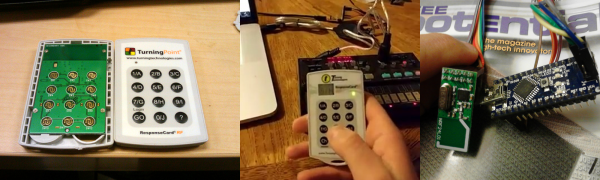
If you aren’t already living on the spacecraft Discovery One, you may not have HAL listening to your every voice command. If that’s the case for you, as it is for us, you may have to resort to mashing buttons on little black monoliths like a primitive monkey. [Barnr]’s universal remote project, and some black PLA filament, will get you there in no time.

2001_obeliskThe remote is based on a nRF24 radios with a PIC to read the button presses. A Raspberry Pi and another nRF24 are listening on the other end. The code that runs either side of the connection is so minimal that both sides fit in the project description. It gets the job done, and it’s easily hackable. And with that, [barnr] can control anything that he can connect up to the Pi without getting up from his campfire.

While [barnr] is shy about his 3D design skills, we think that the box is fantastic. It’s got 3D-printed keycaps for the tactile switches that sit inside, and it’s an easily printed case. Maybe it’s a little blocky and, frankly monolithic, but it gets the job done. Aesthetics are for version 2.0.

When you build something yourself, and it’s not a HAL 9000, you pretty much need a way to control it. It’s no wonder we’ve seen so many projects on Hackaday. If your 2.4 GHz spectrum is too crowded to run a nRF24 remote, you might consider infrared: tiny, tiny, infrared. Or if you want to see the craziest remote that we’ve ever seen, check out this DTMF-over-cellphone build. But if you just want something sweet and minimal that gets the job done, [barnr]’s build is for you.

Thanks [Mikejand] for the tip!

The Most Flexible Synthesizer Is DIY, Raspberry Pi

[Ivan Franco] sent us this great synthesizer project that he’s working on. Or maybe it’s more like a synthesizer meta-project: a synthesizer construction set. You see, what Pryth has is a Raspberry Pi inside that’s running a custom distribution that includes SuperCollider to generate the sound, OSC for the communication layer, and a Teensy with up to 80 (!) multiplexed analog inputs that you’ll connect up to whatever hardware you desire.

Continue reading “The Most Flexible Synthesizer Is DIY, Raspberry Pi”

Mintomat: An Overcomplicated Gumball Machine

How do you get teenagers interested in science, technology, and engineering? [Erich]’s team at the Lucerne University of Applied Sciences makes them operate three robots to get a gumball. The entire demonstration was whipped together in a few days, and has been field-repaired at least once; a green-wire fix was a little heavy on the solder and would short out to a neighboring trace when mechanical force was applied.

Continue reading “Mintomat: An Overcomplicated Gumball Machine”

Floating Walking Robot

It’s no secret that we love bizarre robot locomotion, so we are naturally suckers for BALLU (YouTube link, also embedded below) the Bouyancy-Assisted Lightweight Legged Unit. The project started with a simple observation — walking robots are constrained by having to hold themselves up — and removing that constraint make success much easier. Instead of walking, BALLU almost floats and uses what little net weight it does have to push against the ground.

Continue reading “Floating Walking Robot”

Five-Watt SDR Transceiver For Hams

The availability of cheap SDR hardware created a flourishing ecosystem for SDR software, but a lot of the hardware driving the revolution was still “cheap”. In the last few years, we’ve seen quality gear replacing the TV dongles in many setups, and down-converters designed for them to allow them to work on the ham bands.

But something that’s purpose-built might be a better option if ham radio, particularly the shortwave portion thereof, is your goal. First off, you might want to transmit, which none of the TV dongles allow. Then, you might want a bit of power. Finally, if you’re serious about short-wave, you care more about the audio quality than you do immense bandwidth, so you’re going to want some good filters on the receiving end to help you pull the signal out of all the noise.

rs-hfiq_block_diagram_featuredThe RS-HFIQ 5 W SDR transceiver might be for you. It’s up on Kickstarter right now, and it’s worth looking at if you want a fully open source (schematics, firmware, and software) shortwave SDR rig. It’s also compatible with various open frontends.

The single-board radio isn’t really a full SDR in our mind — it demodulates the radio signal and sends a 96 kHz IQ signal across to your computer’s soundcard where it gets sampled and fully decoded. The advantage of this is that purpose-built audio rate DACs have comparatively high resolution for the money, but the disadvantage is that you’re limited to 96 kHz of spectrum into the computer. That’s great for voice and code transmissions, but won’t cut it for high-bandwidth data or frequency hopping applications. But that’s a reasonable design tradeoff for a shortwave.

Still, an SDR like this is a far cry from how simple a shortwave radio can be. But if you’re looking to build up your own SDR-based shortwave setup, and you’d like to hack on the controls more than on the radio itself, this looks like a good start.

Hackenings: Technologica Incognita Parties After SHA2017 Plans

Welcome to [Hackenings], our weekly calendar of what’s going on in the global hackerspace community this week. As ever, if you have any upcoming events that you’d like us to cover, email us at tips@hackaday.com and put [Hackenings] in the subject so that we don’t miss it.

TechInc Turns Five!

Technologia Incognita is a five-year-old hackerspace in Amsterdam, and they’re having a party on the 26th. How do you celebrate five years of social hacking, creative cooking, and general geekery? With more of the same, plus drinks. If you’ve never been to TechInc, you’ll find directions here.

The TechInc crew is not all play and no work, however. Their party coincides with the end of the second organizational planning meeting for SHA2017, a summer outdoor camping hacker camp/festival/conference that’s going to take place next summer, not coincidentally just outside of Amsterdam.

The European hacker scene is a little bit like international soccer / football — every four years there’s a World Cup, and in the off years there are equally important regional tournaments. The German Chaos Communication Camp and the Dutch series-of-camps-that-changes-name-every-time are like this, but for us. If you missed the CCC last summer, or ToorCamp this summer, then start making plans for SHA2017 next summer.

Don’t Forget Dublin

We mentioned this last week, but TOG Hackerspace in Dublin is having a 36 hour hackathon starting today (the 19th). This looks like a great time to get together with other nerds and make something crazy in a shortish amount of time. If you’re anywhere nearby, you should head on over. After all, it’s for science!