2026 Green Powered Challenge: Cook With The Sun!

One of the problems facing any solar power installation comes in storing enough power for high-intensity operations such as cooking. The high-tech and expensive way involves battery banks and inverters, but [Solar Genius] is taking a more direct route by skipping the energy storage entirely.

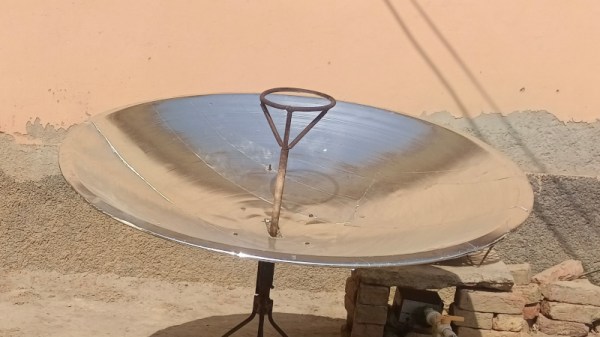
A pair of parabolic antennas are pressed into service as mirrors, catching and focusing the sun’s energy onto a cooking pot. Of course, solar cookers like this are nothing new, so what makes this one different is the in-depth analysis of its performance. This thing can cook!

One antenna is covered in square mirrors while the other is covered in sticky chrome-effect mirror sheeting. They’re described as sun tracking, but since we don’t see any mechanism we’re guessing the tracking is done by hand. The experiment takes place in Pakistan, so there’s a plentiful supply of sunlight that those of us in more northern climes can only dream of.

This hack is part of our 2026 Green Powered Challenge. You’ve just got time to get your own entry in, so get a move on!

KernelUNO, An OS For The Arduino Uno

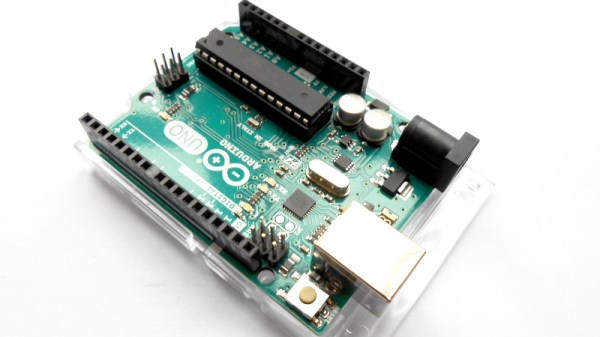
If you were to point to a single device responsible for much of Hackaday’s early success, it might be the Arduino Uno. The little board from an Italian university with its easy to use dev environment changed microcontroller hacking forever, and while it’s now very much old hat, its shadow lies long across single board computing.

Just in case you thought there wasn’t much more life in that old AVR in 2026, along comes [Arc1011], with KernelUNO, describing itself a “A lightweight RAM-based shell for Arduino UNO with filesystem simulation, hardware control, and interactive shell“. It’s an OS for your Arduino, of sorts.

For flashing it to your Uno, you get a shell with some familiar looking filesystem and system commands, the ability to write to files though no editor, and a set of commands to control pins. It’s extremely basic, but you can see the potential.

If we were to speculate as to how this might become more useful then perhaps it might involve a more permanent filesystem perhaps on a flash chip. If possible, the ability to run script files containing a list of commands would also be very nice. Though we are guessing that maybe the reason these features are not in place lies in the meager specifications of an ATmega328, for which we can’t blame the developer at all. Even if it can’t be extended in this way though, it’s still a cool project.

We have to go back quite a while, but this isn’t the first time something like this has appeared on these pages.

AI For The Skeptics: The Universal Function For Some Things Only

It’s a phrase we use a lot in our community, “Drink the Kool-Aid”, meaning becoming unreasonably infatuated with a dubious idea, technology, or company. It has its origins in 1960s psychedelia, but given that it’s popularly associated with the mass suicide of the followers of Jim Jones in Guyana, perhaps we should find something else. In the sense we use it though, it has been flowing liberally of late with respect to AI, and the hype surrounding it. This series has attempted to peer behind that hype, first by examining the motives behind all that metaphorical Kool-Aid drinking, and then by demonstrating a simple example where the technology does something useful that’s hard to do another way. In that last piece we touched upon perhaps the thing that Hackaday readers should find most interesting, we saw the LLM’s possibility as a universal API for useful functions.

It’s Not What An LLM Can Make, It’s What It Can Do

When we program, we use functions all the time. In most programming languages they are built into the language or they can be user-defined. They encapsulate a piece of code that does something, so it can be repeatedly called. Life without them on an 8-bit microcomputer was painful, with many GOTO statements required to make something similar happen. It’s no accident then that when looking at an LLM as a sentiment analysis tool in the previous article I used a function GetSentimentAnalysis(subject,text) to describe what I wanted to do. The LLM’s processing capacity was a good fit to my task in hand, so I used it as the engine behind my function, taking a piece of text and a subject, and returning an integer representing sentiment. The word “do” encapsulates the point of this article, that maybe the hype has got it wrong in being all about what an LLM can make. Instead it should be all about what it can do. The people thinking they’ve struck gold because they can churn out content slop or make it send emails are missing this. Continue reading “AI For The Skeptics: The Universal Function For Some Things Only”

2026 Green Powered Challenge: A Low Power Distraction Free Writing Tool

Distraction free writing tools are a reaction to the bells and whistles of the modern desktop computer, allowing the user to simply pick up the device and write. The etyper from [Quackieduckie] is one such example, packing an e-paper screen into a minimalist case.

These devices are most often made using a microcontroller such as an ESP32, so it’s interesting to note that this one uses a full-fat computer — if an Orange Pi Zero 2W can be described as “Full-fat”, anyway. There’s an Armbian image for it with the software pre-configured, and also mention of a Raspberry Pi port. It works with wired USB-C keyboards, and files can be retrieved via Bluetooth. It doesn’t look as though there’s a framebuffer or other more general driver for the display so it’s likely you won’t be using this as a general purpose machine, but maybe that’s not the point. We like it, though maybe it’s not a daily driver.

This hack is part of our 2026 Green Powered Challenge. You’ve just got time to get your own entry in, so get a move on!

Flipper Zero Transmits APRS With No Extra Parts

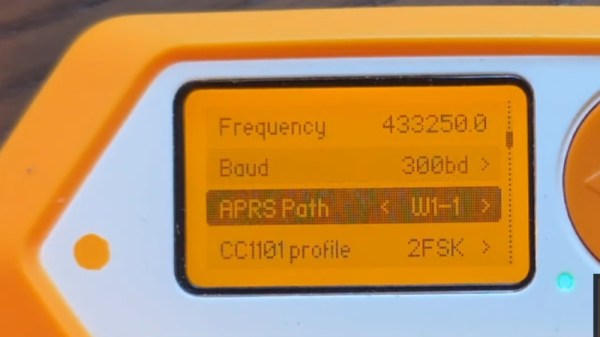
APRs is an amateur radio protocol allowing the exchange of short packets of data. It’s commonly used to transmit a GPS position, though it can find other applications. The Flipper Zero RF hacker’s multi tool normally needs to be hooked up to an external transmitter to do APRS, but [Richard YO3GND] has made his Flipper do the job without any external parts at all.

One of the the Flipper’s radios sits in the 435 MHz ISM band, meaning that the rest of the 70 cm amateur band is well within its reach. There only remains the subject of modulation, in which the Flipper’s FSK and APRS’s FM are similar on paper if not on a waterfall display. Some software hackery ensues, and the Flipper is an APRS station. Because of the FSK-as-FM modulation it won’t be decoded by everything, but you can’t argue with the bill of materials if you happen to own a Flipper. Check out the demo video below.

Meanwhile, should any readers with an amateur radio licence be interested, this certainly isn’t the first time we’ve brought you a minimalist APRS transceiver. Assuming that possession of a Flipper hasn’t got you into hot water, that is. Continue reading “Flipper Zero Transmits APRS With No Extra Parts”

2026 Green Powered Challenge: The Eternal Headphones

Noise cancelling headphones are a great way to insulate yourself from the bustle of the city, but due to their power requirements, continuous use means frequent recharging. [Alessandro Sgarzi] has an elegant and unique solution — powering the noise cancelling electronics by harvesting energy from the ambient noise of the city via a sheet of piezoelectric film.

This impressive feat is achieved using a LTC3588-1 power harvesting IC and a pair of supercapacitors, while an STM32L011K4T6 microcontroller processes the input from a MEMS microphone and feeds a low-power class D amplifier. This circuit consumes an astounding 1.7 nW, a power that a noisy city is amply able to supply. Audio meanwhile comes via a traditional 3.5 mm connector, which we are told is the cool kids’ choice nowadays anyway.

We like this project, and since it’s part of our 2026 Green Powered Challenge, it’s very much in the spirit of the thing. You’ve just got time to get your own entry in, so get a move on!

Hackaday Podcast Episode 366: DOOM On A Toaster, Music In LED Strips, And Old Drives In New Clothes

It’s the evening before publication, and a pair of Hackaday writers convene to record the week’s podcast. This week Elliot Williams is joined by Jenny List, and it’s a bumper episode!

Of course, a bit of Hackaday news makes the cut, as it’s time to make an entry in the Green Powered Challenge. Then we make the first of a couple of sojourns into AI, as we talk about the Linux kernel stance on AI code. In short: if you submit AI code you’re responsible for its bugs. Meanwhile out of this world, we look forward to a time when astronauts breathe oxygen from moon dust.

There are hacks aplenty for your enjoyment, starting with far more than you ever thought it was possible to know about  sound-reactive LED strips. Then we have among others a Mac on an ESP32 forming the UI for a weather monitor, Doom on a toaster, and a fascinating look at screw threads for plastic.

In the longer reads we have our colleague [Tom Nardi] finding Chinese people’s personal data on hard drives he bought in an electronics store, and an attempt to look at what an LLM can do that might be useful. Grab your headphones, and join us!

Download your own Podcast!

Continue reading “Hackaday Podcast Episode 366: DOOM On A Toaster, Music In LED Strips, And Old Drives In New Clothes”