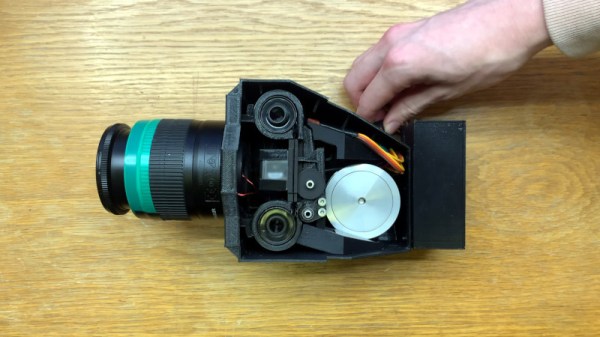
Printed Film Camera Gets 10 Seconds Out Of A 35mm Roll

When the British budget electronics brand Amstrad released their first budget VHS camcorder in the mid 1980s, they advertised it as making a filmmaker out of everyone. Now everyone truly is a filmmaker of sorts with their always-handy mobile phones, even though possessing a camera does not give you the talent of Steven Spielberg.

Such easy access to video hasn’t dimmed the allure of old-style film though, and there is a band of enthusiasts who seek out the older medium. [Joshua Bird] is one, and he’s produced a rather special 3D printed camera that can capture short videos on a standard roll of 35mm camera film. The downside is that, at the going rate, filming your masterpiece comes out to approximately $600 USD for each 10 minutes of footage. Better keep that dense exposition to a minimum.

The two most important mechanisms in a movie camera are the shutter and the film advance. The first is a disc that spins once a frame with an arc-shaped aperture over a section of it to let the light through, while the second is a hook that engages with the film once a frame after the shutter aperture has passed, to advance it to the next frame. Designing these to work in printed form is no easy task, and [Joshua] takes the reader through the various twists and turns in their development. Beyond that he takes a novel approach to a through-the-lens viewfinder, eschewing a split prism for an angled mirror on the shutter disk.

With each frame taking a fraction of the 35mm frame it’s clear from the video below that this doesn’t deliver the highest quality image. But that’s not the point of a device like this, above all it’s a working movie camera that he made himself. Since some of us have interests in that direction, dare we say we’re envious? Meanwhile, this isn’t the first 3D printed movie camera we’ve brought you.

Continue reading “Printed Film Camera Gets 10 Seconds Out Of A 35mm Roll”

This Gun Should Be Banned During The Month Of December

Do you play Whamageddon? It’s a pastime for the month of December, something like the Game, in which you lose when you are exposed to the 1984 Wham! Christmas classic, Last Christmas. Such is the pervasive nature of Christmas music at this time of year, it’s extremely difficult not to encounter a bit of unexpected Wham! during the month. At Tkkrlab hackerspace in the Netherlands, they evidently take their Whamageddon seriously. Seriously enough it seems, to weaponise it, because one of their members has created a Wham! gun.

Starting with a compressed-air kit gun (we think that’s a sealant cartridge gun, for Anglophones) because of its comedy plastic-firearm-like appearance, they’ve put in an AliExpress audio sample player module and a speaker. Add a suitably hazard-warning paint job, and Wham! Any unwary visitor might be ambushed and lose their Whamageddon game before they can even pop the cap on a refreshing bottle of Club-Mate.

It’s all a bit of seasonal fun, but deadly serious if the dulcet tones of George Michael are anathema to you. Don’t get mad, get equal, never visit a Dutch hackerspace in December without first fixing your noise cancelling headphones.

A Concealed Model Railway Rises To The Occasion

Occasional pieces of furniture serve little purpose other than to fill a space and maybe display a prized ornament or two. Who hasn’t got a relative with one two many small tables or display stands overfilling the available space!

If you visit [Peter Waldraff]’s house though, those pieces of furniture may not be what they seem. His display pedestal for example hides an N gauge railway layout that rises from the depths on a system of pulleys, with the action triggered by moving the vase displayed on its top. The vase conceals a magnet, which operates a reed switch that in turn controls the winch motor.

The layout is a loosely Batman themed train chase, with concentric spirals of track forming a continuous loop on which two trains run. There’s an ingenious arrangement with a reed switch and a piece of dead track to ensure that the chasing train is always held to ensure a gap between them. The landscaping is of a set of cliffs with a model of Wayne manor at the top, and there’s even a LED-lit Batmobile. One of the locomotives is recognisably based on a character from the Thomas the Tank Engine books.

All in all we like the ingenuity of this layout, but if you like it too then we’ve got a treat for you. Sharp-eyed readers will remember that this isn’t the first such project from Peter.

Continue reading “A Concealed Model Railway Rises To The Occasion”

A Straightforward Old-Fashioned DAC

With modern microcontrollers, the process of interfacing with the analogue world is easy. Simply enable the on-board DAC or ADC, and talk to the world. If you’ve ever done this with a slightly older microprocessor, you might have encountered the DAC and ADC as chips in their own right, but how about the earliest generation of microprocessors? In those days, if an analogue component was needed, the circuit which would later be integrated on chip would have to be made from scratch. So it is that [Florian Wilhelm Dirnberger] has built a very old-style 6-bit DAC, using a circuit that would have been familiar back in the early 1970s.

At its heart are a pair of 4007 triple CMOS inverters, which form the six bits driving a resistor ladder DAC. This is simply a chair of R… 2R resistors, relying on Ohm’s law for its operation. Each successive bit contributes twice the current to the output of its predecessor, and the 4007 simply provides a buffered supply for the bits.

It’s the simplest of DACs, if not the most capable. Back in the day a typical ADC might also use this circuit, feeding a comparator alongside the input voltage. The microprocessor would count through the digital values until the comparator output bit flipped, at which point it would take the counter value as the analogue measure. You may never need to build one when your microcontroller has one built in, but it’s useful to know how simple DACs and ADCs work.

If the subject interests you, we’ve had a look at DACs including resistor ladders used in audio.

A VM In An AI

AI knoweth everything, and as each new model breaks upon the world, it attracts a new crowd of experimenters. The new hotness is ChatGPT, and [Jonas Degrave] has turned his attention to it. By asking it to act as a Linux terminal, he discovered that he could gain access to a complete Linux virtual machine within the model’s synthetic imagination.

The AI’s first response was a prompt, so he of course first tried to list the files. Up came a list of directories, so the next step was to create a file and put some text in it. All of this resulted in a readable file, so there was some promise in this unexpected computing resource. But can it run code? Continue reading “A VM In An AI”

An Open Source PowerPC Notebook Edges Closer

Back in 2020, we reported on the effort to create a brand new open-source laptop platform using the PowerPC architecture. At the time they had big plans and a PCB design, and we’re very pleased to report that in the intervening two years they’ve progressed to the point of now having some real prototypes ready for testing.

Some might question why this should be necessary, after all there are plenty of laptops and more than one commonly available processor platform. But that’s to miss the point of open source hardware, that it’s as much about plurality as functionality. But if you’ve only encountered the PowerPC architecture in slightly older Macs and some game consoles, what’s the chip powering this device? The answer is, not one of those venerable chips, but the NXP T2080, a 1.8 GHz quad-core device that boasts a respectable power for a laptop.

There is of course many a hurdle still to be crossed between prototype and final device, but given the challenge of a functioning laptop it’s impressive for them to have reached this milestone at all. We look forward to seeing further iterations, and maybe, just maybe, a finished device one day. Our original coverage is here.

Power Over Ethernet, Explained

Most readers will be familiar with Ethernet networks in some form, in particular the Cat5 cables which may snake around the back of our benches. In a similar vein, we’ll have used power over Ethernet, or PoE, to power devices such as webcams. Buy a PoE router or switch, plug in a cable, and away you go! But what lies behind PoE, and how does it work? [Alan] has written a comprehensive guide, based on experience working with the technology.

What we get first is a run-down of the various topographies involved. Then [Alan] dives into the way a PoE port polls for a PoE device to be connected, identifies it, and ramps up the voltage. Explaining the various different circuits is particularly valuable. The final part of the show deals with the design of a PoE module, with a small switching power supply to give the required 48 volts.

All in all, this should be required reading for anyone who works with Ethernet, because it’s one of those things too often presented as something of a black box. If you’re thirsty for more, it’s a subject Hackaday have touched on too in the past.