The 555 Gives The CarolinaCon Badge Life

For the electronic badge enthusiast, these last two years have seen something of a famine. While the pandemic may not be over yet, we’re learning to live with it in 2022, and there’s the prospect of a flush of new badges even if not all events are in-person yet. First to reach us is the Carolinacon Online 2 badge, a fairly simple affair which naturally has us pleased as punch because it incorporates the only chip that’s guaranteed to get you through the semiconductor shortage, an NE555 timer. It’s got everything, a flashing LED, and, well, that’s it because with the best will in the world a 555 is no powerhouse on its own. As a memento and a way to support the event it fits the bill, but it’s fair to say that this is no electronic tour de force.

Carolinacon Online 2 launches on Friday 29th of April, and features a schedule of talks and a set of merch including the badge. If you’re thinking of previous Carolinacon badges, this event has always taken the simple-but-effective route. The version they produced in 2021 for example had a hidden message behind the silkscreen, revealed through clever placement of LEDs controlled by an ATtiny microcontroller.

Can You Help Solve The Mystery Of This 1930s TV?

84 years ago, a teenager built a TV set in a basement in Hammond, Indiana. The teen was a radio amateur, [John Anderson W9YEI], and since it was the late 1930s the set was a unique build — one of very few in existence built to catch one of the first experimental TV transmitters on air at the time, W9XZV in Chicago. We know about it because of its mention in a 1973 talk radio show, and because that gave a tantalizing description it’s caught the interest of [Bill Meara, N2CQR]. He’s tracking down whatever details he can find through a series of blog posts, and though he’s found a lot of fascinating stuff about early TV sets he’s making a plea for more. Any TV set in the late ’30s was worthy of note, so is there anyone else out there who has a story about this one?

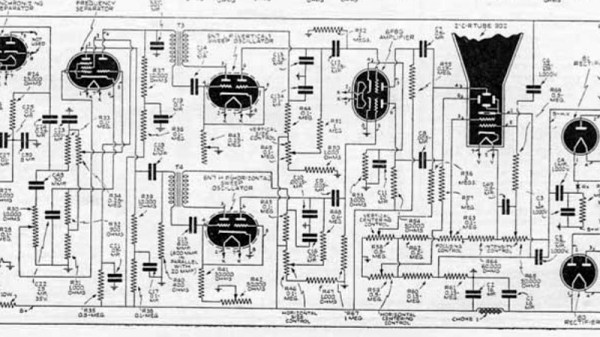
The set itself was described as an aluminium chassis with a tiny 1″ CRT, something which for a 1930s experimenter would have been an expensive and exotic part. He’s found details of a contemporary set published in a magazine, and looking at its circuit diagram we were immediately struck by how relatively simple the circuit of an electrostatically-deflected TV is. Its tuned radio frequency (TRF) radio front end is definitely archaic, but something that probably made some sense in 1939 when there was only a single channel to be received. We hope that [Bill] manages to turn up more information.

We’ve covered some early TV work here not so long ago, but if you fancy a go yourself it’s not yet too late to join the party.

Home Made Stirling Engines From Expedient Materials

Many of us have read about Stirling engines, engines which form mechanical heat pumps and derive motion from the expansion and contraction of a body of air. A very few readers may have built one, but for many they remain one of those projects we’d rather like to try but never quite have the inclination. The YouTube channel of [Geral Na PrĂ¡tica] should provide plenty of vicarious enjoyment then, with the construction of a range of Stirling engines from commonly available materials. We have Coke cans, PVC pipe, and nebuliser cartridges forming pistons and cylinders, with wire wool serving as a regenerative heat store. The latest video is below the break, an amazing 10-cylinder rotary device.

The Stirling engine is perhaps the quintessential example of a device whose time never came, never able to compete in power and efficiency with first steam engines and then internal combustion engines, it has over the years been subject to a variety of attempted revivals. Today it has appeared variously in solar power projects and in NASA’s hypothetical off-world power plants, and will no doubt continue to be promoted as an alternative energy conversion mechanism. We’ve featured many working model Stirling engines in our time and even done a longer investigation of them, but sadly we’ve yet to see a story involving a practical version.

Continue reading “Home Made Stirling Engines From Expedient Materials”

Ask Hackaday: Is It Time For Waste Heat And Cold Area Heating To Shine?

It’s difficult to escape the topic of energy supply at the moment, with the geopolitical situation surrounding the invasion of Ukraine leaving the natural gas supply to an entire continent in jeopardy. Fortunately we’re watching the green shoots of an early spring here in the Northern hemisphere so the worst of the winter weather is behind us, but industrial customers can take no such solace from the season and will have to weather whatever price hikes are to come. Every alternative idea for energy supply is on the table, and with the parallel imperative of decarbonising the economy this goes beyond the short term into a future without so much need to rely on gas.

The Future is Cloudy

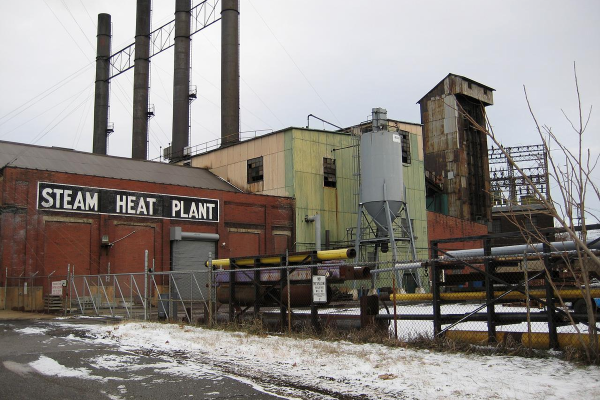
A district heating plant in Vienna, Austria.
A district heating plant in Vienna, Austria. Joadl, CC BY-SA 3.0 AT

A collaboration between a Finnish district heating network and Microsoft caught our eye because the location of a new data centre for the tech giant was chosen specifically to supply waste heat to the network, rather than releasing it to the environment. It’s not uncommon at all for European cities to use district heating networks but they are normally supplied by waste incinerators, boilers, or combined heat and power stations. The use of data centre waste heat is a novelty, as is in particular the siting of the data centre being dictated by the network.
Continue reading “Ask Hackaday: Is It Time For Waste Heat And Cold Area Heating To Shine?”

This Chariot Is Pulled By A Team Of Motorcycles

We’re fans of unusual forms of transport here, so when we saw an article featuring a home-made motorcycle chariot we knew we had to share it with you. You’ll probably notice it comes from the keyboard of our colleague [Lewin Day] as he moonlights writing for The Drive, and he’s brought along a lot of context and history to the dual-Husqvarna chariot built by [Jack Field].

The machine itself is a chariot in the ancient Roman fashion, a two-wheeled platform on which the rider stands and holds the reins. Instead of a team of horses though there is the aforementioned pair of Husqvarna motorcycles, and a pair of rods to their handlebars with throttle and brake controls take the place of reins. It’s fair to say that this might not be the least hazardous of conveyances, but it appears both rideable and controllable, and will appear at motorcycle shows. truth be told we’d like to have a go ourselves, but since it’s in Australia we think there’s little chance. Unexpectedly the motorcycle chariot is not a new idea, with their being used for full-scale races back in the 1930s. There’s a trip into that world with some exciting but lethal-looking racing action to view, but it seems that these machines exist here in 2022 mostly for show.

This isn’t the first machine operated by reins we’ve brought you, how about a rein-operated tractor?

This End Table Conceals A Close Encounter

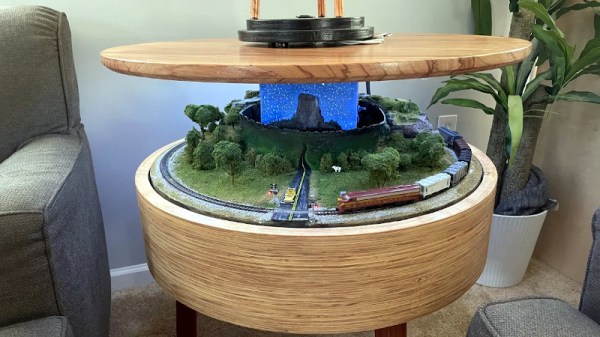
If you’re of a Certain Age, perhaps you had a train set as a child. An oval of track, a loco, and some rolling stock; it matters not whether it was Thomas the Tank Engine or a large express train — they were at the time a pretty cool toy. Move forward a few decades, and model railways have become either super-expensive room-filler layouts, or have sunk low as novelty Christmas ornaments, so that the basic loop of track is in dire need of rescue. Perhaps [Peter Waldraff] can help, with a beautifully-constructed N gauge circular layout concealed in an end table. Even better, when you examine it closely, it becomes apparent that this is no ordinary train set, it’s a scene from Close Encounters Of The Third Kind.

This is a project of two equally well-made parts, the piece of furniture and the train. The former is entirely scratch-built, with a cylindrical outside made from carefully cut rings of plywood and a sliding riser mechanism in the centre with a concrete counterweight. Slide the cylinder upwards, and the layout is revealed — a scratch-built hill in the centre of the ring of track and the lit-up underside of the UFO above it. As the train goes round the track, it even triggers a set of crossing lights and sounds for extra realism. The full story can be seen in the video below the break, and is well worth a watch.

We’ve covered more than one concealed model railway layout in the past, and it comes as no surprise when browsing to find that [Peter]’s work has featured here before.

Continue reading “This End Table Conceals A Close Encounter”

It’s Almost A New Raspberry Pi Compute Module 4. But Not Quite

We know that readers are familiar with the global chip shortage and its effects on product availability. The Raspberry Pi folks haven’t escaped its shadow, for even though they’ve managed to preserve availability of their RP2040 microcontroller, it’s fair to say that some of their flagship Linux-capable boards have been hard to find. All of this has had an unlikely effect in the form of a new Raspberry Pi, but unexpectedly it’s one which few end users are likely to get their hands on.

The Raspberry Pi Compute Module has been part of the range since the early days, and in its earlier versions took a SODIMM form factor. The last SODIMM Compute Module had a Pi 3 processor, and this unexpected new model is reported as having a very similar hardware specification but featuring the Pi 4 processor. It seems that the chip shortage has affected supplies of the earlier SoC, and to keep their many industrial customers for the SODIMM Compute Modules in business they’ve had to produce this upgrade. As yet it’s not surfaced for sale on its own and there’s a possibility it will stay only in the realm of industrial boards, but as the story develops there’s a Raspberry Pi forum topic about it for the latest and you can find the pertinent info in the video below the break.

Of course, the Compute Module of the moment remains the CM4 in its newer form factor, which we see as possibly the most exciting of all the Pi products of the moment. Meanwhile this is not the first custom industrial Raspberry Pi to be seen in the wild.

Continue reading “It’s Almost A New Raspberry Pi Compute Module 4. But Not Quite”