A FLIR One Pro Sees Again, Thanks To Some Nifty Soldering

The Flir One Pro is a thermal camera that attaches to a mobile phone with a USB-C plug. [Gigawatts] has one, and unfortunately managed to drop it, breaking the USB-C plug and rendering the device useless. The plug is separate from the main PCB, an assembly of its own with a flexible cable, but FLIR are not interested in supplying spares. What was the answer? Wire data lines into the device’s charging port, of course!

The One Pro has its own battery, and to avoid draining the phone it is charged through another USB connection, this time a socket. The data lines aren’t connected, which necessitated some very careful soldering of wire-wrap wire to an SMD package to fix. When completed and secured with glue the resulting camera works with a USB-C cable, and there are plans to mount a tripod thread receptacle in the space left by the USB-C plug.

It’s disappointing that Flir choose not to supply replacements for the USB-C plug assembly, seemingly they see the device as a throwaway piece of consumer electronics rather than the expensive instrument that it is. This modification should at lease allow some unfortunate One Pro owners to revive their dead cameras.

If you’re curious about the Flir One series of cameras, perhaps you’d like to read our review.

There’s Only One Way To Play A Star Wars Game

Most computer and console games have a variety of different control schemes depending on the controller peripheral the player has to hand. For Star Wars games the fight scenes may be playable with a gamepad, but perhaps that leaves a little to desired in the realism department.  In that case, [Leonardo Moreno] has the solution, in the form of a motion sensing light sabre for gaming via gesture control.

The first part of any light sabre project is the sabre itself, and for this he uses soft transparent PVC tubing. This might seem an insubstantial choice, but makes sense when the possibility of hitting an expensive television or gamers monitor with it is considered. Up the pipe goes a piece of LED strip, and onto it a hilt containing an Arduino and an MPU6050 gyroscope sensor. The physical controls come courtesy of a small analogue joystick and a trigger fashioned from a wooden clothes pin. The result may be a little rough and ready, but it’s undeniably a light sabre. Full instructions and software can be found at the link.

Light sabres have been a perennial build, but few have captured the original better than this laser based one.

SVG To Gerber, Without The Pain

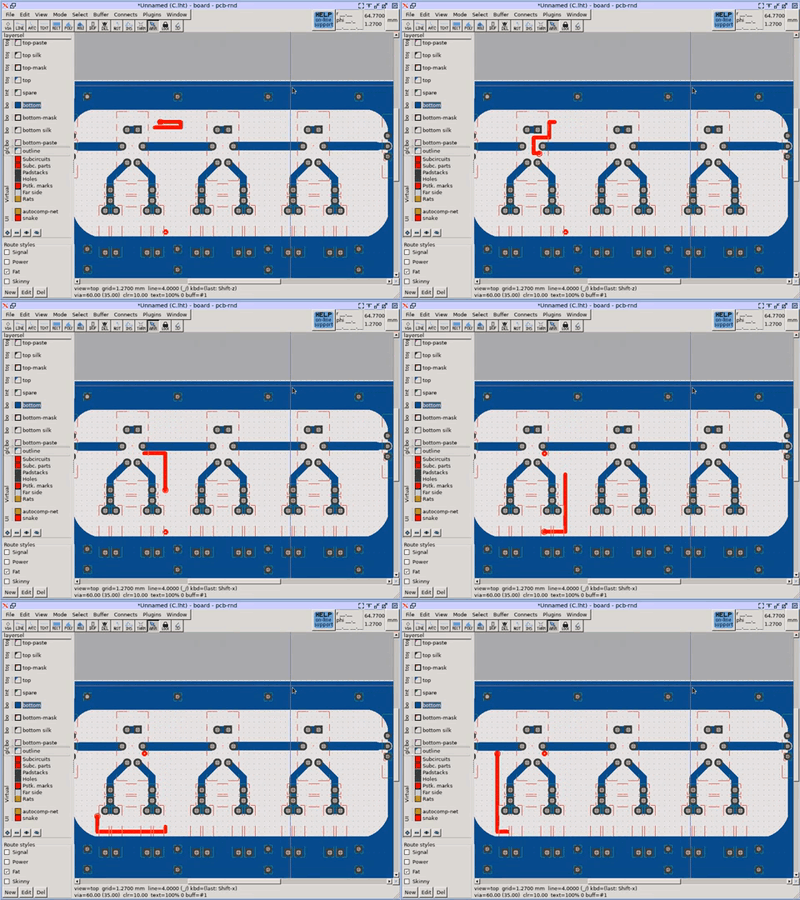
We’ve all marveled at the high quality PCB artwork used within the #BadgeLife and other communities to produce eye-catching designs, but those of you who have dipped your toes in the PCB artwork water will know that it’s hardly an easy process. [Jaseg] may have an answer though with gerbolyze, his software for processing SVG files into Gerber layers or KiCAD footprints.

His impetus for building it came from disappointing experience with other scripts that simply tried to rasterise any SVG they were given, or didn’t fully support the complete SVG spec. It’s designed for minimal preprocessing, allowing for as streamlined a process as possible. It includes a bitmap vectoriser to handle everything that can be thrown at it, and the GitHub repository has full instructions including examples of the output for different settings.

This is the latest in a long progression of enhancements to the PCB art process, but it’s not by any means the first time we’ve ventured down this path. In particular [Brian Benchoff] did a lot of work on the production of multi-colour PCBs.

Tim Hunkin Rides Again With The Secret Life Of Components

Long-time readers may remember one of the occasional Engineering Heroes series that focused on the British engineer, inventor and sometime TV presenter Tim Hunkin, known for his intricate creations, unusual arcade machines, and Secret Life Of Machines TV series’ from the years around 1990. It seems we’re now in for a fresh treat as he’s returning to our screens via YouTube with a new series. The Secret Life Of Components will be his attempt to pass on the accumulated knowledge of a long career that most of us would have given our eyeteeth for.

There will be eight videos in the series which launches on the 4th of March, and judging by the snippets in the preview video below the break he’ll be covering a wide range including springs, adhesives, chains, belts, switches, and much more. His entertaining style and beautifully built working models are guaranteed to make for some very good content while giving a unique view into the workshop of a true master of the craft.

As an appetiser it’s worth reading our profile of Tim Hunkin. It features a visit to his Novelty Automation arcade in London’s Holborn, which should be an essential stop for any travelling Hackaday reader finding themselves in that city.

Continue reading “Tim Hunkin Rides Again With The Secret Life Of Components”

A PCB For A Quarter?

As time has gone by and PCB assembly companies have reached further into the space of affordability for our community, the available types of board have multiplied. No longer are we limited to FR4 with a green solder mask, we can have all colours of the rainbow and a variety of substrates. The folks at BotFactory have taken things a step further with their PCB printer though, by printing a fully-functional PCB on a quarter.

As a base layer the printed five passes of insulation on the coin, before printing the traces. Holes are left in the insulation to create a form of via that connects to the coin. On the board is an ATtiny2313 microcontroller that flashes an LED, and on the reverse side of the coin is a CR2032 cell that’s secured with a set of bolts and washers. You can see it taking shape in the video below the break.

It’s true that an LED flasher isn’t exciting, and that this is a marketing stunt for BotFactory’s printer. But it’s an inventive one, and reminds us that with a bit of ingenuity anything can become a board. We’ve had our share over the years, and instantly springing to mind is this stretchable PCB.

Continue reading “A PCB For A Quarter?”

Exploring The Open Source That Really Goes Into A RISC-V Chip

It’s an exciting time in the world of microprocessors, as the long-held promise of devices with open-source RISC-V cores is coming to fruition. Finally we might be about to see open-source from the silicon to the user interface, or so  goes the optimistic promise. In fact the real story is considerably more complex than that, and it’s a topic [Andreas Speiss] explores in a video that looks at the issue with a wide lens.

He starts with the basics, looking at the various layers of a computer from the user level down to the instruction set architecture. It’s a watchable primer even for those familiar with the topic, and gives a full background to the emergence of RISC-V. He then takes Espressif’s ESP32-C3 as an example, and breaks down its open-source credentials. The ISA of the processor core is RISC-V with some extensions, but he makes the point that the core hardware itself can still be closed source even though it implements an open-source instruction set. His conclusion is that while a truly open-source RISC-V chip is entirely possible (as demonstrated with a cameo Superconference badge appearance), the importance of the RISC-V ISA is in its likely emergence as a heavyweight counterbalance to ARM’s dominance in the sector. Whether or not he is right can only be proved by time, but we can’t disagree that some competition is healthy.

Take a closer look at the ESP32-C3, with our hands-on review.

Continue reading “Exploring The Open Source That Really Goes Into A RISC-V Chip”

A Very Modern Tube Headphone Amplifier

Once a discarded relic, over the years the humble vacuum tube has been rehabilitated in the arena of specialist audio. There are plenty of tube amplifiers now being manufactured, with a popular choice being headphone amplifiers that use a tube as a gain stage followed by an op-amp as a buffer with a low impedance output. This forms the basis of [Ratti3]’s amplifier, but with the added interest of a battery supply and a Bluetooth connection.

The tube circuit is a very conventional anode follower using an EF95 pentode. This provides plenty of gain and of course that “valve sound” beloved of audio enthusiasts, but suffers from an output impedance too high to drive a set of headphones. An NE5532 steps in for the op-amp buffer role, making for a very simple circuit. Power comes from a set of four 18650 Lithium-Ion cells with associated charger and balance boards, while a little switching boost converter provides the 100 volt HT for the tubes.

We’ve visited this type of amplifier before with a similar but much more rough-around-the-edges Chinese version. That had some astonishingly cheap Chinese tubes, but if we’re seeking better components it’s interesting to know just who makes tubes these days.