Is It A Plasma Tweeter Or A Singing Tesla Coil?

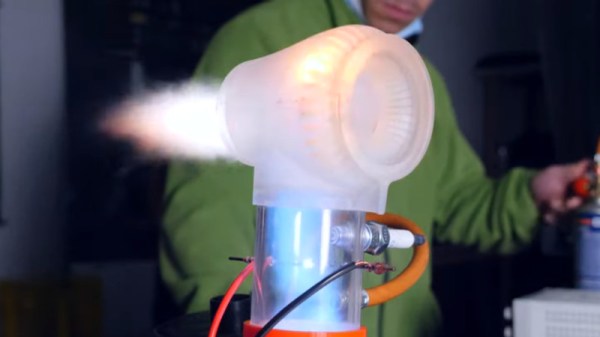
When our ears resolve spatial information, we do so at the higher treble frequencies rather than the bass. Thus when setting up your home cinema you can put the subwoofer almost anywhere, but the main speakers have to project a good image. The theoretical perfect tweeter for spatial audio is a zero mass point source, something that a traditional speaker doesn’t quite achieve, but to which audio engineers have come much closer with the plasma tweeter. This produces sound by modulating a small ball of plasma produced through high-voltage discharge, and it’s this effect that [mircemk] has recreated with his HF plasma tweeter.

A look at the circuit diagram and construction will probably elicit the response from most of you that it looks a lot like a Tesla coil, and in fact that’s exactly what it is without the usual large capacitor “hat” on top. This arrangement has been used for commercial plasma tweeters using both tubes and semiconductors, and differs somewhat from the singing Tesla coils you may have seen giving live performances in that it’s designed to maintain a consistent small volume of discharge rather than a spectacular lightning show to thrill an audience.

You can see it in operation in the video below the break, and it’s obvious that this is more of a benchtop demonstration than a final product with RF shielding, It’s not the most efficient of devices either, but given that audiophiles will stop at nothing in their pursuit of listening quality, we’d guess that’s a small price to pay. Efficiency can be improved with a flyback design, but for the ultimate in showing off how about a ring magnet to create the illusion of a plasma sheet?

Continue reading “Is It A Plasma Tweeter Or A Singing Tesla Coil?”

Do You SpaceAPI?

Here at Hackaday we’re privileged to be part of a global community of hackers, makers, technology enthusiasts and creative people whose collective works make our daily news feeds such a fascinating read. We encounter you all directly in the physical world rather the virtual one at the many events across the community, or at the various hackerspaces we visit on our travels. But how can we keep track of the world of hackerspaces when there are so many? Maybe SpaceAPI might hold the answer.

Continue reading “Do You SpaceAPI?”

Where Are All The Cheap X86 Single Board PCs?

If we were to think of a retrocomputer, the chances are we might have something from the classic 8-bit days or maybe a game console spring to mind. It’s almost a shock to see mundane desktop PCs of the DOS and Pentium era join them, but those machines now form an important way to play DOS and Windows 95 games which are unsuited to more modern operating systems. For those who wish to play the games on appropriate hardware without a grubby beige mini-tower and a huge CRT monitor, there’s even the option to buy one of these machines new: in the form of a much more svelte Pentium-based PC104 industrial PC.

Continue reading “Where Are All The Cheap X86 Single Board PCs?”

Review: Battery Spot Welders, Why You Should Buy A Proper Spot Welder

Making battery packs is a common pursuit in our community, involving spot-welding nickel strips to the terminals on individual cells. Many a pack has been made in this way, using reclaimed 18650 cells taken from discarded laptops. Commercial battery spot welders do a good job but have a huge inrush current and aren’t cheap, so it’s not uncommon to see improvised solutions such as rewound transformers taken out of microwave ovens. There’s another possibility though, in the form of cheap modules that promise the same results using a battery pack as a power supply.

With a love of putting the cheaper end of the global electronic marketplace through its paces for the entertainment of Hackaday readers I couldn’t resist, so I parted with £15 (about $20), for a “Mini Spot Welder”, and sat down to wait for the mailman to bring me the usual anonymous grey package.

Continue reading “Review: Battery Spot Welders, Why You Should Buy A Proper Spot Welder”

An Automatic Shop Vac Dust Extractor

Finding cheap or even free tools in the second-hand adverts is probably a common pursuit among Hackaday readers. Thus many of you will like [DuctTape Mechanic], have a row of old woodworking bench tools. The experience we share with him is a lack of dust extraction, which makes his adaption of a second-hand shop vac as an automatic dust extractor for his chop saw worth a watch. Take a look, we’ve put the video below the break!

The system hooks up a relay coil to the saw’s on/off switch, which controls the vacuum’s power. It’s thus not the most novel of hacks, but there are a few things to be aware of along the way and who among us doesn’t like watching a bit of gentle progress on a workshop project? The 120V current taken by both vacuum and saw sound excessive to those of us used to countries with 230V electricity, but the relay is chosen to easily serve that load. What’s nice about the automatic system is that being at the bench is not accompanied by the constant deafening noise of the shop vac, and save for when the saw is in use the bench is both dust-free and mercifully quiet.

If you happen to have a solid state relay in your parts bin, here’s another way to achieve a similar result.

Continue reading “An Automatic Shop Vac Dust Extractor”

Spam Caught, In A Tin Of Spam

We’ve seen many inventive enclosures for single board computers over the years: some are decorative, others utilitarian, and yet more tailored to an application. This one from [Daniel Hepper] manages to be all three: a practical enclosure for an OrangePi Zero LTS running the PiHole web spam filter, enclosed in a seemingly unopened Spam tin.

The inspiration came from an out-of-date tin of Spam, a souvenir that had lain around for a decade. It had a paper label that could be carefully removed, after which a Dremel was used to cut an aperture in the reverse of the tin. The tasty-but-expired luncheon meat could then be scooped out, and a 3D-printed carrier for the OrangePi slid in. The label reattached, it looks for all the world like an unopened tin of Spam with a PoE cable emerging from its behind.

The constant war on spam has seen many creative attempts at a solution from within our community, and it’s certain that PiHole is one of the better ways to deal with its web-borne variants. It is however not unknown for a Hackaday scribe to play a part in delivering it.

Alexa, Bring Me A Beer!

Voice controlled home assistants are the wonder of our age, once you’ve made peace with the privacy concerns of sharing the intimacies of your life with a data centre owned by a massive corporation, anyway. They provide a taste of how the future was supposed to be in those optimistic predictions of decades past: Alexa and Siri can crack jokes, control your lights, answer questions, tell you the news, and so much more.

But for all their electronic conversational perfection, your electronic pals can’t satisfy your most fundamental needs and bring you a beer. This is something [luisengineering] has fixed, an he’s provided the appropriate answer to the question “Alexa: bring mir ein bier!“. The video which we’ve also put below the break is in German with YouTube’s automatic closed captions if you want them, but we think you’ll be able to get the point of it if not all his jokes without needing to learn to speak a bit of Deutsch.

As he develops his beer-delivery system we begin to appreciate that what might seem to be a relatively straightforward task is anything but. He takes an off-the-shelf robot and gives it a beer-bottle grabber and ice hopper, but the path from fridge to sofa still needs a little work. The eventual solution involves a lot of trial and error, and a black line on the floor for the ‘bot to follow. Finally, his electronic friend can bring him a beer!

We like [Luis]’s entertaining presentational style, and the use of props as microphone stands. We’ll be keeping an eye out for what he does next, and you should too. Meanwhile it may not surprise you that this is not the first beer-delivery ‘bot we’ve brought you.

Continue reading “Alexa, Bring Me A Beer!”