A DIY 6.5-Digit Multimeter Is A Lesson In Clever Circuitry

A multimeter is an easy prospect, right? Back in the day you could make one fairly easily with a decent panel meter and a set of precision resistors, and now a digital one can be had for throwaway prices from China.

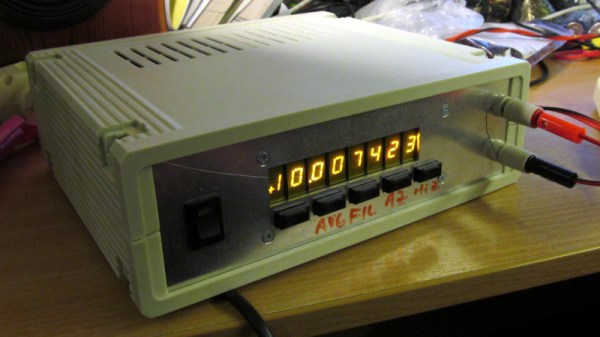
But what if instead of a cheap-and-cheerful bench instrument your needs extend to a high-precision device, a really good multimeter? It’s a path [jaromir.sukuba] has trodden with his 6.5 digit multimeter project, and along the way he’s offered us a fascinating window into their design that should be of interest to any electronic engineer even if they never intend to build a multimeter.

The range selection network of switches and resistors, microcontroller, and seven-segment displays are universal to a multimeter design, meaning that there is nothing too special about them in a high-precision instrument except that here he’s using an FPGA for timing.

Where the meat lies in this project is in the ADC and its associated voltage reference, and for that he takes a surprising turn. Instead of taking an off-the-shelf ADC part from one of the usual manufacturers, he’s created his ADC from scratch using op-amps, and to understand why that is the case he takes us on a journey into the world of dual-slope integrating ADCs. These circuits are very well explained in a 1989 HP journal article (PDF, page 8), and are a clever design that measures the time taken to charge and discharge a capacitor from the voltage to be measured and compares it to the same time from the reference voltage.

The beauty of it comes out in the HP article, that the mathematics of the charge/discharge cycle cancel out any effects of the analogue component values, allowing the much higher precision of the reference and the clock timing to dictate that of the reading. We look forward to seeing more of this project.

It’s surprising how few home-made multimeters we have on these pages, perhaps because of those cheap ones. Of the few we’ve had, perhaps this state-based Nixie one is most unusual.
Digital Caliper Talks For Accessibility, With This App

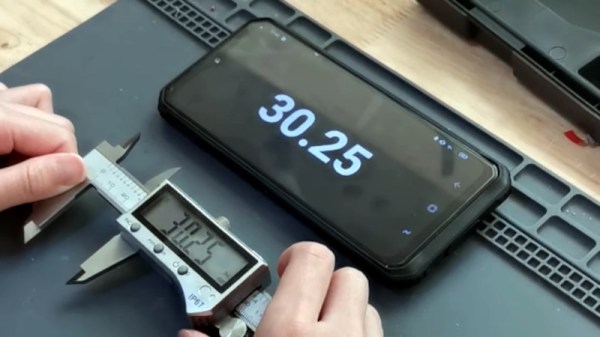
A good instrument stays with its owner for a lifetime, becoming part of their essential trusted toolkit to be consulted as a matter of habit. If you use a caliper to measure dimensions  you’ll know this, and a quick glance at its scale or digital display will be second nature. But if you aren’t fortunate enough to have the eyesight to see the caliper, then it’s off-limits, and that’s something [Naomi Wu] has addressed with her open-source accessible speaking caliper app. It’s an Android app that connects to digital calipers that contain Bluetooth connectivity, and as well as speaking aloud the caliper reading it also displays it in very large text on the device screen. As well as the source link from which you can build the app, it’s available for installation directly from the Google Play Store.

If you’re used to [Naomi] from her video tours of the electronics businesses in her native Shenzhen, her eye-catching wearable projects, or her exploits with an industrial CNC machine in her living room, you might be interested to know that aside from this app she’s been a long-time proponent of open-source in China. She was responsible among other projects for the Sino:bit educational computer board, which holds the distinction for her of having secured the first ever Chinese OSHWA certification.

You can see the caliper app in action below the break.

Continue reading “Digital Caliper Talks For Accessibility, With This App”

A Homebrew Radio, As All The Best Homebrew Radios Should Be

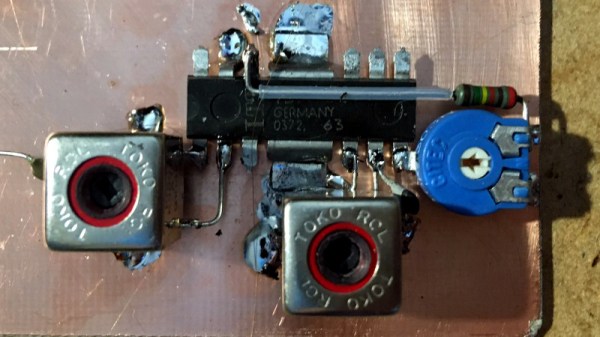
It started with an old TV sound chip, and some curiosity. The TDA1701 that [Philip Bragg] found in a box of junk is a complete FM IF strip and audio power amplifier from the golden age of analogue PAL televisions, and while it was designed for the 5.5 MHz or 6 MHz FM subcarrier of European broadcast TV, he found it worked rather well at the more usual 10.7 MHz of a radio receiver. There followed a long thread detailing the genesis bit-by-bit of a decent quality VHF radio receiver, built dead-bug-style on a piece of PCB material.

The TDA1701 was soon joined by a couple of stages of IF amplification with a ceramic filter, and then by several iterations of a JFET mixer. A varicap tuned MOSFET RF amplifier followed, and then a local oscillator. Finally it became a fully-functional FM radio, with probably far better performance than most commercial radios. He admits tuning is a little impractical though, with what appears to be a cermet preset potentiometer covering the entire band.

We suspect this project isn’t finished, and we hope he posts the schematic. But it doesn’t really matter if he doesn’t, because the value here isn’t in the design. Instead it lies in the joy of creating an ad-hoc radio just for the fun of it, and that’s something we completely understand.

We’ve covered a lot of radios in our time, and while it might be the first to feature a TV sound chip, it’s not the first built on bare PCB.

You’ve Got Rat!

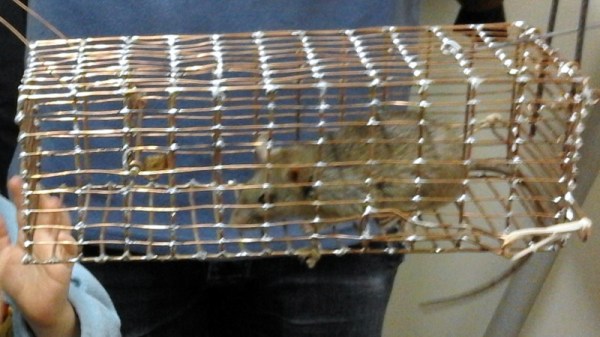
If you home has never been subject to a rodent invasion then you are fortunate. Our world is full of rats and mice, and despite the best efforts of humanity to keep them at bay it is inevitable that a few will find their way through. For [Marius Taciuc] this became a problem, as his traps needed constant checking to avoid the prospect of a festering rat carcass. His solution? A humane trap equipped with an ESP8266, that notifies him when the rodent is incarcerated.

The tech behind it is about as simple as it’s possible to get, the trap’s door activates a switch, that powers on an ESP8266 module. The ESP’s code simply wakes it up, connects to a wireless network, and sends a query to IFTTT with a call to a service that sends him an email alert. There’s no need to monitor any GPIO lines or have any code running to keep an eye on the trap, it’s all purely a function of the power switch.

The trap itself is interesting, in that it’s a home-made one constructed from soldered copper wire. Sadly there are few details of its construction, but you can see more of it including a live rat inside it, in the video below the break. And if making a trap catches your interest, we can help you there.

Continue reading “You’ve Got Rat!”

This Mini Soviet Micro Will Have Astounding Attention To Detail

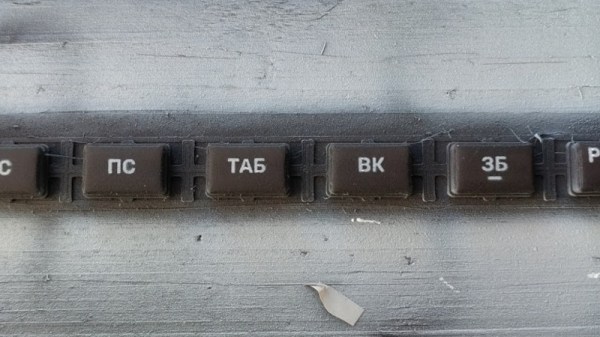
As the retro craze has gone mainstream, we’ve grown used to seeing “mini” versions of classic hardware, preloaded with a selection of games and ready for a wallow in nostalgia. Unfortunately for fans of the less well known platforms, the only devices to get the mini treatment so far are popular ones such as the Nintendo consoles, or the Commodore 64. This is something [Svofski] is aiming to change for one classic micro, by producing a mini version of the Soviet Vector-06c. And unlike the Commodore with its fake keyboard, this one will work in its entirety and have a fully-functional keyboard.

It’s a build that’s not finished yet. But in this case that’s no bad thing, because such is the extreme attention to detail that you’ll want to stick around and watch it unfold. The electronics will come courtesy of an FPGA recreation of the hardware, while the Vector’s unique keyboard is being recreated in miniature, with keycaps designed to fit a particular Alps switch. These are 3D-printed, painted, and then marked with their decals using stencils carefully etched from copper sheet. Even if you have no interest in the Vector-06c, these techniques could find a place in so many other projects.

The wonderfully ingenious and diverse world of Soviet technology has found its way onto these pages many times over the years, including at least one other microcomputer, and even a supercomputer. If your interests extend behind the Iron Curtain though, you might wish to read our colleague [Voja Antonic]’s account of hacking in Communist Yugoslavia.

CampZone 2020 Badge Literally Speaks To Us

The pandemic has left my usual calendar of events in shambles this year. Where I’d have expected to have spent a significant portion of my summer mingling with our wonderful and diverse community worldwide, instead I’m sitting at home cracking open a solitary Club-Mate and listening to muffled techno music while trying to imagine myself in a field somewhere alongside several thousand hackers.

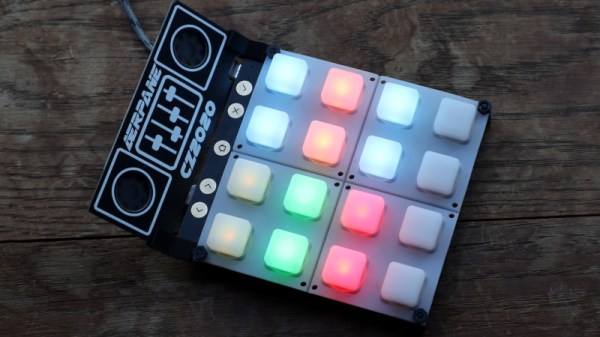
As a knock-on effect of the event cancellations there’s another thing missing this summer, the explosion of creativity in the world of electronic conference badges has faltered. Badges are thin on the ground this year, so the few that have made it to production are to be treasured as reminders that life goes on and there will be another golden summer of hacker camps in the future. This year, the CampZone 2020 badge was given its own voice and perform neat tricks like presenting a programming interface via WebUSB!

Continue reading “CampZone 2020 Badge Literally Speaks To Us”

Join Your Own Private LoRa Mesh Network

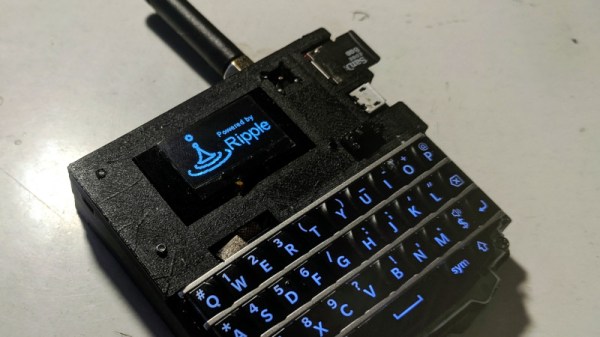
We are fortunate to live in an age surrounded by means of easy communication, and like never before we can have friends on the other side of the world as well as just down the road. But as many readers will know, this ease of communication comes at a price of sharing public and commercial infrastructure. To communicate with privacy and entirely off-grid remains an elusive prize, but it’s one pursued by Scott Powell with his LoRa QWERTY Messenger. This is a simple pager device that forms a LoRa mesh network with its peers, and passes encrypted messages to those in the same group.

At its heart is a LoRa ESP32 module with a small OLED display and a Blackberry QWERTY keyboard, and an SD card slot. The device’s identity is contained on an SD card, which gives ease of reconfiguration. It’s doubly useful, because it is also a complement to his already existing Ripple LoRa communication project, that uses a smartphone as the front end for a similar board.

We feel this type of secure distributed communication is an exciting application for LoRa, whether it be for kids playing at being spies or for more serious purposes. It’s certainly not the first such project we’ve featured.