Chopper And Chopper-Stabilised Amplifiers, What Are They All About Then?

One of my first jobs as a freshly minted graduate engineer involved the maintenance of a set of analogue chart recorders. They were museum pieces by the early 1990s: a motorized roll of graph paper across which a pen would traverse in proportion to the voltage on the input terminals. Inside was a simple servo, with a differential amplifier comparing the feedback via a potentiometer from the mechanism with the amplified input.

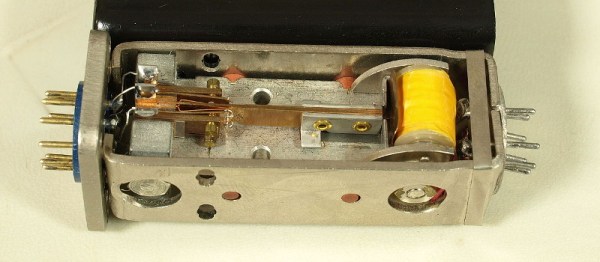
The recorders dated from the early 1960s, and internally their electronics were from the germanium transistor era: many Mullard OC-series devices, black-painted glass tubes with a red dot, and, unexpectedly, a large electromagnet connected to the 50 Hz AC supply with a reed switch through its middle, something completely new to an overconfident youngster who thought she knew everything.

What I’d stumbled upon was a chopper amplifier, a slightly ungainly and long superseded solution to the problem of DC amplification from the days before ubiquitous integrated circuit op-amps. We have become so used to DC amplifiers that just work, that we have forgotten that there was a time when such devices were an impossibility. The close matching of properties between devices on the same wafer allowed integrated circuit op-amps to achieve stable DC amplification in a way that the best attempts at the same circuits with discrete transistors had failed, but before they happened some desperate measures were called for. Continue reading “Chopper And Chopper-Stabilised Amplifiers, What Are They All About Then?”


Maplin For Sale

If you are an American Electronics Enthusiast of a Certain Age, you will have misty-eyed reminiscences of the days when every shopping mall had a Radio Shack store. If you are a Brit, the name that will bring similar reminiscences to those Radio Shack ones from your American friends is Maplin. They may be less important to our community than they once would have been so this is a story from the financial pages; it has been announced that the Maplin chain is for sale.

Maplin started life as a small mail-order company supplying electronic parts, grew to become a large mail order company selling electronic parts, and them proceeded to a nationwide chain of stores occupying a similar niche to the one Radio Shack fitted into prior to their demise. They still sell electronic components, multimeters, and tools, but the bulk of their floor space is devoted to the more techy and hobbyist end of mass-market consumer electronics. As the competition from online retailers has intensified  it is reported that the sale may be an attempt to avoid the company going into administration.

It’s fair to say that in our community they have something of a reputation of late for being not the cheapest source of parts, somewhere you go because you need something in a hurry rather than for a bargain. A friend of Hackaday remarked flippantly that the asking price for the company would be eleventy zillion pounds, which may provide some clues as to why custom hasn’t been so brisk. But for a period in the late 1970s through to the 1980s they were the only place for many of us to find  parts, and their iconic catalogues with spaceships on their covers could be bought from the nationwide WH Smith newsagent chain alongside home computers such as the ZX Spectrum. It’s sad to say this, but if they did find themselves on the rocks we’d be sorry to see the name disappear, but we probably wouldn’t miss them in 2018.

One of the things Maplin were known for back in the day were their range of kits. We’ve shown you at least one in the past, this I/O port for a Sinclair ZX81.

Footnote: Does anyone still have any of the early Maplin catalogues with the spaceships on the cover? Ours perished decades ago, but we’d love to borrow one for a Retrotechtacular piece.

Maplin store images: Betty Longbottom [CC BY-SA 2.0], and Futurilla [CC BY-SA 2.0].

You’ve Never Seen A Flipping Eyeball Like This One!

Inspired by some impressive work on textile flip-bit displays, and with creative steampunk outfits to create for Christmas, [Richard Sewell] had the idea for a flippable magnetic eye in the manner of a flip-dot display. These devices are bistable mechanical displays in which a magnet is suspended above a coil of wire, and “flipped” in orientation under the influence of a magnetic field from the coil.

In [Richard]’s case the eyeball was provided by a magnetic bead with a suitable paint job, and the coil was a hand-wound affair with some extremely neat lacing to keep it all in place. The coil requires about 200 mA to ensure the eye flips, and the job of driving it is performed by a Digispark ATTiny85 board with an LM293 dual H-bridge driver upon which the two bridges are wired in parallel. The whole is mounted in the centre of a charity shop brooch that has been heat-treated to give a suitable aesthetic.

You can see the eyeball in all its glory in the two videos below the break, and should you be curious you can also read our write-up of the original pieces from [Irene Posch] that inspired it.

Continue reading “You’ve Never Seen A Flipping Eyeball Like This One!”

A Robot For Everything: Now Even Zippers

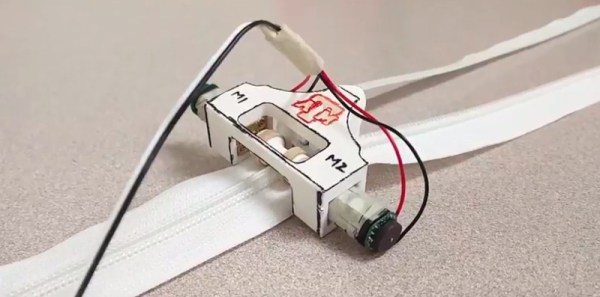
Sometimes we see projects that are so clever while being remarkably simple, that we can’t help thinking: Why didn’t I think of that! Take [Haresh Karnan]’s zipper robot, for example. It’s a well-designed 3D-printed shell with two geared motors for traction, that can both undo and do up zippers. Behind that seemingly simple design probably lies a huge iterative design process to arrive at a shape perfect for the job, but the end result is so elegant that even [Haresh]’s write-up and Hackaday.io page for the project are short and to the point. Download the STL file, snap in the motors, apply to a zipper, and away you go. He suggests rubber bands as a traction aid, but that’s pretty much it.

The results can be seen in the video below the break. While we might be tempted to make jokes about the terminally lazy using this device to save unnecessary labour after a toilet break, we can see that it might have a real application. If you have any friends with restricted dexterity you will understand how having an automated helper with such a fiddly task as a zipper could be an extremely useful accessibility aid.

While we’re on the subject of zippers, if you missed it a few weeks ago here’s our in-depth look at their story.

Continue reading “A Robot For Everything: Now Even Zippers”

A Two Tapes Turing Machine

Though as with so many independent inventors the origins of computing can be said to have been arrived at through the work of many people, Alan Turing is certainly one of the foundational figures in computer science. His Turing machine was a thought-experiment computing device in which a program performs operations upon symbols printed on an infinite strip of tape, and can in theory calculate anything that any computer can.

In practice, we do not use Turing machines as our everyday computing platforms. A machine designed as an academic abstract exercise is not designed for efficiency. But that won’t stop Hackaday, and to prove that point [Olivier Bailleux] has done just that using readily available electronic components. His twin-tape Turing machine is presented on a large PCB, and is shown in the video below the break computing the first few numbers of the Fibonacci sequence.

The schematic is available as a PDF, and mostly comprises of 74-series logic chips with the tape contents being displayed as two rows of LEDs. The program is expressed as a pluggable diode matrix, but in a particularly neat manner he has used LEDs instead of traditional diodes, allowing us to see each instruction as it is accessed. The whole is a fascinating item for anyone wishing to learn about Turing machines, though we wish [Olivier] had given  us a little more information in his write-up.

That fascination with Turing machines has manifested itself in numerous builds here over the years. Just a small selection are one using 3D printing, another using Lego, and a third using ball bearings. And of course, if you’d like instant gratification, take a look at the one Google put in one of their doodles for Turing’s 100th anniversary.

Continue reading “A Two Tapes Turing Machine”

France Proposes Software Security Liability For Manufacturers, Open Source As Support Ends

It sometimes seems as though barely a week can go by without yet another major software-related hardware vulnerability story. As manufacturers grapple with the demands of no longer building simple appliances but instead supplying them containing software that may expose itself to the world over the Internet, we see devices shipped with insecure firmware and little care for its support or updating after the sale.

The French government have a proposal to address this problem that may be of interest to our community, to make manufacturers liable for the security of a product while it is on the market, and with the possibility of requiring its software to be made open-source at end-of-life. In the first instance it can only be a good thing for device security to be put at the top of a manufacturer’s agenda, and in the second the ready availability of source code would present reverse engineers with a bonanza.

It’s worth making the point that this is a strategy document, what it contains are only proposals and not laws. As a 166 page French-language PDF it’s a long read for any Francophones among you and contains many other aspects of the French take on cybersecurity. But it’s important, because it shows the likely direction that France intends to take on this issue within the EU. At an EU level this could then represent a globally significant move that would affect products sold far and wide.

What do we expect to happen in reality though? It would be nice to think that security holes in consumer devices would be neutralised overnight and then we’d have source code for a load of devices, but we’d reluctantly have to say we’ll believe it when we see it. It is more likely that manufacturers will fight it tooth and nail, and given some recent stories about devices being bricked by software updates at the end of support we could even see many of them willingly consigning their products to the e-waste bins rather than complying. We’d love to be proven wrong, but perhaps we’re too used to such stories. Either way this will be an interesting story to watch, and we’ll keep you posted.

Merci beaucoup [Sebastien] for the invaluable French-language help.

French flag: Wox-globe-trotter [Public domain].

OBD-Sniffing A Caddy PHEV

The Cadillac ELR is a plug-in hybrid car with a bit of class, it has the beating heart of a Chevy Volt in a nice coupé body with some up-market styling and a nice interior. Since it wasn’t on the market for long and some consumers are still wary of cars with electric motors, it also represents something of a sweet spot: according to [Andrew Rossignol] you can pick them up for less outlay than you might imagine. He bought one, and being an inquisitive soul decided to probe its secrets through its OBD-II ports.

OBD-II sniffing is nothing especially new, but his write-up provides an interesting run-down of the methodology used to identify the different proprietary pieces of data that it makes available. His Python script attempted to parse the stream as though it were multi-byte words of different lengths, plotting its results as graphs, It was then a straightforward process of identifying the graphs by eye that contained useful data and rejecting those that were obviously garbage. He was able to pick out the figures in which he was interested, and write an interface for his little Sony VAIO UX to display them on the move.

We’ve covered OBD hacks too numerous to mention over the years, but perhaps you’d like to read our history of the standard.