Building A Website-Controlled Christmas Tree

Back in the day, Christmas lights were simple strings of filament bulbs, and if you really splashed out, you could get some that flashed. These days, we expect a lot more capability out of our blinking decorations. [JT] has put together a rather nifty website-controlled setup for his own tree.

The setup is a little different than builds you may be used to. The website runs on a cloud-hosted virtual machine on Digital Ocean, rather than running locally. This allows anyone on the web to visit the site, and use the interface to control the lights on the Christmas tree. An image of the tree is used as the interface, and allows users to set the color of each individual LED on the tree. The LEDs themselves are driven from an NodeMCU ESP8266, which uses its WiFi connection to query the website itself and grab the color data as needed. [JT] has also included a secondary interface, where the chat of the Youtube livestream can be used to control the LEDs, too.

It’s a build that’s a touch more complicated than most typical online LED blinkers, but one that teaches useful skills in interfacing on the web and using virtual machines. We’ve seen other builds in this genre too; even some that are reactive to “Christmas fever” itself. Video after the break.

Continue reading “Building A Website-Controlled Christmas Tree”

Simple AC Current Detector Built On A 9 Volt

When working around mains voltages, it can be useful to know whether a given circuit is live or not. While this can be done by direct connection with a multimeter, non-contact methods are available too. A great example is this simple wireless AC current detector from [NEW PEW].

The circuit is a simple one, and a classic. The spring from a ballpoint pen is soldered to the base of a BC547 transistor, and when held close enough to a conductor carrying AC power, a current is induced in the spring which is sufficient to turn the transistor on. The transistor then switches on a second BC547, which lights an LED. The whole circuit is built on top of a battery clip so it can be run straight from the top of a standard 9 volt battery.

It’s a circuit you’ll find all over the place, even built into many modern multimeters. It can be particularly useful to help avoid drilling through mains wires embedded in the walls of your home. Of course, if you’d like even more information about what’s lurking within your walls, consider this capacitive imaging hack. Video after the break.

Continue reading “Simple AC Current Detector Built On A 9 Volt”

How To Get Into Cars: Drifting Mods

Drifting is a hugely popular motorsport unlike any other, focusing on style and getting sideways rather than the pursuit of the fastest time between two points. It’s a challenge that places great demands on car and driver, and proper attention to setup to truly succeed. Here’s a guide to get your first drift build coming together.

Getting Sideways (And Back Again)

Drift cars are specialised beasts, and like any motorsport discipline, the demands of the sport shape the vehicle to suit. If you’re looking to drift, you’ll want to choose a project car with a front-engined, rear-wheel drive layout. While it’s somewhat possible to drift with other layouts, the act of kicking out the tail and holding a slide at speed is best achieved with the handling characteristics of such a vehicle. It all comes down to weight transfer and breaking traction at will. Of course, over the years, certain cars have become expensive on the second-hand market due to their drift prowess, so you may have to get creative if your first choice isn’t available at your budget. It pays to talk to the drifters down at your local track to get an idea of which cars in your area are the best bet for a drift build. Once you’ve got yourself a car, you can get down to installing mods!

Continue reading “How To Get Into Cars: Drifting Mods”

Active Aero For A Radio Control Car

Motorsport became obsessed with aerodynamics in the middle of the 20th century. Moving on from simple streamlined shapes, designers aimed to generate downforce with wing elements in order to get more grip between the tyres and the track. This culminated in the development of active aero, where wing elements are controlled by actuators to adjust the downforce as needed for maximum grip and minimum drag. Recently, [Engineering After Hours] decided to implement the technology on his Traxxas RC car.

The system consists of a simple multi-element front wing, chosen for its good trade-off between downforce and drag. The wing is mounted to a servo, which varies the angle of attack as the car’s pitch changes, as detected by a gyroscope. As the car pitches up during acceleration, the angle of the wing is increased to generate more downforce, keeping the nose planted.

The basic concept is sound, though as always, significant issues present themselves in the implementation. Small bumps cause the system to over-react, folding the wing under the front wheels. Additionally, the greater front downforce caused over-steer, leading to the install of a rear wing as well for better aero balance.

Regardless of some hurdles along the way, it’s clear the system has potential. We look forward to the next build from [Engineering After Hours], which promises to mimic the fan cars of the 70s and 80s. If you’re looking to improve aero on your full-size car, we’ve got a guide to that too. Video after the break.

Continue reading “Active Aero For A Radio Control Car”

Blackboard Becomes Tidy Pen Plotter

Printers are all well and good, but they’re generally limited to smaller paper sizes and use expensive ink. If you instead want to produce art on a larger scale, a plotter can be a great way to go. [tuenhidiy] built a tidy example using an old blackboard as a base.

These days, such a build is quite easily approachable, thanks to the broad DIY CNC and 3D printing communities. The plotter consists of a pair of stepper motors, driven by an off-the-shelf RAMPS 1.4 controller and an Arduino Mega 2560. The motors are mounted at the top corners of the blackboard, and move the pen holder via a pair of toothed belts, counter-weighted for stability. The pen holder itself mounts a simple permanent marker, and uses a servo to push the holder away from the paper for retraction, rather than moving the pen itself. Control of the system is via the Makelangelo firmware, an open-source effort capable of driving a wide variety of CNC motion systems.

The final result is a simple plotter using readily available parts that can reliably plot large graphics on a piece of A1 paper. We’re particularly impressed by the clean, continuous lines it produces – testament to a sound mechanical design.

We see plenty of plotters around these parts; even rotary types that can draw on curves. Video after the break.

Continue reading “Blackboard Becomes Tidy Pen Plotter”

Domino Layer Lets You Focus On Toppling

Knocking dominoes down is a fun pastime for a rainy afternoon, but setting them all up can be a drag. Thankfully, [Lewis] of [DIY Machines] has built a helpful machine to do the job for you, letting you focus on the fun part instead!

The machine is run by an Arduino Uno, that can be pre-programmed with a layout or controlled over Bluetooth in real time. It uses a geared-down DC motor to drive around a smooth surface, with a servo for steering. A second servo is used to turn a carousel loaded with up to 130 dominoes, allowing the machine to lay long runs without needing a refill. It’s designed to be easy to change so multiple carousels can be printed to quickly run courses of extended lengths.

The build is a great example of a machine capable of doing a tricky task with ease, thanks to 3D printing and smart design. We’re particularly impressed with the simple domino transport mechanism integrated into the drive system without requiring extra motors or servos. It’s not the first domino layer we’ve seen, either. Video after the break.

Continue reading “Domino Layer Lets You Focus On Toppling”

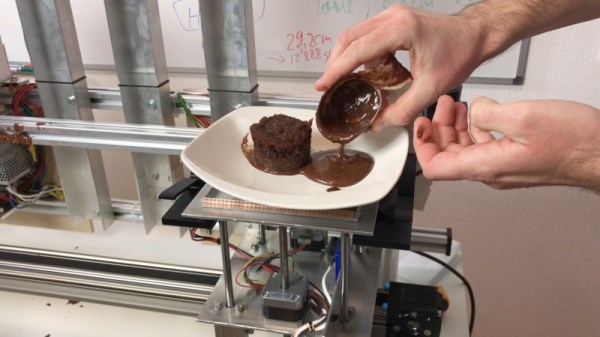
Cupcake Machine Makes Tasty, If Weird, Creations

Baking cupcakes is a fun pastime, and one which we imagine many people took up in this year of quarantine and lockdown. However, anything a human can do, a machine can certainly make an attempt at, as [Skyentific] shows with this roboticized cupcake machine.

The build will be familiar to anyone who has worked with 3D printers or DIY CNC machines before. A series of stepper motors move a carriage carrying a regulation-sized patty pan. This is filled with dough from a tube, squirted out by a modified electric caulking gun. The carriage then transports it to a small microwave chamber of custom construction. After a minute or so of cooking, it’s then removed, and topping is applied from a further two caulking guns. An Arduino is in charge of the operation, running the show with some stepper drivers, limit switches, and a bank of relays.

The final product isn’t the prettiest cupcake we’ve ever seen, but it’s perfectly edible. We can imagine with some small modifications the device could probably cook batches of four at a time without too much trouble. We’ve seen other baking robots before, too. Video after the break.

Continue reading “Cupcake Machine Makes Tasty, If Weird, Creations”