Pickaxe Controller Is Great For Minecraft, Just Aim Carefully

Minecraft started out as a lovable indie game, and became an unstoppable billion-dollar juggernaut in a remarkably quick fashion. Over time, it’s become a favorite among modders and those that seek to explore what’s possible with the game. [Eric] decided that the game could be more immersive, and built this awesome pickaxe controller.

The controller is built around an off-the-shelf Minecraft pickaxe toy; a popular piece of merchandise given the tool’s importance in the game. [Eric] added an Arduino, an accelerometer, and buttons. This lets the controller act as a mouse, allowing the user to control the camera by moving the pickaxe. The buttons unlock further functionality, with the red button allowing the user to mine by swinging the axe. Reportedly this is a lot of fun, albeit tiring in long sessions. Other features are still controlled by the keyboard, such as movement and accessing inventory screens. We’d love to try it out; carving out a tunnel block by block would be quite satisfying after all the exertion!

[Eric] is actually giving the controller away to a lucky subscriber, so head over to the Youtube video if you’d like a shot to own the nifty pickaxe. We’ve seen other advanced Minecraft controllers before, too. Video after the break.

Continue reading “Pickaxe Controller Is Great For Minecraft, Just Aim Carefully”
3D Printed Tools For Quick Press Brake Jobs

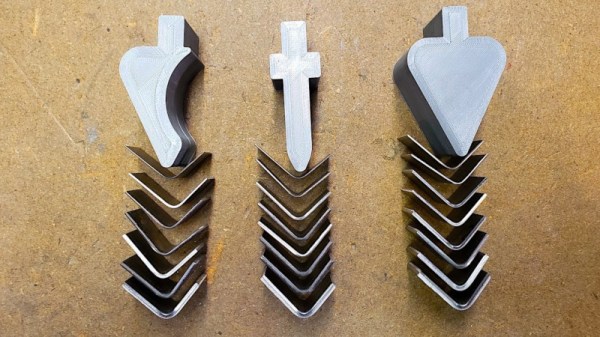
Press brakes are a workshop staple when working with sheet metal. They’re ideal for executing accurate and repeatable bends over and over again. Typically, they’re fitted with steel tooling that can hold up to thousands of press cycles. However, such tooling is expensive, and time consuming to produce. [Anthony] recently had a job come through the shop that required a unique internal radius. Rather than rush out and buy tooling, he decided to 3D print his own instead!

The press brake tools were printed on a standard Prusa i3, using regular PLA filament. There’s nothing particularly special in the process, with the prints using 12 perimeters and 20% infill. Despite being made of plastic, the tools held up surprisingly well. In testing, the parts were able to bend up to 3.4 mm steel, undergoing several cycles without major visible wear. [Anthony] also experimented with gooseneck parts, which, while less robust, make it easy to accommodate more complex sheet metal parts.

3D printing is a great way to produce custom press tooling, and can be done far more cheaply and quickly than producing traditional steel tooling. While it’s unlikely to be useful for long production runs, for short runs that need custom geometry, it’s a handy technique. We’ve even seen 3D printed punch-and-die sets, too. Video after the break.

Continue reading “3D Printed Tools For Quick Press Brake Jobs”

Resurrecting A Recalcitrant SE/30

The Macintosh SE/30 is well regarded as the choice pick of the compact Mac line. Packing a powerful 68030 processor and with the capability to use up to 128 MB of RAM, it brought serious grunt to bear in a tight form factor. With these machines now over 30 years old, they’re often quite worse for wear. [This Does Not Compute] had his work cut out for him getting this particular example up and running. (Video embedded below.)

With the computer displaying the famous SimasiMac screen on startup, it was sadly non-functional when switched on. [This Does Not Compute] went through all the usual attempts to fix this – washing the board, recapping, checking potentially broken traces – all to no avail. After much consternation, the fix was not so hard – a fresh set of RAM helped cure what ailed the Mac.

With the Mac now showing some signs of life, there was more to do. The floppy drive refused to boot, ejecting disks and failing to read anything. A head cleaning proved helpful, but not enough. It was only when the head motor’s worm gear was relubricated, enabling it to seek properly, that the drive was successfully able to boot. The hard drive proved resistant of any attempts to get it to work, so was replaced with a SCSI2SD instead.

With the suite of repairs completed, the SE/30 was once again up and running. With a little elbow grease, the case and keyboard turned up a treat, too. [This Does Not Compute] now has one of the all-time classic Macs in excellent condition.

We’ve seen some great restorations over the past – this Commodore 64 full of dirt was a particularly compelling story. Video after the break.

Continue reading “Resurrecting A Recalcitrant SE/30”

Ask Hackaday: What’s The Perfect Hacker Smart Watch?

Since Dick Tracy all the way back in ’46, smart watches have captured the public imagination. After several false starts, the technology has gone through a renaissance in the last 10 years or so. For the average consumer, there’s been a proliferation of hardware in the marketplace, with scores of different models to choose from. For the hackers, however, pickings are a little more slim. So what is the best smart watch for the tinkerers among us? Continue reading “Ask Hackaday: What’s The Perfect Hacker Smart Watch?”

Tracking Ants And Zapping Them With Lasers

Thanks to the wonders of neural networks and machine learning algorithms, it’s now possible to do things that were once thought to be inordinately difficult to achieve with computers. It’s a combination of the right techniques and piles of computing power that make such feats doable, and [Robert Bond’s] ant zapping project is a great example.

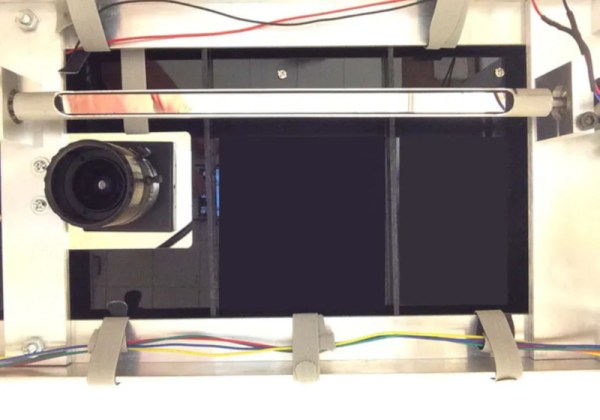
The project is based around an NVIDIA Jetson TK1, a system that brings the processing power of a modern GPU to an embedded platform. It’s fitted with a USB camera, that is used to scan its field of view for ants. Once detected, thanks to a little OpenCV magic, the coordinates of the insect are passed to the laser system. Twin stepper motors are used to spin mirrors that direct the light from a 5 mW red laser, which is shined on the target. If you’re thinking of working on something like this we highly recommend using galvos to direct the laser.

Such a system could readily vaporize ants if fitted with a more powerful laser, but [Robert] decided to avoid this for safety reasons. Plus, the smell wouldn’t be great, and nobody wants charred insect residue all over the kitchen floor anyway. We’ve seen AIs do similar work, too – like detecting naughty cats for security reasons.

Continue reading “Tracking Ants And Zapping Them With Lasers”

How To Get Started With Fadecandy And LEDs

The internet is awash with millions of stunning LED projects, and for that, we are all very thankful. For those outside the hacker/maker matrix, it can be difficult to know how to approach such a build. Never fear, for [Amy Goodchild] has put together a beginner’s guide to building pretty glowables, using Fadecandy and Processing.

Fadecandy is a platform specifically designed to drive WS2812B LEDs for artistic purposes. This allows users to focus on the visual side of things without getting bogged down with the hassle of selecting the right microcontroller and choosing the applicable libraries. It works great in combination with Processing, a piece of software designed for coders experimenting with visual arts. Through a USB link, any graphics drawn by processing can be mapped to the LEDs attached to the Fadecandy controller.

[Amy] does a great job of explaining how to do everything required, from purchasing the right equipment, through wiring everything up, and then getting it all humming along with the correct software. If you’ve ever wanted to build a big flashy project with a ton of LEDs, this would be a great place to start.

We’ve seen Fadecandy put to good use before, too. Video after the break.

Continue reading “How To Get Started With Fadecandy And LEDs”

Mt Everest Lamp Recreates The Famous Peak

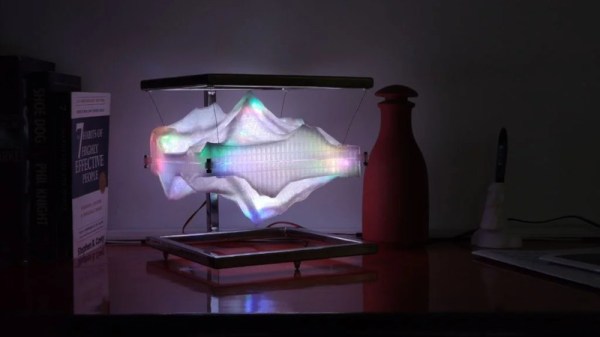
Anyone who has travelled to distant mountain peaks has marvelled at the beauty of the natural, rugged terrain. [apoorvas15] is no different, and created a lamp that celebrated the awe of the largest mountain on earth.

When it comes to reproducing an accurate geometrical representation of the landscape, the easiest approach is to reach for some variety of CNC machinery. Here, a 3D printer is used to create a translucent shell replicating the mountain. A reverse shell is then laced on the bottom to create an effect akin to that of a reflection in a lake. The assembly was fitted with WS2812 LEDs run by an Arduino Nano, and suspended from a stainless steel frame for an attractive floating look.

It’s a great piece, one that would look suitably impressive on any desk or coffee table. The 3D printer has served many makers well when it comes to producing attractive home lighting. We’ve seen many great builds — from the 8-bit to the floral-inspired. Video after the break.

Continue reading “Mt Everest Lamp Recreates The Famous Peak”