Even Joke Torpedoes Are Pretty Hard To Get Right

It’s rare that makers get involved in out-and-out munition production. It’s dangerous, and usually frowned upon by local authorities. That said, it can be fun to experiment around, and [Ivan] does just that, attempting to launch a 3D-printed torpedo from a kayak. The build may have been done as a marketing exercise, but it raises some interesting questions about naval engineering.

The first revision consists of a 3D-printed hull, containing a rubber-band powered propeller. A soda bottle filled with compressed air is then used as a warhead, fitted with a contact fuse to release its charge on impact. Unfortunately, initial tests were underwhelming, with the rubber band mechanism failing to provide any real forward propulsion.

A trip back to the drawing board was due, and the design was revived with a brushless motor powerplant instead. This allowed the torpedo to trawl, albeit slowly, through the water. It also proved that the compressed air “warhead” could successfully discharge, albeit with less of a bang, more of a whimper.

The build, while undertaken for the sake of fun, does highlight some of the engineering challenges inherent in building a working torpedo. There were issues with buoyancy, as well as providing the torpedo with enough power to move quickly in the water. On top of this, the matter of guidance is also an important one. We’d love to know how the Hackaday commentariat would go about solving these issues when undertaking their own build – let us know down below. We’ve seen others tackle similar builds before, too. Video after the break.

Continue reading “Even Joke Torpedoes Are Pretty Hard To Get Right”
Subaru Coils Make A Great HV Power Source

High-voltage experimenters are a unique breed. They’re particularly adept at scrounging for parts in all kinds of places, and identifying how to put all manner of components to use in the service of the almighty arc. [Jay Bowles] is one such inventor, and recently came across a useful device from Subaru.

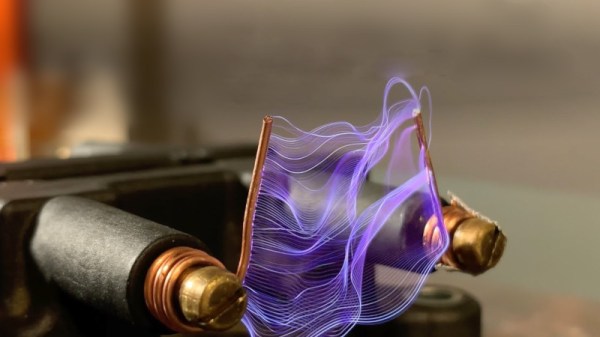
The device in question is an ignition coil from the Subaru Outback. It consists of a pair of high-voltage transformers, connected together, in a wasted-spark setup to run four-cylinder engines. Having sourced the part from a friend, [Jay] realized that with some modification, it would make a great high-voltage power source.

A 555 timer coil driver

The first job was to figure out how to remove the internal electronics that drive the transformers. In this case, it was a simple job of hacking off a chunk of the case, removing the interfering hardware. With this done, it’s possible to directly access the transformer connections.

In [Jay]’s experiments, the device is run in an anti-parallel configuration, to produce higher than normal voltages at the output. In various tests, it’s demonstrated running from both a classic 555 circuit, as well as a ZVS driver. For future projects, [Jay] intends to use this setup to drive a large voltage multiplier, also noting it can be used with Tesla coils and plasma balls with the right additional hardware.

While [Jay] doesn’t include any specific model numbers, reports are that these coils are readily available in a variety of 1990s and 2000s Subaru vehicles. Others have used similar hardware to create high voltage projects, too – this stun gun is a great example.

Continue reading “Subaru Coils Make A Great HV Power Source”

Analyzing Data To Build Better Surfboards

In the world of surfing, the equipment available is as diverse and varied as the enthusiasts themselves. Different boards are optimized for different conditions and styles, and the industry continues to innovate towards ever greater performance. [DARK-labs] aim to bring data analysis into the field to help create boards personalised to the individual.

The goal is to use a sensor network embedded in a surfboard to analyze the style of a particular surfer. This data is then used to identify characteristics such as stance and foot preference, which can then be used to optimize a board design to suit. Once a CAD model is created along these guidelines, it can then be CNC machined and turned into a finished board, ready to hit the waves.

It’s a project that we expect will capture the interest of many a surfer, and we wouldn’t be surprised to see the concept take further strides in coming years. We’ve featured some other board hacks, too – this electric build is particularly compelling. 

A 4G Rover And The Benefits Of A Shakedown Mission

Many moons ago, in the shadowy darkness of the 1990s, a young Lewin visited his elder cousin. An adept AMOS programmer, he had managed to get his Amiga 500 to control an RC car, with little more than a large pile of relays and guile. Everything worked well, but there was just one problem — once the car left the room, there was no way to see what was going on.

Why don’t you put a camera on it? Then you can drive it anywhere!

Lewin

This would go on to inspire the TKIRV project approximately 20 years later. The goal of the project is to build a rover outfitted with a camera, which is controllable over cellular data networks from anywhere on Earth. For its upcoming major expedition, the vehicle is to receive solar panels to enable it to remain operable in distant lands for extended periods without having to return to base to recharge.

The project continues to inch towards this goal, but as the rover nears completion, the temptation to take it out for a spin grew ever greater. What initially began as an exciting jaunt actually netted plenty of useful knowledge for the rover’s further development.

Continue reading “A 4G Rover And The Benefits Of A Shakedown Mission”

Solder Ninja Dabbles In USB Power Arcana

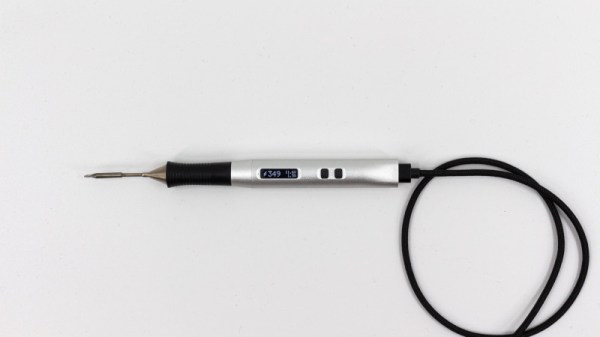
USB first hit the scene in the 1990s, and was intended to simplify connecting peripherals to PCs and eliminate the proliferation of various legacy interfaces. Over 20 years later, it’s not only achieved its initial goals, but become a de facto standard for charging and power supply for all manner of personal electronic gadgets. If you asked someone back in 1995 whether or not you could build a USB-powered soldering iron, they’d have politely asked you to leave the USB Implementers Forum. But times change, and Solder Ninja is just that!

With a maximum power draw of 40 W, the Solder Ninja required careful design to ensure practicality. It supports a variety of USB power standards, including USB-BC 1.2, USB Quick Charge, and USB Power Delivery. This enables it to draw the large amounts of current required for the heating element. To make it easy to use with a variety of chargers out in the wild, it displays the current negotiated voltage and maximum current draw. This enables the user to understand the varying performance of the device, depending on the charger it’s plugged into.

Given the multitude of different USB power standards, we imagine [Nicolas] has the patience of a saint to perfect a project like this. We’ve seen similar builds before, too. Video after the break.

Continue reading “Solder Ninja Dabbles In USB Power Arcana”

SNES Drone Aims To Rock The SPC700

Way back when, home computers and consoles didn’t have the RAM or storage space for full-length recorded audio tracks. Instead, a variety of techniques were used to synthesize music on the fly. The SNES was no exception, using the SPC700 Wavetable Synthesis chip to bust out the tunes. [Foxchild] wanted to use this chip as a standalone synthesizer, but didn’t want to hack up a console to do so. Thus, the SNES Drone was born!

Instead of gutting the console for the juicy chips inside, à la most SID based builds, the SNES Drone takes a different approach. It consists of a cartridge which interfaces with a stock SNES console, making the install easy and non-invasive.

The build is in an alpha state, with the oscillators in the SNES generating continuous tones, with frequency and volume controlled by potentiometers mounted on the cartridge. Having physical controls on the cartridge makes the build feel more like a real synth, and promises to look awesome on stage for a chiptune performance.

[Foxchild] is looking for others to get involved to help get the project to the next stage, so if you’re interested, reach out on the Hackaday.io page. We’ve seen other projects to liberate the awesome chip sounds of yesteryear, too. Video after the break.

Continue reading “SNES Drone Aims To Rock The SPC700”

ALEKYA Builds With Bricks And Mortar

Construction is often a labor-intensive task, particularly in the developing world where access to electricity and machinery can be limited. As always, robots promise to help ease the burden. [Nishant Agarwal] is working on just such a project, known as ALEKYA.

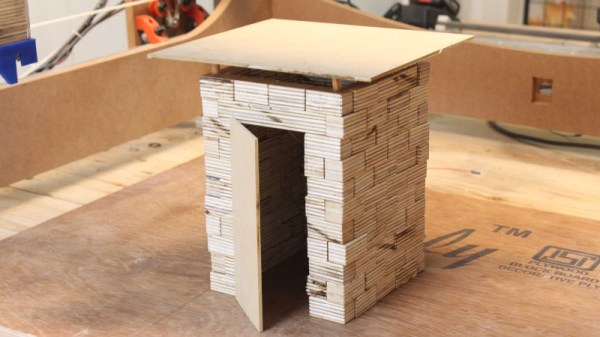
The aim of ALKEYA is to make construction easier and more automated, with the help of robotics. We’ve seen large-scale concrete printers before, but ALEKYA takes a different tack. With a focus on making use of local materials, it combines two gantries on a single frame. One lays down a bead of mortar, before the other swoops in to drop bricks into position. This is followed by another layer of mortar, and the build continues.

By using this manner of construction, progress can be much more rapid compared to more traditional 3D printing techniques which must build up height layer by layer. Currently operating on a small scale, the next step for the project is the construction of a 20×20 foot version for creating full-sized buildings.

We think there’s definite promise in this hybrid approach, and can’t wait to see what comes next! Video after the break.

Continue reading “ALEKYA Builds With Bricks And Mortar”