Since ELIZA was created by [Joseph Weizenbaum] in the 1960s, its success had led to many variations and ports being written over the intervening decades. The goal of the ELIZA Archaeology Project by Stanford, USC, Oxford and other university teams is to explore and uncover as much of this history as possible, starting with the original 1960s code. As noted in a recent blog post by [Anthony Hay], most of the intervening ‘ELIZA’ versions seem to have been more inspired by the original rather than accurate replicas or extensions of the original. This raises the question of what the original program really looked like, a question which wasn’t answered until 2020 when the original source code was rediscovered. Continue reading “The ELIZA Archaeology Project: Uncovering The Original ELIZA”→
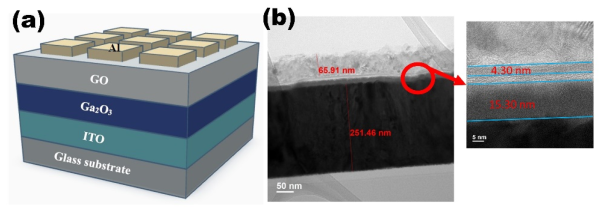
Resistive random-access memory (RRAM) is a highly attractive form of RAM, as it promises low-power usage with stable long-term storage, even in the absence of external power. Finding the right materials to create an RRAM cell which incorporates these features is however not easy, but recently researchers have focused their efforts on gallium(III) oxide (Ga2O3), with a research article by [Li-Wen Wang] and colleagues in Nanomaterials describing a two-bit cell (MLC) based around an aluminium-gallium oxide-graphene oxide stack which they tested for an endurance of more than a hundred cycles.
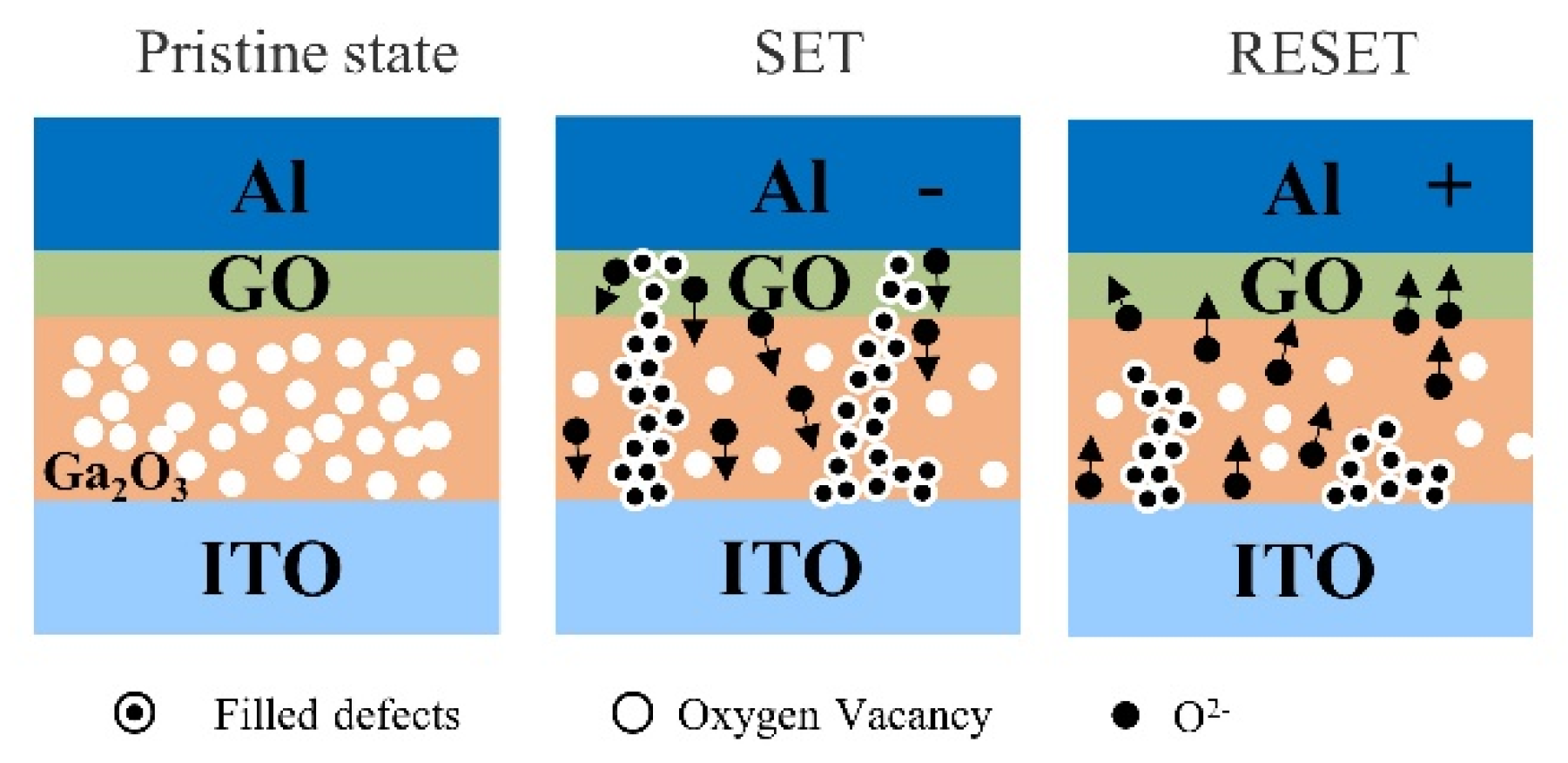
Filament models of the Al/GO/Ga2O3/ITO/glass device. (Credit: Li-Wen Wang et al., 2023)
The way gallium-oxide works in an RRAM cell is by forming a conductive filament formed by oxygen vacancies. These vacancies and the resulting conductive path are controlled by an externally applied current via the top (Al) and bottom (ITO) electrodes, with the graphene-oxide (GO) layer acting as a source of oxygen ions.
In related research, [Zhengchun Yang] and colleagues described in a 2020 article in Ceramics International how they constructed a device consisting out of gallium(III) oxide RRAM data storage with a piezoelectric ceramic element that served both as pressure sensor and power supply. The current generated by the piezo element is used to power the memory device and record measurements.
Then there is the somewhat more wild ‘FlexRAM’ idea pitched by [Ruizhi Yuan] and colleagues in Advanced Materials who describe how they created a device consisting out of flexible polymer called ‘EcoFlex’ with pockets in it for a ‘liquid gallium-based metal’ to create a flexible memory device. At millimeter-sized structures it’s hard to see practical applications for this technology, even if the associated PR article in IEEE Spectrum goes pretty hard on breathless speculation.
There are many benefits to learning to fly an airplane, drive a racing car, or operate some complex piece of machinery. Ideally, you’d do so in a perfectly safe environment, even when the instructor decides to flip on a number of disaster options and you find your method of transportation careening towards the ground, or the refinery column you’re monitoring indicating that it’s mere seconds away from going critical and wiping out itself and half the refinery with it.
Still, we send inexperienced drivers in cars onto the roads each day as they either work towards getting their driving license, or have passed their driving exam and are working towards gaining experience. It is this inexperience with dangerous situations and tendency to underestimate them which is among the primary factors why new teenage drivers are much more likely to end up in crashes, with the 16-19 age group having a fatal crash nearly three times as high as drivers aged 20 and up.
After an initial surge in car driving simulators being used for students during the 1950s and 1960s, it now appears that we might see them return in a modern format.
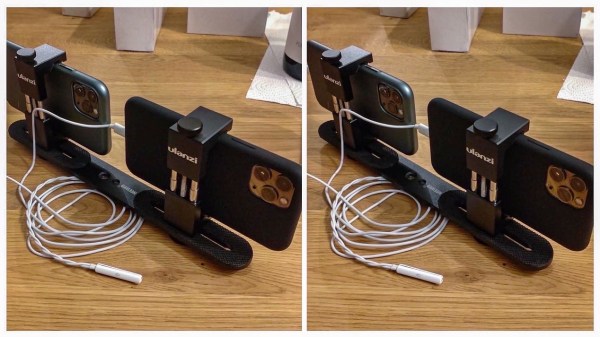
Stereo photography has been around for almost as long as photography itself, and it remains a popular way to capture a scene in its 3D glory. Yet despite the fact that pretty much everyone carries one or more cameras with them every day in the form of a smartphone, carrying a stereo photography-capable system with you remains tricky. As [Pascal Martiné] explains in a How-To article, although you can take two smartphones with you, syncing up both cameras to get a stereo image isn’t so straightforward, even though this is essential if you want to prevent jarring shifts between the left and right image.
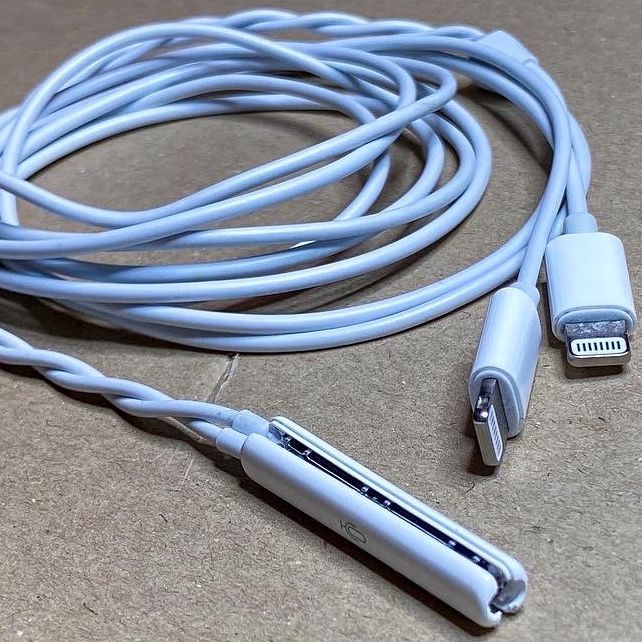
Custom made twin shutter. (Credit: Pascal Martiné)
Fortunately, having two of the exact same smartphone with the exact same camera modules is not an absolute requirement, as apps like i3DStereoid offer auto-adjustments. But activating the camera trigger on each phone is essential. The usual assortment of wireless remote triggers don’t work well here, and the twin-pairing in i3DStereoid had too much delay for dynamic scenes. This left the wired remote trigger option, but with a dearth of existing stereo trigger options [Pascal] was forced to make his own for two iPhones out of Apple Lightning cables and wired earbud volume controls.
Although the initial prototype more or less worked, [Pascal] found that each iPhone would often ‘decide’ to release the trigger at a slightly different time, requiring multiple attempts at the perfect shot. This led him down a rabbit hole of investigating different camera apps and configurations to make shutter delay as deterministic as possible. Much of this turned out to be due to auto exposure and auto focus, with enabling AE/AF lock drastically increasing the success rate, though this has to be done manually before each shot as an extra step.
With this one tweak, he found that most of the stereo photo pairs are now perfectly synced, while occasionally there is about a ~3 ms jitter, the cause of which he hasn’t tracked down yet, but which could be due to the camera app or iOS being busy with something else.
In the end, this iPhone-based stereo photography setup might not be as reliable or capable as some of the purpose-built rigs we’ve covered over the years, but it does get extra points for portability.
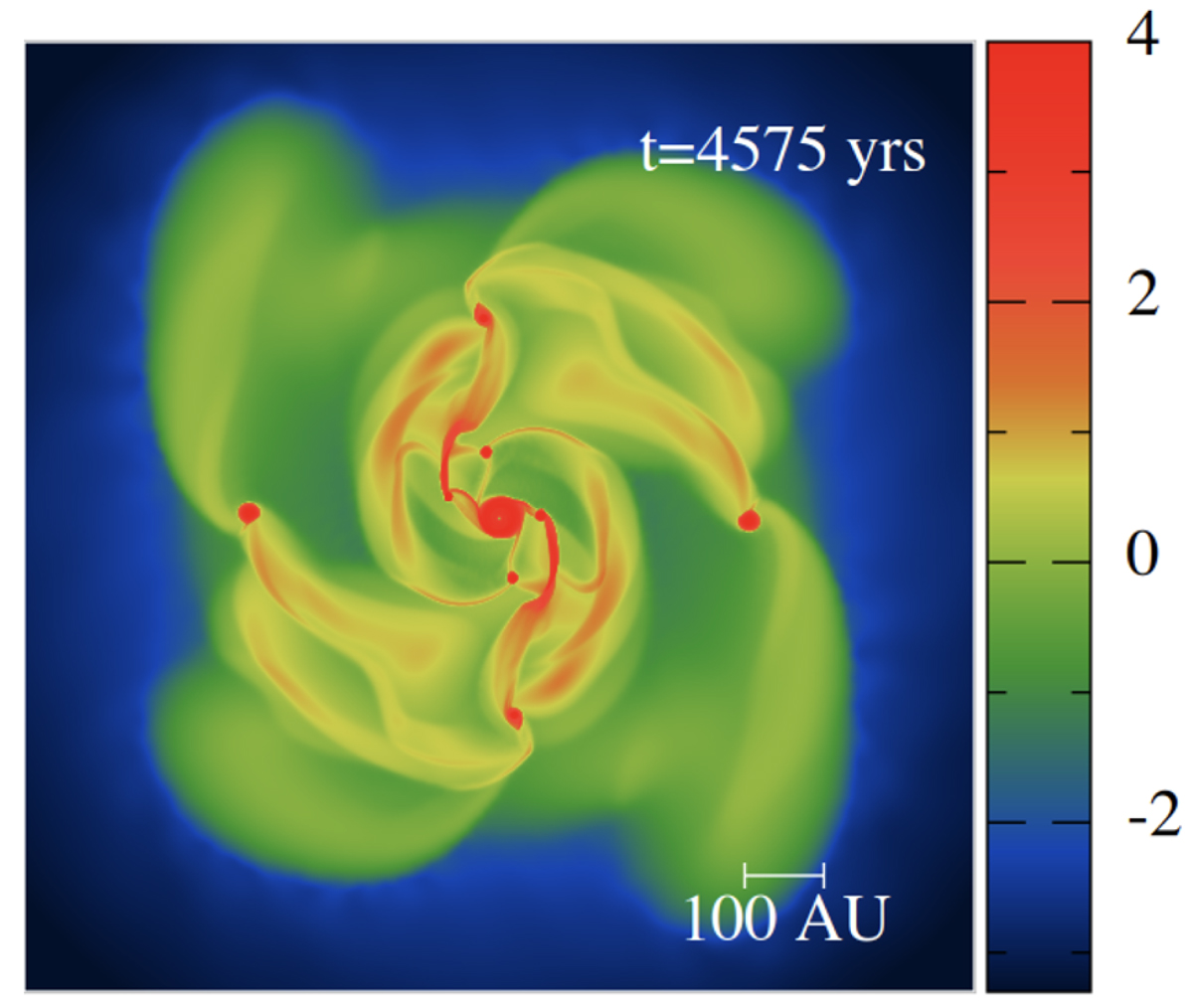
Surface density of the benchmark run disc (in g cm−2). The disc becomes gravitationally unstable and fragments. Four of the fragments or protoplanets are followed until they reach density 10−3 g cm−3. (Credit: Fenton et al., 2024)
While the very idea of a flat planet millions of years after its formation is patently ridiculous, recent modelling shows that during the protostar phase – where material from a nebula is drawn around a hydrostatic core into an accretion disc – it is likely that many of of the protoplanets which form inside a fragmentary protostar accretion disc take on a strongly oblate spheroid shape, rather than a spherical one. This according to [Adam Fenton] and [Dimitris Stamatellos], who ran half a million CPU hours worth of simulation time at the UK’s DiRAC HPC facility, per the University of Central Lancashire (UCLan) press release.
The research was published in the February 2024 issue of Astronomy & Astrophysics, titled The 3D structure of disc-instability protoplanets.
Where this research is essential is not just in our understanding of how our own solar system came to be – including our own oblate spheroid Earth – but also in interpreting what we observe via the Hubble Space Telescope, James Webb Space Telescope and others as we examine areas of the observable Universe such as the Orion Nebula, which is one of the regions with the most actively forming stars. By comparing these simulations with observations, we may find that the simulation matches perfectly, matches partially, or perhaps not at all, which provides data to refine the simulation, but also helps to reconsider how observations were previously interpreted.
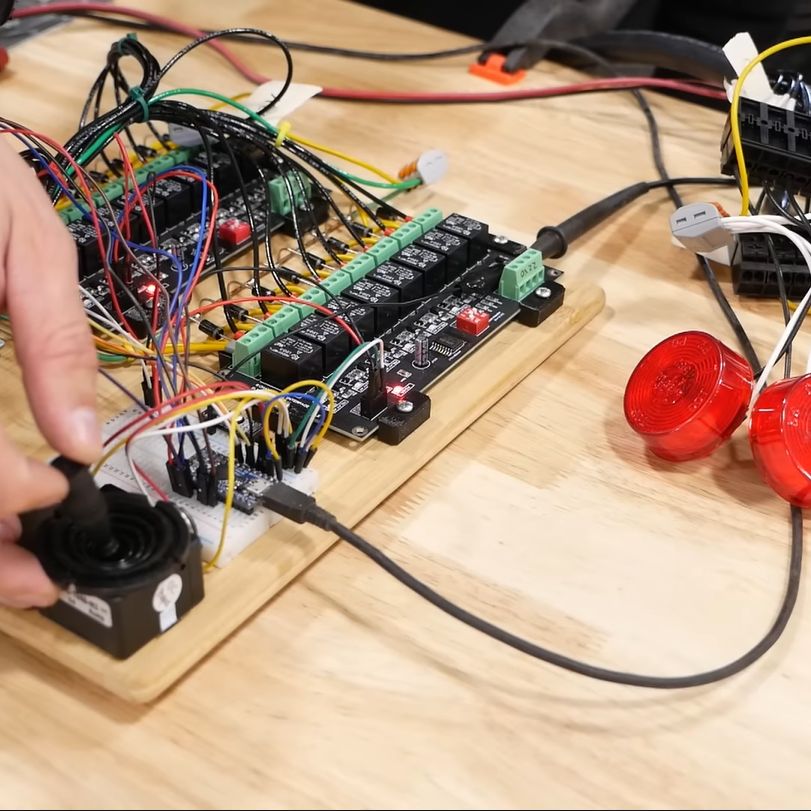
When we last left [Wes] amidst the torn-open guts of his Logg Dogg logging robot, he had managed to revitalize the engine and dug into the hydraulics, but one big obstacle remained: the lack of the remote control unit. In today’s installment of the Logg Dogg series, [Wes] summarizes weeks of agony over creating a custom circuit based around a microcontroller, a joystick and a lot of relays and other bits and pieces to drive the solenoids inside the logging machine that control the hydraulics.
Giving the remote controller a bench test before connecting to the logging robot (Credit: Watch Wes Work)
Most of the struggle was actually with the firmware, as it had to not only control the usual on/off solenoids, but also a number of proportional solenoid valves which control things like the track speed by varying the hydraulic flow to the final drives.
This requires a PWM signal, which [Wes] generated using two MOSFETs in a closed-feedback system, probably because open loop controls with multi-ton hydraulic machinery are not the kind of excitement most people look forward to.
Ultimately he did get it sorted, and was able to take the Logg Dogg for its first walk since being rescued from a barn, which both parties seemed to rather enjoy. The background details of this machine and the project can be found in our first coverage.
We’re looking anxiously forward to the next episode, where the controller goes wireless and the sketchiness gets dialed down some more.
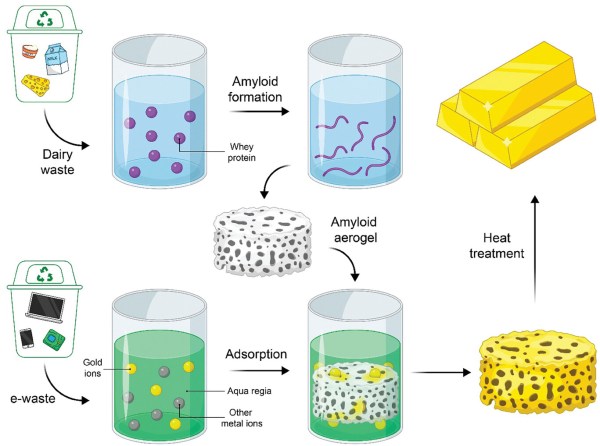
A big part of the recycling of electronic equipment is the recovery of metals such as gold. Usually the printed circuit boards and other components are shredded, sorted, and then separated. But efficiently filtering out specific metals remains tricky and adds to the cost of recycling. A possible way to optimize the recovery of precious metals like gold could be through the use of aerogels composed out of protein amyloids to which one type of metal would preferentially adsorb. According to a recent research article in Advanced Materials by [Mohammad Peydayesh] and colleagues, such aerogels could be created from protein waste from the food industry.
The adsorption mechanism of the protein amyloids is a feature of these proteins which form chelants, which are structures that can effectively bond to metal ions. These are usually organic compounds, and are used in certain medical treatments where heavy metal poisoning is involved (chelation therapy). By having these protein amyloids in an aerogel structure, the surface area for adsorption is maximized, which in the research article is said to have an efficiency of 93.3% for gold recovery, while leaving the other metals in the aqua regia solution (nitric and hydrochloric acid) mostly untouched.
Of note here is that although the food waste protein angle is taken, the experiment used whey protein. This is also one of the most popular food supplements in the world, to the point that microbial production of whey is a thing now. Although this doesn’t invalidate the aerogel chelation approach to e-waste recycling, it’s a curious omission in the article that does not appear to be addressed.