Using Nuclear Decay As Random Number Generator Source For An MCU

Although there are many ways to get a random number generator (RNG) set up on a microcontroller, it’s hard to argue with the sheer randomness of the various kinds of radiation zipping all around us from nuclear decay events. For [gbonacini] the purchase of a Geiger counter first in 2022 was the reason to tinker with using these as the source for an RNG, which simply runs a counter until a Geiger counter event occurs that ‘selects’ a number and the counter is reset to zero.

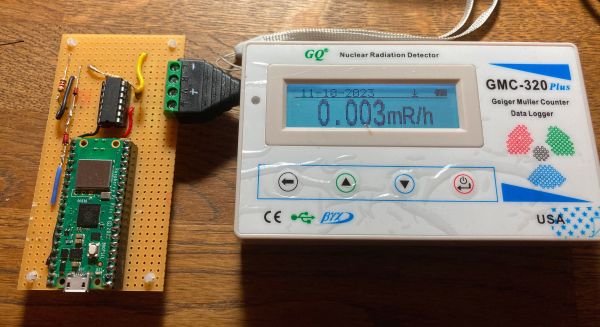
With the next version of this system the hardware and layout has changed somewhat, using a commercial handheld Geiger counter (GMC-320+) and its audio output as a generic input for any MCU. The (pulsed) audio signal is amplified with an opamp (left unspecified) that connects to a GPIO pin of the MCU (RP2040-based Pico W). Here the same algorithm is used to create a continuous queue of randomly picked numbers, which can also be queried via the WiFi interface with a custom protocol, essentially making it a network-connected RNG that could be used by other network-connected appliances.

C++ source is provided for the Pico W example, but it should be easy enough to adapt to other platforms. The GMC-320+ is also among the more affordable Geiger counters out there, even if it’s somewhat bulky to pair with just a single MCU, making a more basic Geiger counter module better for a permanent installation. Either way you should get pretty good RNG this way without splurging on exotic hardware.

Thanks to [navigator] for the tip.

Molybdenene whiskers. (Credit: Sahu et al., 2023)

Introducing Molybdenene As Graphene’s New Dirac Matter Companion

Amidst all the (well-deserved) hype around graphene, it’s important to remember that its properties are not unique to carbon. More atoms can be coaxed into stable 2-dimensional configuration, with molybdenene previously theoretically possible. This is now demonstrated by Tumesh Kumar Sahu and colleagues in a recent Nature Nanotechnology article, through the manufacturing of a 2D molybdenum-based material which they showed to be indeed molybdenene. Essentially, this is a 2D lattice of molybdenum atoms, a configuration in which it qualifies as Dirac matter, just like graphene. For those of us unfamiliar with Dirac materials, this gentle introduction by Jérôme Cayssol in Comptes Rendus Physique might be of use.

Manufacturing process of molybdenene. (Credit: Sahu et al., 2023)

In order to create molybdenene, the researchers started with molybdenum disulfide (MoS2), which using a microwave-assisted field underwent electrochemical transformation into whiskers that when examined turned out to consist out of monolayers of Mo. The sulfur atoms were separated using a graphene sheet. As is typical, molybdenene sheets were exfoliated using Scotch tape, in a process reminiscent of the early days of graphene research.

Much like graphene and other Dirac materials, molybdenene has many potential uses as a catalyst, as cantilever in scanning electron microscope (SEM) tips, and more. If the past decades of research into graphene has demonstrated anything, it is that what once seemed more of a novelty, suddenly turned out to have endless potential in fields nobody had considered previously. One of these being as coatings for hard disk platters, for example, which has become feasible due to increasingly more efficient ways to produce graphene in large quantities.

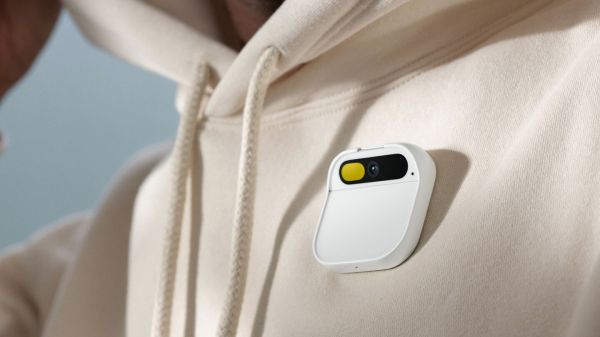
Human AI Pin marketing picture. (Credting: Humane)

The AI Pin: A Smart Body Camera That Wants To Compete With Smartphones

Seeking to shake up the smartphone market, Humane introduced its ‘AI Pin’, which at first glance looks like someone put a very stylish body camera on their chest. There’s no display, only the 13 MP camera and some other optics visible above what turns out to be a touch panel, which is its main gesture-based input method, while it’s affixed to one’s clothing using either a magnet on the other side of the fabric, a wireless powerbank or a clip. Inside the unit you find a Qualcomm octa-core processor with 4 GB of RAM and 32 GB of eMMC storage, running a custom Android-based ‘Cosmos’ OS.

The AI Pin home screen, demonstrating why hand palms are poor projection surfaces. (Credit: Humane)

There is also a monochrome (teal) 720p laser projector built-in that provides something of a screen experience, albeit with the expectation that you use your hand (or presumably any other suitable surface) to render it visible. From the PR video it is quite clear that visibility of the projection is highly variable, with much of the text often not remotely legible, or only after some squinting. The hand-based gestures to control the UI (tilting to indicate a direction, touching thumb & index finger together to confirm) are somewhat of a novelty, though this may get tiresome after a day.

An article by [Ron Amadeo] over at Ars Technica also takes a look at the device, where the lack of an app ecosystem is pointed out, as well as the need for a mandatory internet connection (via T-Mobile). Presumably this always-on ‘feature’ is where the ‘AI’ part comes in, as the device has some voice assistant functionality, which seems to rely heavily on remote servers. As a result, this ends up being a quirky device with no third-party app support for a price tag of $700 + the $25/month for online service. Not to mention that people may look a bit odd at you walking around with a body camera-like thing on your chest that you keep rubbing and holding your hand in front of.

To be fair, it’s not often that we see something more quaint in this space come out than Google Glass, now many years ago.

Putting 3D Printed Screw Threads To The Test

One of the challenges with 3D printing is seeing how far designs can be pushed before they break. This includes aspects like flexible hinges and structural components, but also smaller details such as screw threads. Often metal inserts with threads are added to FDM 3D prints by melting them into the plastic, but might 3D printed threads be sufficient for many cases?  This is a question which [Adam Harig] sought to investigate in a recent video while working on parts that would connect to a rather expensive camera.

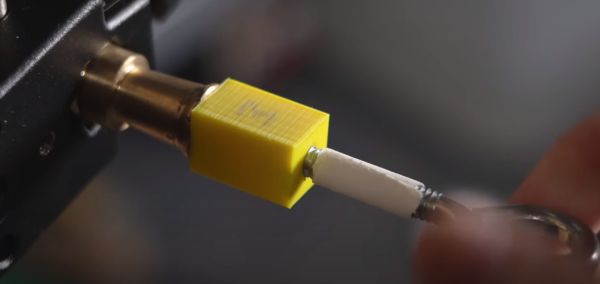
Trusting expensive camera gear to 3D printed threads... (Credit: Adam Harig)
Trusting expensive camera gear to 3D printed threads… (Credit: Adam Harig)

Rather than risking the camera, a few stand-in cubes printed in PLA+ (AnkerMake brand) were used, with these and their internal thread being exposed to destructive testing. For the measuring equipment only a luggage/fishing scale was used. The difference between the test parts was the amount of infill, ranging from 10 to 100% infill, with 0.2 mm layer height. After this the test involved pulling on the metal hook screwed into the plastic test item with the scale, up to the point of failure or the human element giving up.

The results are rather interesting, with the 100% infill version scoring better than than the 50% infill version (the next step down), with [Adam] giving up on trying to pull the test unit apart and with the scale maxed out. This gave him enough confidence to use this design to lift his entire camera off the table. What’s perhaps most interesting here is that the way the test items were printed, the layers experienced a peeling force, which as the final clips in the video show seemed to often result in the bottom layers giving away, which was the part not being held together by the metal screw inside the item. What the effect of dynamic loads are is something that should possibly also be investigated, but it does show that FDM printing screw threads is perhaps not that silly.

(Thanks to [Pidog] for the tip)

Continue reading “Putting 3D Printed Screw Threads To The Test”

Rendering of 6-unit NuScale VOYGR SMR plant.

Utah NuScale Nuclear Plant Project Canceled Due To Lack Of Interest From Utilities

Intended to be the first 6-unit deployment of NuScale’s 77 MW VOYGR small modular reactors (SMRs), the Carbon Free Power Project (CFPP) in Utah was scheduled to begin construction by 2025 on the grounds of the Idaho National Laboratory (INL), yet it has now been canceled by NuScale (press release) after not finding enough utilities interested in purchasing power from the nuclear plant. This led NuScale and UAMPS (Utah Associated Municipal Power Systems) to back out of the CFPP project.

To be clear, it seems this decision neither reflects on SMRs as a whole, nor NuScale’s prospects. Currently NuScale still has a number of projects which it is involved in, including the use of its SMR technology with the Polish copper and silver producer KGHM Polska Miedź SA. Demand for SMRs is also being flooded with various designs by both established and start-up companies, with TerraPower’s Natrium reactor seeing additional demand, including at the Kemmerer site in Wyoming.

Meanwhile, the European Commission is establishing an SMR Industrial Alliance, and countries like Norway are looking to build their first nuclear plants using SMRs, which includes Danish Seaborg’s molten salt reactor. In the end it should be clear that whether a singular infrastructure project works out economically or not depends on many factors. This can also be seen with e.g. wind farm projects, where Danish Ørsted canceled two large US offshore wind projects, Swedish Vattenfall abandoned its new British offshore wind project due to rising costs and Siemens Energy is having to borrow billions of Euros to patch up financial holes in its Spanish wind turbine unit.

Continue reading “Utah NuScale Nuclear Plant Project Canceled Due To Lack Of Interest From Utilities”

Lunar Gateway’s Advanced Solar Electric Propulsion Engine Passes Initial Qualification Tests

Recently NASA announced earlier this month that the 12 kW Advanced Electric Propulsion System (AEPS) — which is scheduled to form an integral part of the Lunar Gateway when it is launched — has passed a number of qualification tests, after a rather tumultuous number of years during its development.

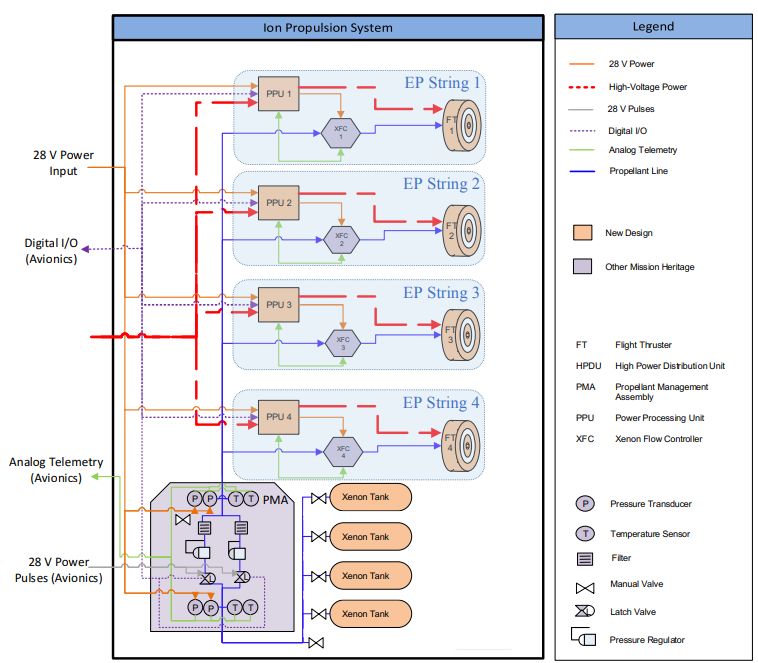
Top-Level PPE Conceptual Ion Propulsion System (IPS) Block Diagram. (Credit: NASA)

Originally designed since 2015 to propel the AARM mission to fetch rocks from an asteroid, when AARM was cancelled it became the cornerstone of the Lunar Gateway that should enable astronauts in the Artemis program to land on the Moon.

The AEPS is a solar electric propulsion system that uses xenon as its propellant, much like existing ion engines. Where it differs is in the power output, which should allow it to work as the primary propulsion method for large deep space and cargo missions. Much of the development and projections are covered in a 2017 presentation at the International Electric Propulsion Conference (IEPC).

Although the projected dates for much in this presentation (e.g. first flight of SLS Block 1 was in 2022, not 2018) are decidedly off, once the individual AEPS thrusters are validated, three strings will be mounted on the Power and Propulsion Element (PPE) that forms the core of the Lunar Gateway and is scheduled to be launched in November of 2025.

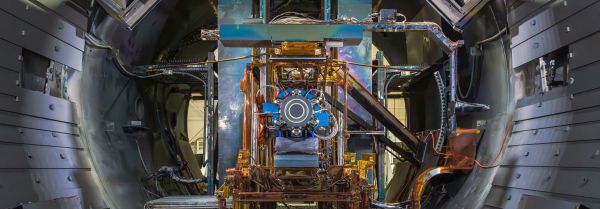
Top image: AEPS installed for testing at NASA Glenn. (Credit NASA)

Trouble Brewing For RISC-V As Issue Of Technology Transfer Is Questioned

Within the messy world of international politics, a major consideration by governments concerns which types of kn0w-how and technology can be transferred and sold to other nations, with each type facing restrictions depending on how friendly the political relations are with the target country at that point in time. Amidst all of this, there are signs that a so far relatively minor player in the world of CPU instruction set architectures – RISC-V – may become a victim of this, as a bipartisan group of US politicians is petitioning the White House to restrict transfer of know-how (so-called Intellectual Property, or IP) to RISC-V, as this may benefit adversaries like China.

As a US citizen who is involved in the RISC-V ecosystem, [Andrew ‘bunnie’ Huang] feels rather strongly about this, and has written an open letter to the US President, pleading to not restrict the way that US citizens can deal with the Switzerland-based RISC-V organization. This comes as the California-based RISC-V startup SiFive has announced that it’ll lay off 20% of its workforce. Depending on how a restriction on RISC-V is implemented, this could mean that US citizens would be forbidden from contributing to this ISA and surrounding ecosystem.

China has made it clear that RISC-V is a big part of its strategy to loosen its dependence on the West along with its investments in its MIPS-based Loongson processors, all of which strengthens the case for restricting US participation in RISC-V, even if it forces US companies like SiFive to move countries or cease its operations.

(Thanks to [cbjamo] for the tip)