Electric BMX Has Pedals That Can’t Be Pedalled

electric-bmx

We don’t mind it that there’s no chain connected to these pedals. At least there’s still somewhere to put your feet and our legs are too long to comfortably pedal this size of bike anyway. As you can tell, the added hardware takes care of locomotion using an electric motor.

The first step in this project was to find a steel bike frame to make welding a bit easier than it would be for aluminum. From there the paint was sanded at the attachment points and mounting brackets were fabricated from some angle iron. The rear mount houses a 500W 30A AC motor which uses a chain to drive the rear wheel. A specialty hub was found which allows the added sprocket to be installed on the left side of the rear wheel. Some threading issues prompted [Michael Monaghan] to come up with a method of adding a slot to lock the part in place.

Near the front fork the second mounting bracket holds the batteries; a pair of sealed lead-acid units. The speed control mounts on the top where the rider has easy access to it. The finished bike can get up to thirty miles per hour with a range of up to twenty miles between charges.

If you want your own electric bike on the cheap you can try building one from a salvaged washing machine motor.


Automatic Bluetooth Module Programmer

automatic-bluetooth-programming

Before we dive in don’t be confused by the title. This doesn’t flash firmware to the device. But it does automate the process of setting up the Bluetooth to serial module for use in your projects.

We’re often confused by the lack of a standard way of describing these inexpensive modules. We would look at this can call it an HC-05, but we’re not sure if that’s right or not. [James Daniel] calls it a JY-MCU board. If you have a handle on the differences (or lack of) please let us know in the comments. Either way we know that these boards can be frustrating to work with. They can be found with a wide variety of different firmwares, which can make the configuration process a bit different for each.

[James’] solution connects the device to an Arduino running a sketch that he wrote. Connect the device, launch the terminal monitor in the Arduino IDE, then give it your desired settings. The sketch will poll the Bluetooth module to see what speed it is set to run at. It will then establish which firmware version the board is running, displaying this info in the terminal. It then uses that information to program the board with your desired settings.

In this case [James] is using one of the modules to drive his 3D printer without being tethered to his laptop.

Continue reading “Automatic Bluetooth Module Programmer”

Backlit PCB Panel As Wall Art

For his buddy’s wedding [Saar Drimer] wanted a one-of-a-kind gift, and what’s more unique than a piece of art? He set out to design something that would speak to his geeky game-loving friend. This full-panel PCB is what he came up with. It’s a wall hanging that uses addressable LEDs and a PCB for the enclosure and as a diffuser.

On the right you can see the panel as it was delivered to him. He used routed slots to separate the main body of the enclosure from the four side pieces and the mounting bracket. This design lets him snap off the parts and solder them in place. The only thing you need to add to it is a pair of screws (well, and the components that make it light up).

We’re shocked by how well the PCB works as a diffuser. The substrate is translucent when not covered with silk screen or the copper layers. The outline of the letters uses that, as well as circular areas along the side pieces. The letters themselves are copper fills that have artistic patterns removed from them. This really adds to the visual appeal when the piece is illuminated by 42 WS2812B LEDs. The video below shows the piece in action. It really takes PCB as art to the next level

Continue reading “Backlit PCB Panel As Wall Art”

Guest Rant: Ham Radio — Hackers’ Paradise

Editor’s Note: This is a guest post written by [Bill Meara]

The suits at Hack-a-Day reached out to SolderSmoke HQ and asked me to send in a few words about why their readers should take a fresh look at ham radio. Here goes:

First, realize that today’s ham radio represents a tremendous opportunity for technical exploration and adventure. How about building a station (and software) that will allow you to communicate by bouncing digital signals off the moon? How about developing a new modulation scheme to send packets not down the fiber optic network, but around the world via the ionosphere, or via ham radio’s fleet of satellites? How about bouncing your packets off the trails left by meteors? This is not your grandfather’s ham radio.

You can meet some amazing people in this hobby: Using a very hacked-together radio station (my antenna was made from scrap lumber and copper refrigerator tubing) I’ve spoken to astronaut hams on space stations. Our “low power, slow signal” group includes a ham named Joe Taylor. Joe is a radio astronomer who won the Nobel Prize for Physics. He’s now putting his software skills to use in the development of below-the-noise receiving systems for ham radio. Join me after the break for more on the topic. Continue reading “Guest Rant: Ham Radio — Hackers’ Paradise”

Hackaday Links: September 22, 2013

hackaday-links-chain

First we start with some protection… for your USB charged devices. Here’s a USB Condom which acts as a pass-through for the power rails but not the data lines. This prevents untrusted charger security exploits. [Thanks Markus]

[OutKastz] seems to think he’s uncovered a price matching conspiracy at Best Buy. His post references an HDTV video wall he has built. But he also discovered that there are two different version of the same television sold as the same SKU. His theory is that this prevents the big box from matching prices on half of their inventory.

When you’re in need of some breadboarding action with your Raspberry Pi and want to make it as painless as possible you need to build your own Pi Cobbler. This is the diy version of an Adafruit product, built using a couple of pin headers, stripboard, and an IDE cable.

Speaking of Adafruit, did you see Ladyada’s teardown of an ICEdot crash sensor?

[Phineas] is showing off a really really small hexacopter. Check out the maiden flight, as well as first indoor and first outdoor tests.

Perhaps this coded entry system will inspire a future project for you. It uses piezo elements to enter a code which unlocks the back door to the company. The glass door already had a series of large dots painted on it. This turns out to be a nice interface for a four button code system.

Many projects use a Raspberry Pi as a web server. But there is more than just one flavor available. [Jeremy Morgan] performed a variety of Pi server benchmarks using Nginx, Monkey, Lighttpd, and Apache. [Thanks Walter]

Can an old TV antenna reflector be used to boost the range of a WiFi dongle? We’re a bit skeptical. Let us know what you think in the comments.

And finally, we do wish there was more information on this upright piano used to play Doom [Thanks Itay].


Trash To Treasure Bluetooth Radio And Tube Amp Build

trash-to-treasure-internet-radio

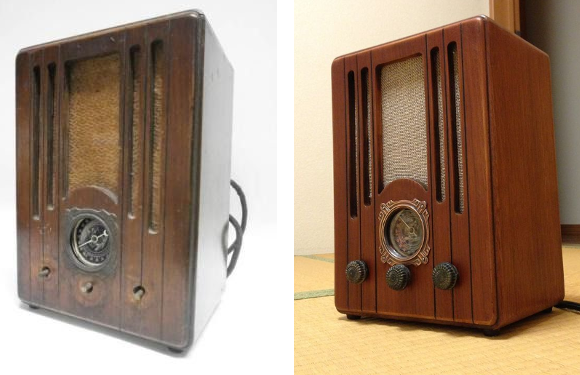
The before image doesn’t look all that bad but we were still impressed with what went into the restoration of this radio. Perhaps restoration isn’t the right word since it didn’t manage to hold on to any of the original internals. This is more resurrection of a retro radio case for use as a Bluetooth radio.

At first look we didn’t notice that the original knobs were missing. The speaker fabric is ripped and the glass on the tuning dial is broken as well. [Yaaaam] happened to have another antique radio with interesting knobs — but he didn’t just transplant them. He made a mold of one knob and cast three replacements for the radio. After refinishing the wood he replaced the fabric and things were really starting to look up.

All of the electronic components were removed and a new tube amp was built on the original metal chassis. It uses a Bluetooth module for input which facilitates using your smart phone as the playback device without involving any wires or other nonsense. Two problems popped up after the project was completed. The first replacement power supply overheated. The second replacement had a different problem, needing some additional shielding to prevent noise from creating unwanted… noise.

This looks so much better than modern injection molded plastic shelf systems. But there are some fun wireless hacks out there for those too.

Building A Brushless Motor Controller Around An ATmega Chip

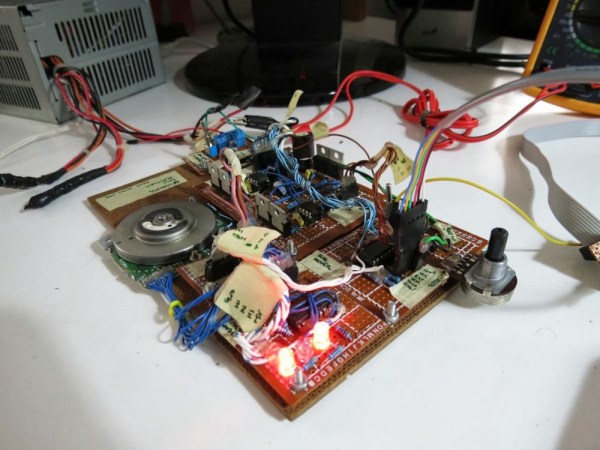
You know when you see something like this it’s just going to be awesome, and we weren’t disappointed by our first impression. [Davide Gironi] built a brushless motor controller from the ground up using an ATmega8 as the brain. If you want to understand every aspect of a subject this is how to do it. Lucky for us he explains what each portion of the prototype does.

Brushless motors have no brushes in them (duh). But what does that really mean? In order to spin the motor a very carefully crafted signal is sent through the motor coils in the stationary portion (called the stator), producing a magnetic field that pushes against permanent magnets in the rotor. A big part of crafting that signal is knowing the position of the rotor. This is often accomplished with Hall Effect sensors, but can also be performed without them by measuring the back EMF in the coils not currently being driven. The AVR-GCC compatible library which [Davide] put together can be tweaked to work with either setup.

Get a good look at the system in action after the break.

Continue reading “Building A Brushless Motor Controller Around An ATmega Chip”