Kitchen Timer Makes Mario Your Sous-chef

[Alan] was unimpressed by the cheap ticking egg timers that grace many of our kitchens. He decided this was an execllent opportunity to ply his skills with microcontrollers. He built this kitchen timer complete with an enclosure and audible alarm.

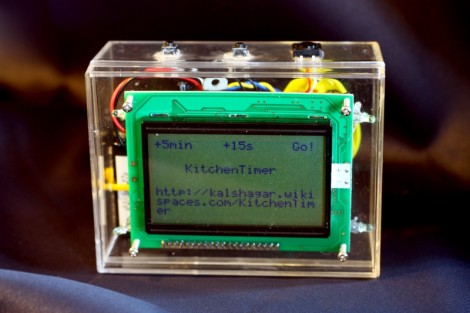
The device is Arduino based, which makes driving the graphic LCD quite easy thanks the libraries associated with that platform. As you can see above, his user interface makes use of virtual buttons – three tactile switches whose function is listed at the top of the display.

But we think the alarm sound really earns this a place in his kitchen. He used the same hardware as that that Super Mario Bros. Toilet project to play classic video game sounds when your soufflé needs come out of the oven. We haven’t come across them ourselves, but apparently there’s a line of key chains for sale in Japan (yes, we need to plan a trip there!) that have the tunes programmed into them. They’re easy to crack open and it beats dealing with a speaker and amp circuit.

Last Century’s Guided Missile Steps Aside For This Guided Bullet

Here’s an image of a bullet’s path to the target. There’s a couple of things to note. First of all, this is not a tracer round, the projectile actually has an LED incorporated which was picked up as a trail in the long (relative to bullet speed) exposure. The second – and most obvious – thing to consider is the non-liner path it took to its objective. That’s because this is a laser guided bullet.

The smart bullet is a about four inches long and carries with it a light sensor, 8-bit processor, and some electromagnetic actuators. The tip is searching for a laser-painted target, with an algorithm calculating course corrections along the way and using the actuators to move fins which alter its path. For us the most interesting part is that this ammo requires a non-rifled barrel. The rifling spins the bullet as it leaves the firearm, which usually results in a straighter and more dependable path. But the microcontroller wouldn’t be able reliably steer if it were spinning.

We’d bet this ends up as a special sniper tool in video games before we hear about it on the battlefield. Check out a clip of the dart-like bullet leaving the muzzle in the clip after the break.

Continue reading “Last Century’s Guided Missile Steps Aside For This Guided Bullet”

Flexible Web Interface Makes The Universal Remote Nearly Perfect

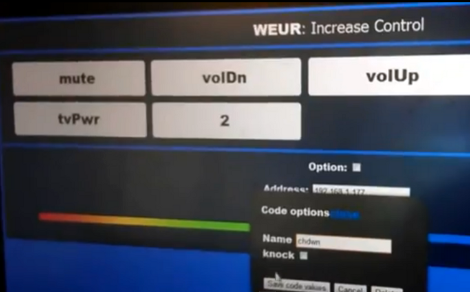
[Fall Deaf] built an Arduino based universal remote control system. It uses a shield which has both an IR receiver and transmitter. This gives it the tools to learn codes from your existing remotes and play them back in order to control the devices. This functionality is really nothing new, but we think the user interface he developed for the system is absolutely fantastic!

Software is web-based. You can simply point a remote at the Arduino and push a button. The receiver will store the code which can later be assigned to a virtual button. The image above shows the channel-up option being created; it will be added to the list once confirmed. From there any web enabled device – smart phone, tablet, netbook, etc – can be used as the remote for the system. The only feature we think is missing is the ability to alter the layout of the buttons, with larger areas for the most frequently used commands.

After the break you can see a demonstration of this system, as well as the one extra feature we haven’t touched on yet. [Fall Deaf] included a Piezo element in the hardware design which lets him knock on his coffee table to use the remote if a smart-device isn’t close at hand.

Continue reading “Flexible Web Interface Makes The Universal Remote Nearly Perfect”

Lens Adapter From A Plastic Soda Bottle

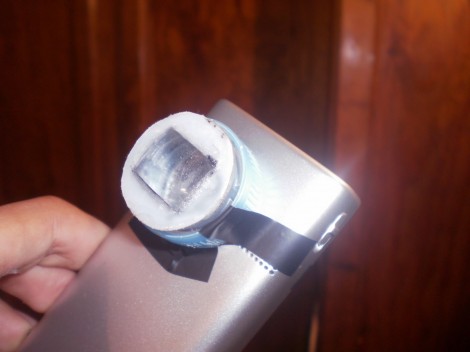
This lens adapter makes a lot of sense if you’re looking to interface with cameras that don’t have an in-built mounting option. It uses the cap and threaded neck from a soda bottle (translated) to make the lens adjustable and removable.

In the past we’ve seen this hack using a lens cap with a hole drilled in it as the mounting bracket. But that’s only useful if the lens you’ve chosen actually has a cap to use. This method lets you cut the top off of a the soda cap and mount it on the camera. Now each lens can be affixed to the threaded neck of the bottle, allowing for some adjustment of the focal point by screwing the add-on in or out.

Obviously this would work well for macro or fish-eye lenses. But there’s all kinds of other options out there like adding a microscope lens adapter, or actually attaching quality optics to your device.

Reading Diodes To Create A Thermal Imaging System

[Udo Klein] was working with some 1N4148 transistors and was interested in the specs relating to their performance at different temperatures. The forward voltage actually changes quite a bit depending on temperature and wondered if this could be reliably measured. He hacked his own LED shield for the Arduino to use as a 1×20 thermal imaging system.

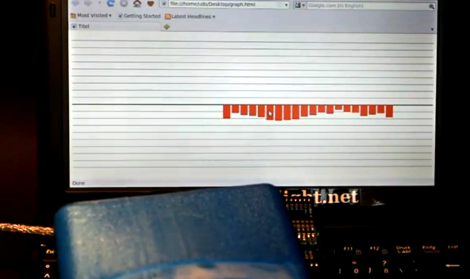
The screenshot above is mapping the voltage measurements from a row of diodes (see the video after the break to get the full picture). He’s holding an ice pack over the row of diodes and observing the change. The on-screen display is facilitated by a Python script which is pulling data from the Arduino. Since there aren’t enough analog inputs to read all twenty diodes separately they have been multiplexed. Four I/O pins each enable five of the diodes, readings are taken with five analog inputs before moving on to the next set.

What can this be used for? That is precisely the wrong question… sometimes you’ve just got to go where your curiosity takes you. Continue reading “Reading Diodes To Create A Thermal Imaging System”

Weapon Of Mass Graffiti

What uses a fire extinguisher, a bike pump, and provides hours of probation, community service, and possibly jail time? If you said an automatic graffiti writer you’re correct! [Olivier van Herpt] calls this little job the Time Writer. We call it defacing property… but tomato, tomahto.

Details are a bit scarce, but you get a fine overview of the system from the video after the break. [Olivier] tagged the post as Arduino; it’s obviously running the dot matrix printer made up of seven solenoid valves on a metal rod. These are fed ink via a tube connected to a fire extinguisher which serves as the reservoir. The bike pump is used to pressurize the enclosure so that a pump isn’t necessary when out and about.

Obviously you shouldn’t try this at home, but let’s talk about possible improvements as an academic exercise. First off the mix of the ink/paint needs to be reigned in to get rid of the dripping. We’d also like to see the inclusion of some proper spray can nozzles to tidy up the results. That, paired with an IMU board should be able to smooth out the printed designs.

This might make an interesting add-on to that rainbow graffiti writer.

Continue reading “Weapon Of Mass Graffiti”

Overclocking A Starfox Game Cartridge

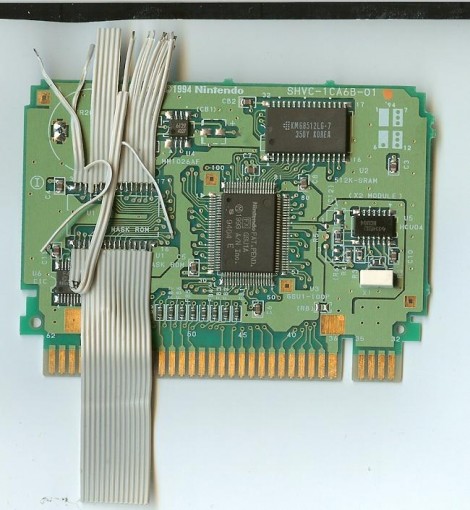
Some of our younger readers will never have experienced this before, but back in the day your video games would slow way down if there were too many moving objects on the screen. The original Castlevania comes to mind, but many will remember the problem while playing the fantastically three-dimensional Super Nintendo game Starfox. [Drakon] isn’t putting up with that hardware shortfall any longer, he hacked this cartridge to run at 42 MHz, twice as fast as the design spec.

We only occasionally look in on the cart hacking scene so it was news to us that three different versions of a pin compatible chip were used in this hardware. The first two suffer from the slowdown problem, but the final revision (SuperFX GSU 2) doesn’t. It can also be overclocked as high as 48 MHz but because of the video frame rate you won’t see added improvement with the extra 6 MHz.

[Drakon] used a Doom cartridge as a guinea pig because it offers the most RAM, and set to work rerouting the traces for the ROM chip to an EEPROM so that the hardware can be used with different games. He also took this opportunity to patch in the faster clock signal.