Using Google Documents As A Web Proxy

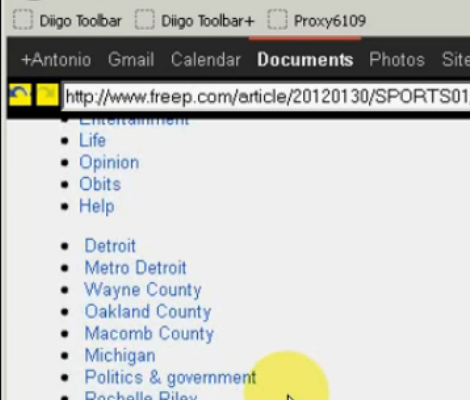
As weird as it might sound, there’s a way to use Google documents as a web proxy. The image above is a screenshot of [Antonio] demonstrating how he can view text data from any site through the web giant’s cloud applications. Certain sites may be blocked from your location, but the big G can load whatever it wants. If all you need is the text, then so can you.

The hack takes advantage of the =IMPORTDATA() function of Google Spreadsheet. We guess the command is meant to make import of XML data possible, but hey, that’s pretty much what HTML data is too, right? But what good it the raw webpage code in a spreadsheet? This is where [Antonio] made a pretty brilliant leap in putting this one together. He authored a bookmarklet that provies a navigation interface, hides the raw code which is stored in the spreasheet, and renders it in the browser. This ties together a user supplied URL, reloading data on the hidden spreadsheet and refreshing the window as necessary. See for yourself in the clip after the break.


Continue reading “Using Google Documents As A Web Proxy”

NAS Firmware Hack: Synology Running On QNAP Hardware

[XVortex] pulled off a pretty incredible firmware hack. He managed to get a firmware upgrade for Synology running on a QNAP machine. These are both Network Attached Storage devices, but apparently the Synology firmware is better than what QNAP supplies with their offerings.

The nice thing is that this is not a one-off hack. You can download the raw image and give it a spin for yourself. A few words of warning though. It will only work on models which use the Atom and ICH9R chipset, you’re out of luck if you have one sporting an ARM processor. You will also need to format the drives once the new firmware is flashed so do this before you fill them up.

This harkens back to the days when DD-WRT was first being run on Linksys routers. We don’t remember if that started with upgrade image hacks like this one uses, or if the source code was available (Linksys was compelled to release it once it was proven they were in violation of the GPL).

See a proof video of this hack after the break.

Continue reading “NAS Firmware Hack: Synology Running On QNAP Hardware”

Fractal Viewer Can Zoom And Enhance Like On CSI

This fractal viewer is a great way to get your feet wet with Field-Programmable Gate Arrays. The project will give you some experience working with video output, user input, and a whole bunch of math and memory management. [Hamster] built it using the Papilio Plus board which hosts a Spartan 6 FPGA. This continues his odyssey into the realm of hardware design; part of which we looked at back in December.

The arcade Megawing for the dev board gives him easy access to the controls needed to scroll and zoom on the fractal design. Calculations to generate the shape are being run at 240 MHz, with the VGA output running at 80 MHz. The device has enough horse power and SRAM to show an 800×600 pixel output with a 60 Hz refresh rate.

We really liked the logic diagram that [Hamster] drew up when planning how the calculations would be handled. It’s not overly complex, but it took us a while to conceptualize how everything fits together. It’s certainly an improvement from his last attempt as we couldn’t make heads or tails out of that flow chart.

If you’re just interested in the pretty shapes and colors there’s a demo embedded after the break.

Continue reading “Fractal Viewer Can Zoom And Enhance Like On CSI”

Firmware Programmer For A Cheap Bluetooth Module

Here’s a nifty programmer for a cheap Bluetooth module. So just how cheap is this part? Does $6.60 sound like an extreme deal?

The information on this hack is spread throughout a series of posts. The link above goes to the completed programmer (kind of a look back on the hack). But you might start with this post about module firmware options. Just because you can get the part inexpensively doesn’t mean that it’s going to work as you expected. [Byron] sourced similar devices from different suppliers and found they were not running the same firmware; the footprints were the same but he features were not. With his help you can tailor the code to your needs and reflash the device.

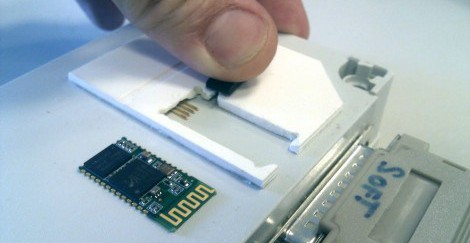
The programmer that he build has a nice slot for the module which interfaces with the programming lines using pogo pins (spring-loaded contacts). It connects to the CSR BC417 chip’s SPI pins in order to flash the firmware. If you’ve had any experience working with these cheap parts we’d love to hear your tale in the comment section.

[Thanks MS3FGX]

Easy Tactile Controls And Displays For Your Flight Simulator

If you’ve been thinking of adding some tactile controls and readouts for your flight simulators this guide should give you the motivation to get started with the project. [Paul] explains how to build controls and connect them to the simulator data. He makes it look easy, and thanks the interface examples in his code it actually is.

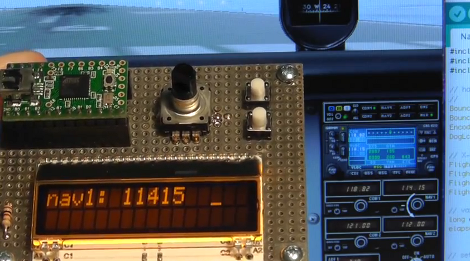
Here he’s built the hardware using a Teensy controller board. The controller communicates via USB and the software is cross-platform. He’s controlling the heading information of the X-Plane simulator using the rotary encoder for fine adjustments and the buttons for increments of 100. But he doesn’t stop there. He’s working on an auto-throttle design that uses a servo motor to move the throttle lever. A potentiometer can be used to vary the throttle, with the servo mapped to the position of that knob. But it works both ways, dragging the virtual throttle on-screen will do the same.

This is one way to make flight simulators more interesting without devoting a whole room of your house to the cause. Don’t miss [Paul’s] fantastic demo video after the break.

Continue reading “Easy Tactile Controls And Displays For Your Flight Simulator”

Lamp Upgrade Makes You A Hot-head

[Cameron] decided to give his twenty-year-old headlamp a makeover. He uses it when he’s out for a run and wanted to have more light to see where he’s going, as well as a red tail light on the back. The stock design uses an incandescent bulb on the front of the head band, and a battery pack on the back. He managed to convert the device to output 700 lumens without major changes to the form factor of the unit.

The first change he decided on is to use a Cree XLamp which provides the 700 lumens of light by drawing about 9.5 Watts of power. Obviously the original battery pack isn’t going to do well under that kind of load, so he also sourced a 5000 mAh Lithium battery. A bit of circuit design and PCB layout gives him two driver chips for the four-element LED module, a charging circuit for the battery, and an ATtiny13 to drive the head lamp and flash the red LED tail light. See the blinky goodness in the video after the break.

That’s a lot of light, but we wonder if he experiences a warm forehead from the heat sink used to keep that LED package cool? Continue reading “Lamp Upgrade Makes You A Hot-head”

Petition For DMCA Exemptions Regarding Rooting/unlocking Gadgets

So you’ve been rooting devices eh? If you get caught you’re headed for the big house, the lockup, the pen, the joint, they’ll send you up the river, you better be careful! Seriously though, if you buy a device and circumvent the security features should that in itself be breaking the law? We’re not talking about stealing intellectual property, like playing copied games on a chipped system (yeah, that’s stealing). We mean unlocking a device so that you can use it for what you wish. Be it your own prototyping, or running open-source applications. Unfortunately if the current Digital Millennium Copyright Act exemptions expire it will be a crime.

Thankfully, [Bunnie] is doing something about this. You may remember him as the guy that found most of the ridiculous security holes in the original Xbox, or the brain behind the Chumby. Now’s he’s got an online petition where your voice can be heard. Speak up and let the US politicians know why unlocking a device isn’t a crime.

[via Twitter]