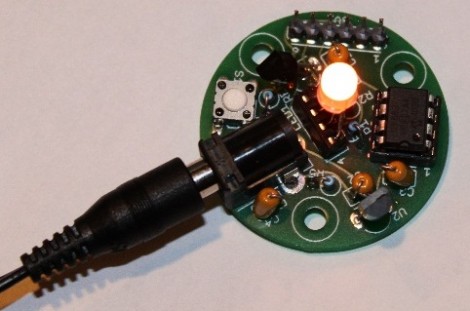
Electronic Candle Protects Sleeping Infant

[William] developed this temperature candle as a tool to help keep babies safe as they sleep. It seems that ambient temperature has an effect on Sudden Infant Death Syndrome (SIDS). This device is meant to alert you when room temperature is outside of the recommended envelope.

The board hosts an eight-pin PIC microcontroller (12F683P), a temperature sensor, RGB LED, and a push button. The round PCB is the same size as a votive candle, which is nice except that you’re going to have to drill a hole in your candle holder to accommodate that barrel jack.

The temperature sensor is read by the microcontroller and used to determine the color of the LED. Red is hot, blue is cold, and just right is somewhere in between. But if you’d rather know the exact current temperature you can press the button and it’ll blink out the Celsius reading using blue for 10 degree increments (three blinks is 30 degrees, etc.) and red for single degrees. Don’t miss the demo of the candle in the video after the break.

Continue reading “Electronic Candle Protects Sleeping Infant”
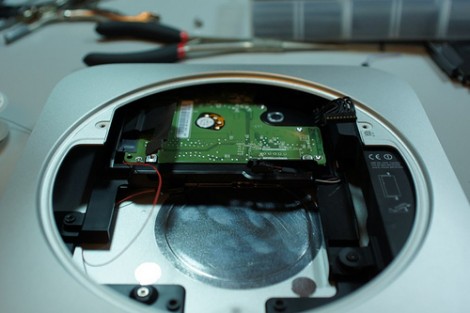
Speedier Hard Disk Option For Your Mac Mini

[Andrew] was left wanting by the slow hard drive in his 2011 Mac Mini. He set out to add a 10,000 RPM drive and we think he did a great job of pulling it off. Luckily he also took the time to document the process so you can try it yourself.

As with a lot of Apple products, a big part of this hack is just getting the darn thing apart without breaking something. Once that’s done, you’re got to do a little bit of interface hacking. To save space Apple uses a non-standard SATA breakout cable so [Andrew] starts by ordering a second hard drive cable from the company. He then soldered a thin wire connecting 12V from the motherboard to the 12V pin on a SATA connector. From there it’s just a matter of altering the original hard drive sled to make room for the 500 GB WD Velociraptor drive. It fits below the original and serves as additional space instead of as a replacement.

A.R.T. Sorts Your Recyclables For You

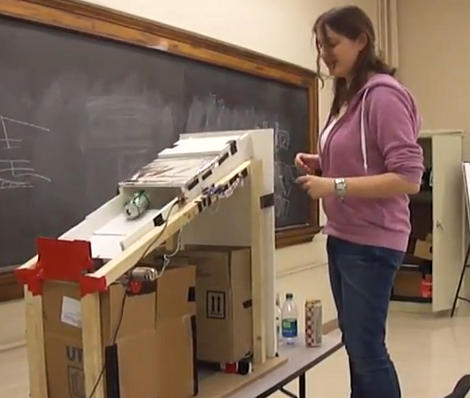
[Yuhin Wu] wrote in to let us know about the Automated Recycling Sorter that was built with a group of classmates at the University of Toronto. They entered it the school’s student design contest and we’re happy to report that it took first place.

The angled sled has been designed to separate glass, plastic, and metal containers. The first sorting happens at the intake area. A set of moment arms are used to weed out the glass bottles. Since there are several of them in a row, a larger and heavier plastic container will not be falsely sorted and the same goes for smaller glass bottles.

With the glass out of the mix the team goes on to separate metal and plastic. An Arduino was used for this purpose. It senses an electrical disturbance caused by a metal can passing through the chute and actuates a trap door to sort it. Plastic has no effect on this sensor and slides past the trap to its own sorting bin.

Don’t miss both demo videos which we’ve included after the break.

Continue reading “A.R.T. Sorts Your Recyclables For You”

Coffee Table Puts On A Show Behind Smoked Glass

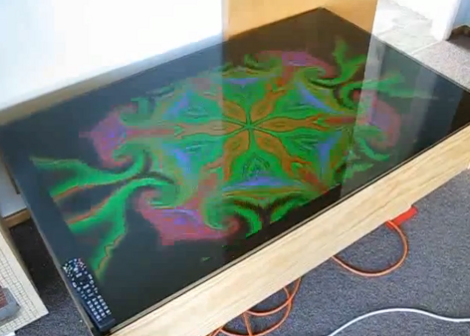
This coffee table is a real show-piece. It’s got a smoky glass surface that is hiding the LCD screen within. But what fun would it be if it could only play video? The rest of the enclosure houses all the parts necessary to make this living room centerpiece into a computer.

After the break you can see a video showing off each step of the build process. It starts by ridding the screen of its enclosure, and using what’s left to determine the size of the wood frame for the table. With the display firmly in place [Nate] sets to work position, mounting, and developing cooling solutions for the motherboard and the rest of the bits. He does nice work and ends up with a table that we’d be proud to feature in our homes.

Now he’s got a lot of computing power and a huge display, but isn’t something missing? How hard do you think it would be to add touch sensitive input to this? We’re wondering if the overlays used to make those Android touchscreens could be mounted on the underside of the glass?  Continue reading “Coffee Table Puts On A Show Behind Smoked Glass”

Reclaim The Wireless Controller Module From A Broken Xbox 360

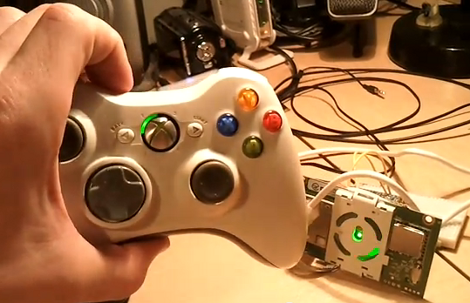
If you’re one of the hordes whose Xbox 360 died the fiery death associated with the RRoD you may be wondering what to do with that multi-hundred dollar door stop you’re left with. Why not salvage the parts for other uses? If you’ve ever wanted to use your wireless controller with a computer here’s a way to pull out the RF module and reuse it.

The concept is simple enough, there’s a daughter-board in the Xbox 360 which hosts the RF module for wireless controller connectivity. Once you extract it from the carcass of the beast, you just need to find a way to read and push the data to your computer. Any USB enabled microcontroller will do, in this case an Arduino nano was chosen for the task. A bit of level converting was necessary to interface with the device, but nothing too involved.

It sounds like at first there was an issue with syncing a controller with the hacked module, but as you can see in the clip after the break that problem has been solved.

Continue reading “Reclaim The Wireless Controller Module From A Broken Xbox 360”

Dog Pod Grid One Step Closer To Reality

What’s better than one amazingly acrobatic quadcopter? How about a swarm of acrobatic micro-quadcopters? It’s not a rhetorical question, but an experimental reality. A team at the University of Pennsylvania are showing off their latest round of hovering robots which can move in formation and alter their orientation as a swarm.

You may remember us salivating over the unbelievable stunts the team pulled off with a single ‘copter back in 2010. That device needed a sophisticated camera installation to give provide feedback, and this uses the same framework. But we don’t that detracts from the achievement; it’s simply a future hurdle for the project.

The video after the break shows some of the stunts the slew of whirring devices are capable of. Watching them move as a grid, and even landing simultaneously, we can’t help but think of the Dog Pod Grid from Neal Stephenson’s book The Diamond Age. It was used as a protection system, keeping unwanted flying intruders out. Doesn’t sound so far-fetched any more, does it?

Continue reading “Dog Pod Grid One Step Closer To Reality”

Printable Wire Stripper Lights Up When You Hit The Conductor

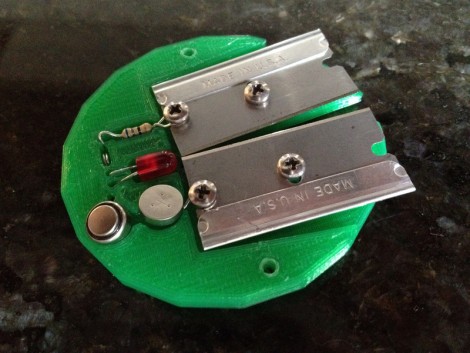
Agonize no more over stripping the insulation off of tiny wires like those used in ribbon cables. For years we’ve used razor blades to do this, as the tiniest wires don’t have a slot on our trusty wire strippers. But often we cut all the way though the conductor (or many of the strands) when doing so. [Bjbsquared] came up with this design that will alert you when you’ve hit the conductor.

It uses the two metal razor blades as electrodes in the LED circuit. When anything metal connects the two, the LED will be illuminated. This way you know you’ve cut far enough, and should be able to tug the insulation off of the wire. This image only shows half of the printed unit, a second piece covers up the inner workings, and helps keep stray fingers away from the edges of the blades.

Overkill? We don’t think so, and we hope everyone will agree this is a wonderful design.

[via Reddit and Gizmodo]