Tweeting Bird Feeder Keeps A Picture Record Of All Visitors

wireless_tweeting_bird_feeder

If you weren’t aware, Adafruit Industries is sponsoring the “Make it Tweet” contest over at Instructables, and this Twitter-enabled bird feeder is [quasiben’s] entry into the competition.

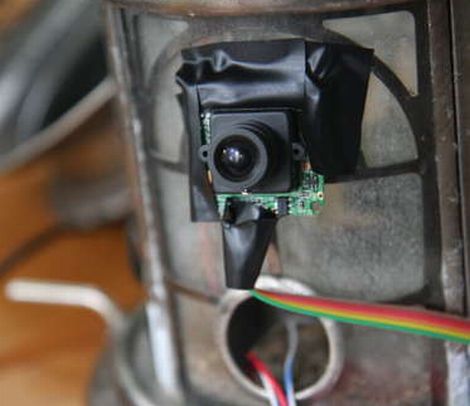
His bird feeder not only sends messages to Twitter, it also sends a picture of each bird to Twitpic. The feeder itself is a standard off the shelf model which has been fitted with a LinkSprite camera. A LilyPad Arduino controls the camera, sending images to his computer via a pair of XBee modules. To detect when a bird has stopped by for something to eat, [quasiben] used an infrared LED and an IR detector. The emitter and detector are positioned at opposing sides of the feeder’s opening, triggering the Arduino to snap a picture whenever the beam is broken. Once the image has been transferred to his computer, it is posted to TwitPic.

We’re pretty sure [quasiben] built this Tweeting bird feeder just because he could, but we think it’s a pretty smart idea for people who don’t necessarily have the free time to gaze out the window into their yard. It’s a great way to keep tabs on all your new winged visitors while on the go.

Keep All Eyes On Your Kegerator With This Light Up Gauge Cluster

kegerator_gauge_cluster

A few years back [Evan] built a kegerator from a mini fridge and was quite happy with his new beer chiller. Like many of us do, he started thinking up ways in which he could improve the project as soon as it was completed. While it took a couple of years, he recently got around to adding the temperature and capacity gauges he always wanted.

He added a temperature probe to the refrigerator, and then constructed a pair of tools that he could use to measure how much beer was left in the keg. The volume monitors include a scale built using a pair of pressure sensors from SparkFun, and a flow sensor installed in the beer line.

[Evan] scored an old Chevy gauge cluster and cleaned it up before installing a pair of analog meters which he used to show the keg’s temperature and “fuel” level. Since he feels no project is complete without some LED love, he added a few of them to the display without hesitation. The LEDs calmly pulsate when the keg sits idle, but spring to life and begin flashing when the flow sensor is activated.

As evidenced by this pair of keg monitoring systems, we think that you can never have enough information when it comes to your beer stash, so we really like how this project came together.

Be sure to check out his kegerator’s gauge cluster in the video below.

Continue reading “Keep All Eyes On Your Kegerator With This Light Up Gauge Cluster”

Solder Paste Dispenser Hacked To Run Off Compressed Air Cans

solder_paste_dispenser_air_can_hack

[John] got a shiny new solder paste dispenser for a steal, and before he hooked up the tool, he decided to take a look inside to make sure everything was on the up and up. Aside from a few questionable wiring practices he didn’t approve of, everything else looked to be in good working order.

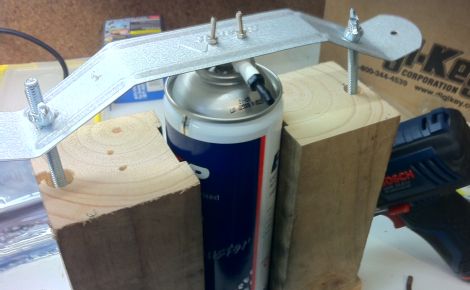
The only thing that was bothering [John] is that he wasn’t too keen on keeping his noisy and large air compressor in his workshop, so he set off to find a different way to provide compressed air to the device. He settled on air dusters like those used for cleaning the crumbs out of your keyboard, but he needed to find a way to reliably get the air to his solder dispenser. He heated the air can’s nozzle until he was able to screw his dispenser’s hose barb into it, creating a tight seal. The modified nozzle was reattached to the can and placed in a simple jig that keeps the nozzle held down continuously.

[John] fired up his dispenser, and the 80 psi coming from the duster was plenty to get the solder paste flowing. Sure the rig might not be the most high tech solution, but we think it’s a pretty good means of getting quiet compressed air anywhere you need it.

Tiny Hardware-based DSLR Intervalometer

diy_dslr_intervalometer

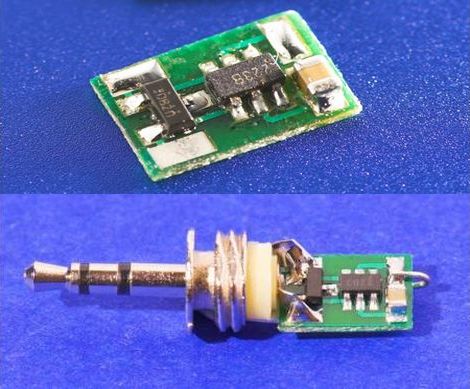
Most DSLR cameras have the ability to take pictures at set intervals, but sometimes the menu system can be clunky, and the options are often less than ideal. [Achim] is a big fan of time lapse photography and has been hard at work creating a hardware-based intervalometer to suit his needs. He has just finished the second revision of the controller which is just about small enough to fit inside the housing of a 2.5mm stereo plug. The timer is not 100% universal, but so far he has confirmed it works on Nikon, Canon, and Pentax cameras.

Based on a PIC10F222, the circuit’s operation is quite simple. Once the dongle is connected to your camera, you simply need to take two pictures anywhere from 0.4 seconds to 18 minutes apart. The intervalometer “watches” to see how long you waited between pictures, and proceeds to take shots at that interval until the battery dies or your memory card fills up.

As you can see in the video on his site, the timer works a treat. If you want to make one of your own, swing by his site to grab schematics and code – it’s all available for free.

*Whoops, it looks like we’ve actually covered this before. Our apologies.

MSP430-based Palm Size Quad Copter

palm_sized_quadcopter_msp430

[Thanh] has spent some time flying quad-copters measuring 12” motor to motor, but wanted to build something smaller so that he could fly indoors. Instead of building just one, he actually constructed five different quad-copters, with motor to motor arm spans ranging from 10” to just 3”.

In his forum post, he highlights the construction process of his 10” copter, covering each step in great detail. While he breaks down his component lists into two categories based on motor to motor span, the one common item is the TI MSP430-based controller board. In particular, he used the eZ430-RF2500 development kit, which has the added benefit of a built-in 2.4 GHz wireless radio. His quad-copter uses a Wii Motion Plus gyro board to help keep it aloft, as well a handful of other components which should be pretty familiar to most of our readers.

It’s great to see the construction broken down in such detail, we imagine it will be a great resource for anyone else looking to build their own quad-copter.

Stick around to see a quick video demonstration of his mini quad-copter in action.

[Thanks, Panikos]

Continue reading “MSP430-based Palm Size Quad Copter”

2005 Subaru Aux-in Hacking

2005_subaru_outback_aux_in

The CD player in [mukmuk’s] 2005 Subaru Outback gave up the ghost, and faced with a long road trip ahead of him, he was desperate to find a way to listen to something other than static-filled radio. He considered a 3rd party auxiliary input solution, but after seeing a similar aux-in hack here, he figured he could give it a go himself.

The stereo head unit design was changed between the 2004 and 2005 model years, so while he had a good idea of what to look for, he had to find the proper components on his own. Once he identified the radio module, he was able to locate the left an right input pins through trial and error. He carefully soldered a 3.5” audio jack to the head unit’s input lines, wiring it to cut off the audio signal from the radio whenever his Zune was plugged in.

Everything was reassembled, and the input jack was inconspicuously mounted in a cubby hole just above the stereo. [mukmuk] is quite happy with his modification, and we’re guessing his road trip was far more pleasurable as a result of his work.

Behold, The Oomphalapompatronium!

Oomphalapompatronium

For over 25 years, [Len Solomon] has been performing a one-man variety show that features crazy-looking, hand-made musical instruments that operate on air. Some of his more famous instruments include a callioforte he constructed, as well as his Majestic Bellowphone, both powered by some form of bellows, of course.

His most recent musical creation is something [Len] likes to call the “Oomphalopompatronium” (try saying that five times fast). The bellows-driven Willy Wonka-esque organ looks to be built from just about anything and everything he could get his hands on. We spied a few plastic and glass bottles, plenty of PVC pipe, and a few tin cans before we stopped looking and just listened.

At first glance you might think that the Oomphalopompatronium will produce some cacophonous excuse for music, but once [Len] stepped up to the keyboard we were pleasantly surprised. The sound is that of a small scale Oompah band, much like the name implies.

We think it’s a fantastic creation – we’re just bummed that it we can’t check it out in person.

Stick around to see a video of the Oomphalopompatronium in action.

[Thanks, BoKu]

Continue reading “Behold, The Oomphalapompatronium!”