Autonomous Quadcopter Fits In The Palm Of Your Hand

[Horiken Engineering], which is made up of engineering students at the department of aerospace at the University of Tokyo have developed an autonomous quadcopter that requires no external control — and its tiny. By using two cameras and a sonar sensor, the quadcopter is capable of flying by itself due to its ability to process the data from the on-board sensors. To do the complex data processing fast enough to fly, it is using a Cortex-M4 MCU, a Spartan-6 FPGA, and 64MBs of DDRSDRAM. It also has the normal parts of a quadcopter, plus gyros, a 3D printed frame and a 3-axis compass. The following video demonstrates the quadcopter’s tracking ability above a static image (or a way point). The data you see in real-time is only the flight log, as the quadcopter receives no signal — it can only transmit data.

Continue reading “Autonomous Quadcopter Fits In The Palm Of Your Hand”

Bicycle Powered Sander

sanding

[Andy] does a lot of framing and needed a way to sand down pieces at proper angles. He goes by the moniker [Organikmechanic] on YouTube, and as such is trying to rely less and less on electricity — so he’s created this hand-powered sander using components from a bicycle.

His first iteration just used the spindle off of a bicycle wheel as the main axle, but he quickly found it wasn’t rigid enough for the sanding disk. Instead he decided to make use of the entire crankshaft assembly off of an old bicycle. He cut the frame down to size, removed one of the pedals, and shortened the other one to a more useful hand cranking length. The main gear of the bicycle provides a large and sturdy mounting surface for his home-made sanding disk which consists of a large piece of rounded chipboard.

It’s a pretty clever use of recycled parts — but what do you think? Are you environmentally inclined enough to give up your power tools? A full video explanation of the project is after the break.

Continue reading “Bicycle Powered Sander”

3kW Electric Scooter

IMG_20131228_012222

[Exco] had been playing around with the idea of building an electric scooter for a while now, and over the holidays he decided to just do it.

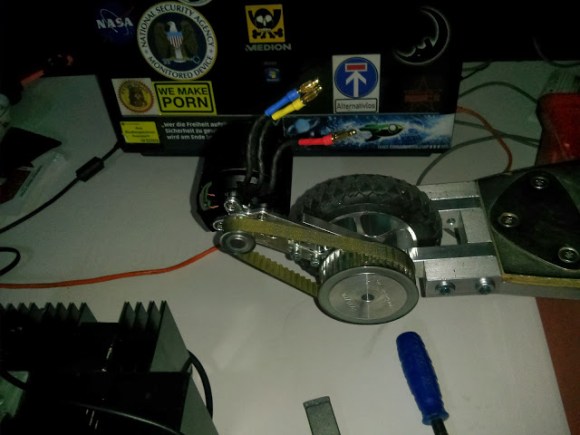
Similar to the motorized long board we shared last month, this scooter makes use of an RC hobby motor — in this case, a 63mm 3kW brushless outrunner (for a RC plane), coupled with a 100A ESC. He bought the scooter (“kick board”) off eBay for cheap, and spent a few days in the machine shop modifying it. It has better wheels now, and custom milled aluminum brackets for mounting the motor. The drive system uses a belt and pulley with a sliding rail to provide tensioning.

To power it, he bought a bunch of 2.5Ah, 18V LiPo packs on eBay originally from a Makita drill set. He then sorted out the cells, removed the dead ones, and soldered everything together for his own Frankenstein pack to balance them. The final configuration features twenty-one 18650 lithium cells. He even shrink wrapped it, which makes it look relatively professional!

It’s controlled by a push-button potentiometer hooked up to the ESC. Theoretical top speed is about 27km/h @ 1285RPM, and they managed to get it up to 25km/h in a real test. There’s more info over at the Endless Sphere forum, and we’ve got two test videos for you after the break.

Continue reading “3kW Electric Scooter”

Custom Workbench Computer

IMG_20140105_154013_152

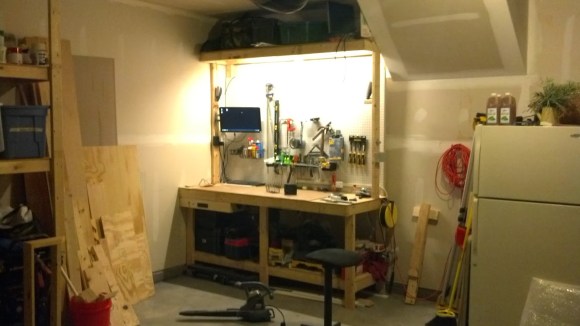
[Michael Solar] recently bought a house with his wife, and now with his first garage he’s started building his workshop man-cave. First order of business was a workbench — second, a computer built into it.

He started with an old Dell tower, but found it took too much space underneath the work bench — so he set to downsizing it. Using pine boards he created a stepped wooden enclosure that utilizes the space under the front lip of the work bench. He’s mounted the motherboard using standoff pins and created cutouts in the back for the power supply and outputs. It features three intake and two exhaust fans — currently without filters, although he plans on adding them soon, otherwise he’ll end up with a sawdust filled computer!

It’s a rather simple project, but it gives a great introduction into making your own custom computer case, and provides some handy lessons learned near the end. It might not be a flashy case mod like this heavy metal computer desk, but it is certainly functional and robust!

USB Charger Solves Mongolia Electricity Problem

thermoelectric

People living in remote areas of Mongolia do not have access to electricity or gas, and rely on traditional wood stoves for their homes, which are used almost all the time. Many use solar panels to generate some electricity for small tools, but unfortunately there are often times when it is cloudy for days on end. [Chingun Has] saw this problem and created his own clever solution — a small thermoelectric USB charger.

[Chingun’s] device features an array of peltier plates inside of an aluminum shroud. The device is designed to sit on top of a stove, or to be strapped onto a stove pipe. When there is a large enough temperature differential between the two sides of a peltier plate, a charge is induced. He’s using a small fan to help cool the other side of the peltier plates. A small control box houses a voltage regulator circuit that provides 5V over USB.

The cool thing about this project is that it is partially the result of [Tony Kim], an MIT professor who traveled to Mongolia to teach students an edX circuits course about a year ago. [Chingun] was one of his students, and this is a great example of a solution to a real-world problem.

An excellent video after the break gives a complete explanation of the project, as detailed by [Chingun] himself — it’s well worth the watch!

Continue reading “USB Charger Solves Mongolia Electricity Problem”

Extremely Slick Game Of Life Based Clock

[Matthews] needed a good present to give to his brother-in-law, who just so happens to be a mathematician and programmer. He wanted something functional but equally geeky at the same time, so he decided to try his hand at making a Game of Life style clock.

He was originally inspired by a Game of Life Clock we shared a few months ago, but with a few improvements. First, he wanted a much bigger playing field, so he found a 16×32 RGB LED matrix. Second, he wanted the time to always be visible so it actually works as a functional clock.

At the heart of the device is an Arduino UNO which utilizes a Chronodot RTC module for accurate time keeping. The entire clock is encased in acrylic sheets and it looks extremely good for a home-made project. He designed the case using a site called MakerCase, which is a super handy application for designing boxes.

At the beginning of every minute starts a new Game of Life which plays over top of the time displayed. Three buttons on the top allow for many adjustments including brightness, timezone, speed, colors, and even edge behavior! To see it in action, stick around after the break.

Continue reading “Extremely Slick Game Of Life Based Clock”

Printer Up-cycled CNC Machine Uses More Than Just The Stepper Motors

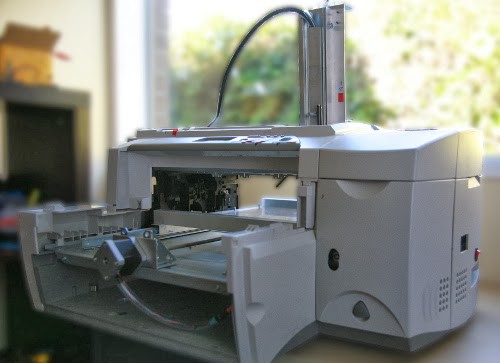
Sometimes you just know from the photo that this is going to be a really cool project. When most people salvage parts from an old printer, they usually chuck the rest. In this case [Shane] made use of the entire printer to build his CNC machine.

He started with an old HP 2500C A3 printer, which he had planned to salvage for parts only. While he was taking it apart he realized the chassis would make a great frame for his actual CNC machine! With that in mind he quickly changed his game plan to making each axis inside of the printer.

He’s using regular ball bearing drawer runners for both the X and Z axes, covered with a clever design of aluminum angle to keep any possible chips from jamming them. The Y axis on the other hand makes use of the original shaft runners from the print head carriage. Each axis is driven by threaded rod using recycled stepper motors from the printer.

An Arduino UNO sits at the heart of the project with a Protoneer CNC shield to control the stepper drivers. He’s also included an emergency stop, hold, resume, and cancel buttons for manual control.

It’s a great project, and an amazing example of using what is on hand for a project. Stick around after the break to see a demonstration of it printing!

Continue reading “Printer Up-cycled CNC Machine Uses More Than Just The Stepper Motors”