Gesture Based Security Lock

1

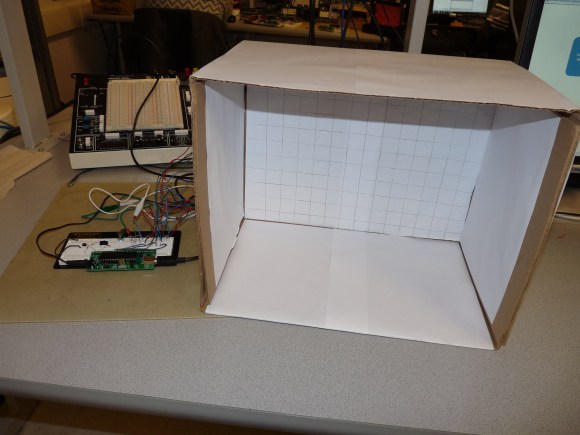
A team of students from Cornell University are looking into alternative ways of creating a security system that can be locked or unlocked by using physical gestures in an enclosed space.

It is the final year project for [Ankur], [Darshan] and [Saisrinivasan] in their MEng of Electrical and Computer Engineering. The system prototype is capable of recording a gesture and then comparing the gesture with future gestures to lock or unlock the system. Consider it like a secret handshake to get into the office!

To analyze the gesture they are using four SparkFun proximity sensors setup in a linear array to sense the distance a hand is moved. An ATMega1284P is used to convert the analog sensor signal to digital for further processing. The project is extremely well documented, as it appears to be the final report for the project.

A short video after the break shows off the prototype and gives a good explanation of how the system works.
Continue reading “Gesture Based Security Lock”

Un-crapifying A Car Stereo

11161323212

[Noah Farrington] has just accomplished a major milestone in his life, purchasing his first car! A glorious 2001 Ford Focus wagon. While it may be a fully loaded luxury vehicle, it is missing one thing poor [Noah] can’t live without. An aux-in port.

He had a few options for rectifying the situation. Live with it as is, hack the strange Ford media protocol out of the back, or fool the CD player into playing his input. Naturally he chose the third option.

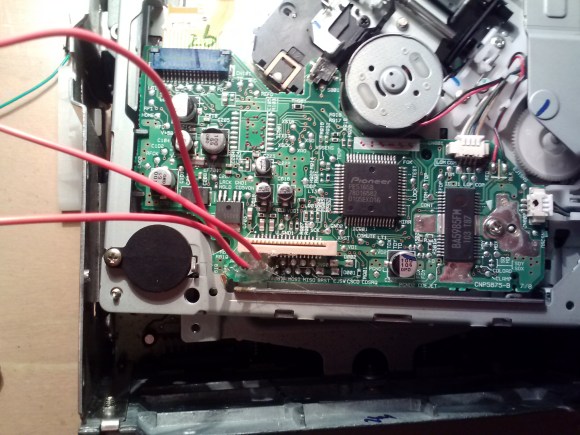
His first challenge was removing the deck from the car. People told him he’d have to buy fancy stereo removal tools — he made do with tent pegs and coat hangers. Using the same method as described in a past aux-in hack, he identified the audio in leads on the CD player’s ribbon cable. By carefully soldering in his own aux-in plug, he’s almost ready for business! Unfortunately, the CD player also needs to think that it is on for it to properly output the audio. [Noah] chose the simple solution — record a silent CD to always leave in the deck.

Stick around after the break to see it in action.

Continue reading “Un-crapifying A Car Stereo”

Glowing Balloon Blimps

_B093896

Looking for a neat decoration for your next soirée? How about floating fleet of glowing balloon blimps?

[Kensho Miyoshi] — an avid reader of Hack a Day — needed an art installation project in Tokyo, he came up with these clever glowing balloon blimps.

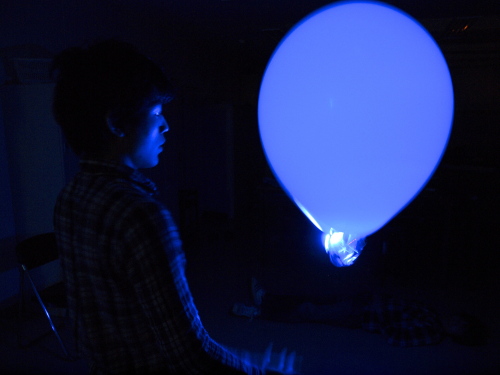
They feature a mini gondola hanging from the bottom of a regular balloon which holds a small motor with a propeller, an Arduino Pro Mini, LEDs, an ultrasonic sensor and of course, a battery. They float up to a certain height with the LEDs shining bright, and when the ultrasonic sensor trips, it all turns off and the balloon sinks gently back to the ground. The process repeats, and in a completely dark room it looks like a series of glowing bubbles forming and floating away, again and again.

To see the floaty, glowy, balloon blimps, stick around for a video after the break.

Continue reading “Glowing Balloon Blimps”

Electronic Phenakistoscope!

phenakistoscope

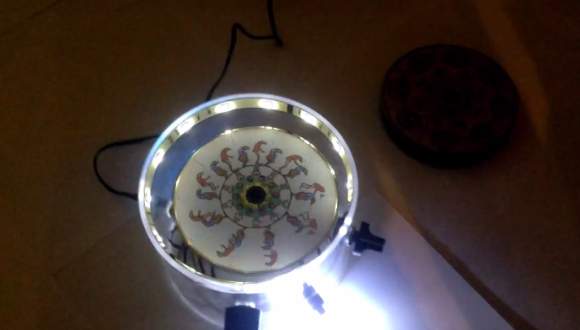
Looking for a clever way to build a Phenakistoscope? Maybe you’re more familiar with its other names; Fantoscope, Phantasmascope, or perhaps its close cousin the Zoetrope?

If you’re still scratching your head, that’s okay — they have really weird names. What we’re referring to here is a type of optical illusion that mimics movement by showing a series of still images at an offset interval — this can be achieved by looking through slots, strobing a light (like in this case) or even by the use of mirrors.

This particular Phenakistoscope is a very simple but clever design that makes use of a recycled stepper motor from a printer, a CD as the animation disk, a strip of LED lighting, a few potentiometers and an Arduino to control the strobe. It works by synchronizing the strobe frequency with the motor rotation, resulting in the image in motion effect.

Stick around after the break for a full gallery of the build and a demonstration video.

Continue reading “Electronic Phenakistoscope!”

Wireless Power Transfer For Quadrotors

quadcopter

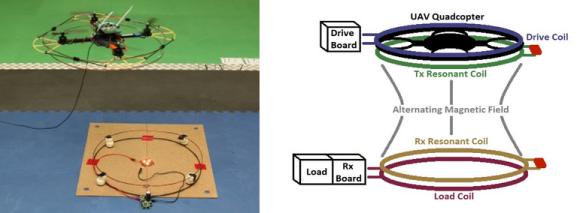
Quadrotors are great, but what kind of range can you get on them, really? What if you could charge them up just by flying over high voltage power lines, by or temporarily hovering by a charging station? That’s just what [Dr. Carrick Detweiler] wrote a paper about! (Caution: PDF)

The paper discusses the method of wireless power transfer via magnetic resonance, which, depending on the scale, can transfer power at medium distances (~1 meter). This outperforms inductive coupling which requires a much closer proximity (~1-2 centimeters) for power to transfer. It does still require a certain amount of accuracy, but as we all know, quadrotors have no problem with even the most complex aerodynamic feats!

There is an excellent demonstration video of a small scale wireless quadrotor prototype after the break.

Continue reading “Wireless Power Transfer For Quadrotors”

The Art Of Box Making

IMG_2507-1000

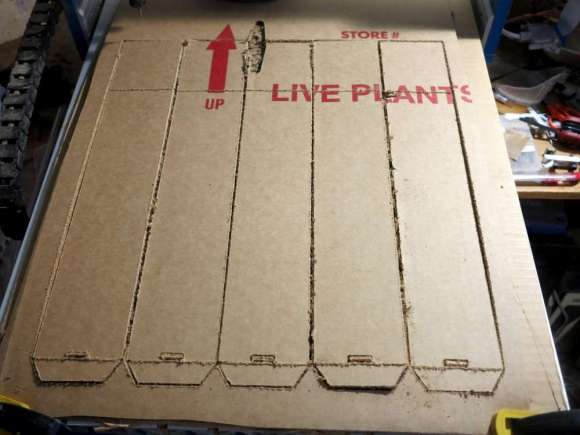
[Darcy] has a bit of a love affair with cardboard. What started out as a simple way to mail things cheaper by making custom sized boxes has turned into the full-blown art of box making.

He originally started by making the boxes by hand, but after he got suitably adept at it, he quickly refined his craft by adding in some technology. He now designs the boxes in SketchUp and then uses a home-made CNC router to cut and score the cardboard into even fancier styles. His blog has a whole slew of his cardboard box designs and it’s actually pretty cool to see what he’s come up with. He also has a bunch of tips for making your own, so if you’re one of those lucky hackers who can sell the things they make, it’s definitely worth a look! If you’re not selling anything perhaps a cardboard lamp shade is more for you?

To see a video example of one of his CNC cut boxes, stick around after the break. Now all he needs to do is design an automatic box folding machine!

Continue reading “The Art Of Box Making”

Barbot Mixes Drinks Perfectly With Web Interface

barbot-with-laptop

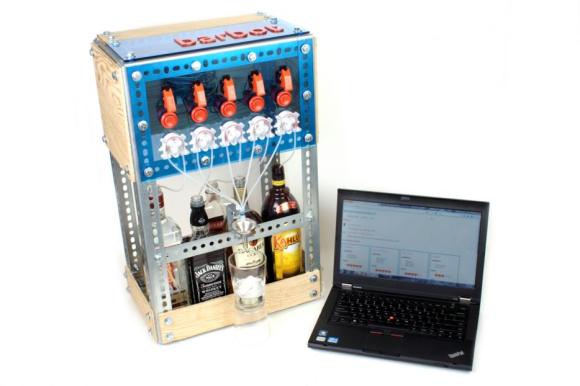
Are you good at mixing drinks? We think this Barbot might give you a run for your money!

Not only does this Barbot have room for 5 different liquors, but you can combine them any way you want with an extremely slick web interface that you can check out for yourself.

During initial setup, you add your chosen liquors to the machine and then using the configure mode in the web interface, you tell Barbot what it has to work with. Once these fields are populated, Barbot will list various drinks that it is capable of mixing with the provided ingredients. It also has a cleaning mode, which allows you to prime the pumps and set administrative access for your parties.

The hardware behind this build is a BeagleBone Black running Ubuntu 13.04 with Apache2, MySQL, and PHP to host the web interface — bind and DHCP are used to create the web portal using a USB WiFi dongle. The online interface directly controls the pumps using PHP via the GPIOs.

To see a full demonstration stick around after the break for the included video.

Continue reading “Barbot Mixes Drinks Perfectly With Web Interface”