Bally’s Bomber – A 1/3rd Replica Of A B-17G

bally bomber

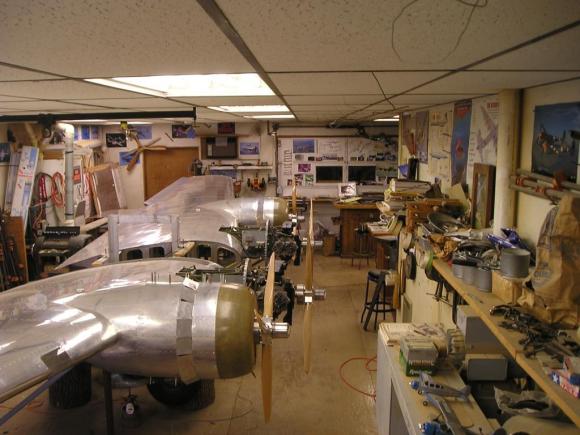
One of our tipsters just sent us this fascinating story about The Bally Bomber, a single man’s huge undertaking that started back in 1999. It’s a 1/3rd scale version of the B-17G Bomber — and no, it’s not remote controlled, there will be a pilot.

Not familiar with the B-17G? What about its trade name? It’s called the Boeing B-17 Flying Fortress. This massive bomber was developed back in the 1930’s for the United States Army Air Corps as a combination between the Boeing 247 transport plane and the experimental Boeing XB-15 Bomber.

8680 of the B-17G model were built, but as of September 2011, only 13 of the entire B-17 family remain airworthy. The Bally Bomber is the only known scale replica, and looking through the progress photos it is an absolutely jaw-dropping project. It hasn’t been test flown yet, but they are getting painfully close to its maiden flight.

For more information, you can also check out their Facebook page which seems to be updated on a regular basis.

[Thanks Ryan!]
3D Printer Exhaust

[Malcolm] finally got fed up with the fumes produced by his 3D printer, so he decided to setup this rather extensive fume exhausting system.

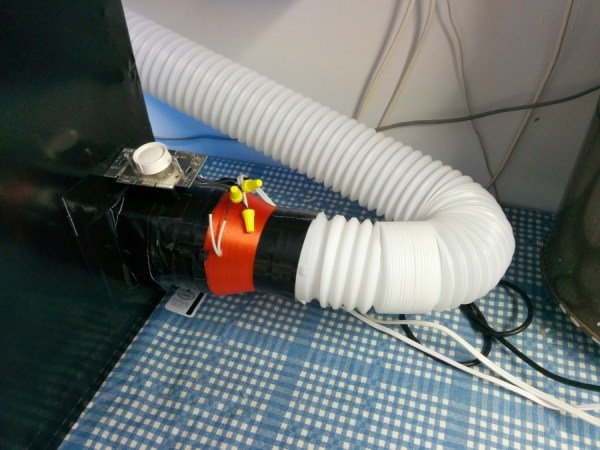
He already has a pretty awesome setup with his Type A 3D printer inside of a filing cabinet, with a plastic tote above it to keep his filament from absorbing too much water. But as you know, the fumes released while printing ABS are actually pretty bad for you. With this in mind he 3D printed adapter rings and fitted a fan salvaged from a space heater to the outside of his filing cabinet. A dimmer switch provides variable fan speeds and some dryer vent tubing reroutes the fumes to central vac piping which then goes directly outside. When the system is not in use the piping can be plugged to prevent cold air from entering the house. It’s a fairly clean build but [Malcolm] wants to make a nicer enclosure for the fan and speed control circuit.

The major problem we see with doing something like this is removing too much heat from the build chamber which can always affect print quality. Do you vent your 3D printer?

Continue reading “3D Printer Exhaust”

Instant Inkjet Circuits With Silver Nanoparticle Ink

Researchers at the University of Tokyo, Georgia Tech and a team from Microsoft Research have developed a low-cost method of printing circuits using an ordinary inkjet printer using a technique called Instant Inkjet Circuits.

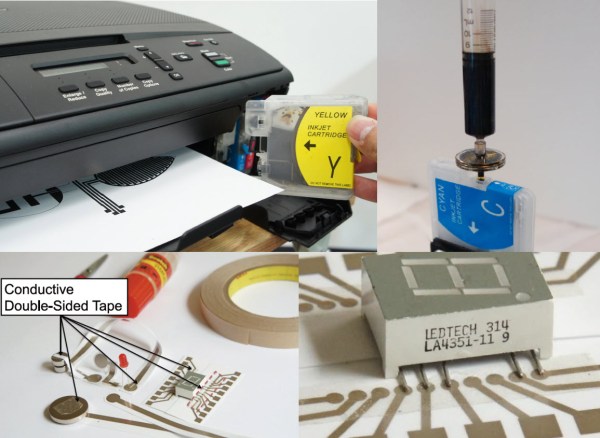
The hack is quite literally as simple as injecting a refillable printer cartridge with a commercially available Silver Nano-particle Ink. This allows the printing of circuits onto many different flexible substrates including paper, transparent film, or basically anything you can fit in the printer. Typically if the medium is designed for printing it will work. Some exceptions to this include canvas cloth, magnetic sheets, and transfer sheets.

The researchers chose a Brother inkjet printer because they typically have nozzles that eject higher volumes of ink than other printers. The exact model they used was the Brother DCP-J140w. To maximize ink deposition, all cartridges are filled with the ink, and printed using photo mode where the C M and Y cartridges are simultaneously used to create black. No special software is required to print.

The full article is well worth the read and shows many examples of the different applications this could be used for — including instant prototyping using nothing but scotch tape.

If anyone can source some of this ink and try it out we would love to hear from you! Those that can’t may want to give the old inkjet/laser toner etch resist trick a try.

[via Power Electronics]

AVR Atmega Based PID Magnetic Levitator

[Davide] saw our recent post on magnetic levitation and quickly sent in his own project, which has a great explanation of how it works — he’s also included the code to try yourself!

His setup uses an Atmega8 micro-controller which controls a small 12V 50N coil using pulse-width-modulation (PWM). A hall effect sensor (Allegro A1302) mounted inside the coil detects the distance to the magnet and that data is used by a PID controller to automatically adjust the PWM of the coil to keep the magnet in place. The Atmega8 runs at 8Mhz and the hall effect sensor is polled every 1ms to provide an updated value for the PWM. He’s also thrown in an RGB LED that lights up when an object is being levitated!

So why is there a kid with a floating balloon? [Davide] actually built the setup for his friend [Paolo] to display at an art fair called InverART 2013!

After the break check out the circuit diagram and a short demonstration video of the device in action!

Oh yeah, those of you not impressed by magnetic levitation will probably appreciate acoustic levitation.

Continue reading “AVR Atmega Based PID Magnetic Levitator”

LearnCNC Game

Do you want to learn how a CNC machine works, but don’t have access to one (yet)? One of our tipsters just informed us of this great project that was created by a team of students from the University of British Columbia, and it’s an interactive 3D learning system that teaches everything about CNC machining.

We downloaded the “game” and it’s pretty cool — you get to walk around a virtual workshop and can click on various things to learn about their functions. Alternatively, you can go just go through their lessons (that appear when you click on things) on the website. It’s a great summary to get your feet wet in the world of CNC machining.

Beyond how the machines themselves work, the website also goes into great detail about the various applications you can use CNC machining for and physics behind tooling design.

Even if you’ve had a brief introduction to CNC machining before, this site provides a great summary of most everything — it’ll be very handy if you’re hoping to use a school’s machine shop for personal projects…

[Thanks Chris!]

LavaAMP Spectrum Analzyer

lavaamp

Is your dusty Lava Lamp just not cool enough anymore? What if you could make it bubble to the music? [Christian] and [Eric] managed to do just that.

No, they aren’t regular Lava Lamps. In fact, they look like oversize jam jars, but the video of them in action is pretty cool! They designed and built this system for the UIST 2013 Student Innovation Contest, and while there isn’t too much information on the actual build, the contest required everyone to use the exact same kit. The kit consists of 8 aquarium pumps, a PumpSpark controller board, assorted tubing and fittings and an optically-isolated serial interface for use with an Arduino or another kind of microcontroller. From there, it’s pretty easy to guess the rest — analyzing the audio, and timing the pumps according to the various levels.

Other competition entries of note include an awesome game of WaterPong, a Water Bottle Bagpipe, and even an Xbox H2O!

Stick around after the break to see the LavaAMP bubble to the bass.

Continue reading “LavaAMP Spectrum Analzyer”

Crab-ble – A Table That Walks

124_dsc0417-xl2

Do you have a heavy kitchen table? Wish you could move it all by yourself? [Ekaggrat] set out to design one for this year’s Beijing Design Week back in September.

It’s based off of the awesome Strandbeest design by [Theo Jansen], and it looks great. [Ekaggrat] made several prototypes of the “Crab Table” out of ABS plastic, and was planning to make a full size one using bamboo rods, which were the theme of the design week. Unfortunately the team ran out of time and was not able to make the full scale model. The prototypes walk around all by themselves with geared DC motors, but the plan for the full size one was to simply be able to push it.

We’ve seen lots of walking tables before, but there’s just something about the mechanical beauty of this design that we love. It’d be heavy — but imagine it in chrome! Maybe just the plastic could be plated… Stick around after the break to see it scuttle about!

Continue reading “Crab-ble – A Table That Walks”