Persistence Of Vision Planetary Map

POV planetary map

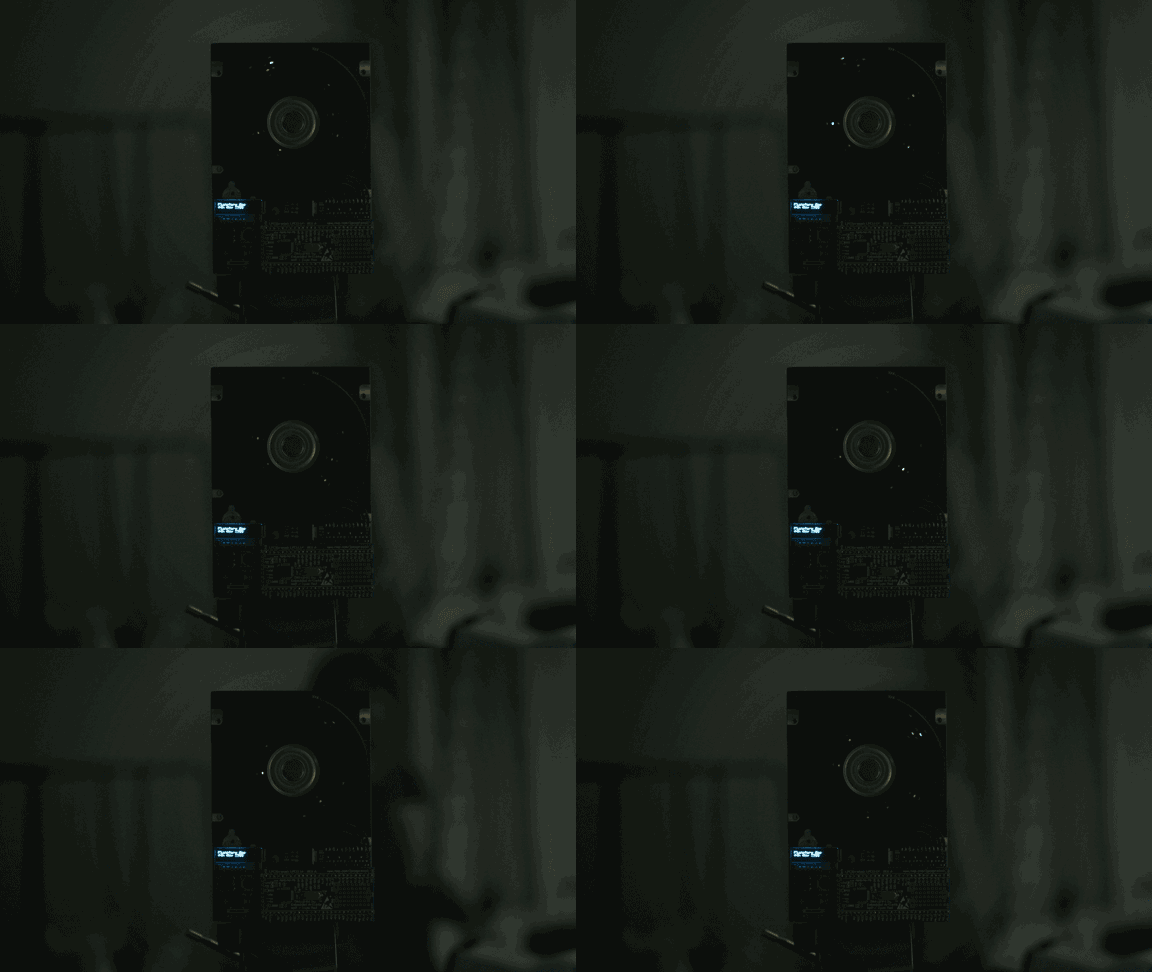
Looking at the looping GIF above you’re probably thinking, oh, another hard drive POV setup… Well… Not quite.

This is one of [Dev’s] latest projects, and it is a planetary map that shows the angular positions of all 8 of the major celestial bodies from any given date between 1800 and 2050. It’s also capable of showing analogue clock hands, the phases of the moon, and other simple graphics.

The main unit is a hard disk, but [Dev] milled off many of the features on it to give it a more exposed, purpose-built look. He designed the LED bearing PCB from scratch using EagleCAD, which sits on the back of the drive, with the spindle poking through. It has 8 rings of 5 surface mounted LEDs, which shine through opaque plastic diffuser rings that he printed using Shapeways — they feature small recesses to fit snugly on the board over the LEDs. On the top level is a 1mm thick black disc of some unknown material that [Dev] had sitting around, which now has 8 holes machined into it in the exact position of the LEDs.

A Cortex-M0 drives the LEDs using an LPCXpresso board which allows the LEDs to sit across only one byte of a hardware I/O port. On the software end, each rotation of the disk is segmented into three hundred and sixty 1 degree slices. This system allows him to achieve a circular resolution of 8×360 pixels at 25 frames per second. Not bad for a persistence of vision device!

Stick around after the break to see the rather entertaining demo video of the device.
Continue reading “Persistence Of Vision Planetary Map”

The Game Of NIM

game of nim

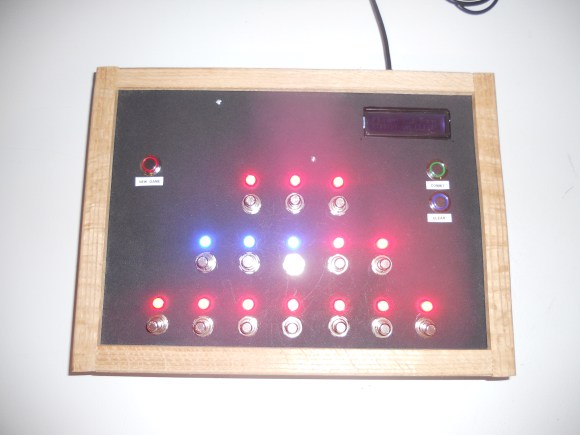
[Greg] has been fascinated with the Game of NIM ever since he was a freshman in highschool. Recently he remembered it and decided to try his hand at making an AI version to play, written using Visual Basic.

If you’re not familiar with the game, it’s fairly simple. Each row of lights represents a certain type of object. The players make take as many objects from any one row, per turn. The player with the last object loses.

Now, as you can imagine, writing an AI into a game can be a rather challenging ordeal. [Greg’s] first attempt was to use a memory structure that captures every possible move. There’s only 15 moves, and 1 to 7 lights, and the options decrease as the game goes on so… That can’t be too bad, right? Upon running his freshly written code he got an out-of-memory error. Not just any out-of-memory error either, over an Exabyte of memory was needed! Whoops.

He eventually figured the proper code out, and what resulted in game play was a very interesting experience. You see, the computer learns from each game played. At first, it’s like playing a young child — easy to trick and beat. But as the games progressed, the computer picked up his patterns and never made the same mistake again. He simply lost track of the number of games he played with it, but it just kept getting better at better. Must be pretty satisfying to make something that learns from you — kind of like parenthood…

Anyway, [Greg] has an awesome writeup available on his blog, so you should definitely check it out — we can only summarize so much! Stick around after the break to see a video of the game in action.

Continue reading “The Game Of NIM”

Indio Picaro Doll Mixes Drinks…

pissCO

Ever heard of the Indio Picaro doll? They are those kinda weird phallic statues, and they also happen to be a national joke in Chile. So hackers [Nathan] and [Pablo] decided to make use of its popularity for a hilarious drink serving robot (Translated) at this past weekends Santiago Mini Maker Faire.

Dubbed the PissCO, the bartending robot(s?) make use of eight Bartendro drink pumps, which is a system that was successfully funded on Kickstarter at the beginning of the year. Add some servos to make the little statues dance and swing around their… Anyway the whole system is probably one of the most unique cocktail mixing robots we’ve seen yet.

After all, who doesn’t want a drink served from a stainless steel basin that looks vaguely like a urinal?

Stick around after the break to uh, see it in action.

Continue reading “Indio Picaro Doll Mixes Drinks…”

DIY Home Control Using A SSRelay

ssrelay

[Ben Jones] just started a new site called Maker-Guide, where he makes some very informative and well produced DIY videos on anything from homemade photography hacks, to controlling an outlet using a solid-state relay.

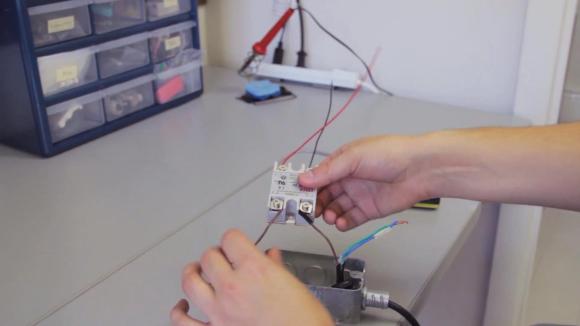
It’s not the first time we’ve seen a relay controlled outlet, or this one… but it’s certainly one of the cleanest jobs we’ve seen. In his video guide, [Ben] shows us exactly how to fit a standard solid state relay into a regular outlet box, and easily control it with an Arduino Uno.

It even looks like there might be enough space inside the box for a small wireless setup — maybe using a Trinket even? What about using Power-Line networking to control each box via LAN? Could be the easiest home automation implementation yet! Well, aside from certain NEC (national electrical code) concerns of running high and low voltage in the same box…

Anyway if that wet your whistle, check out the great video guides after the break!

Continue reading “DIY Home Control Using A SSRelay”

Laser Wire Stripping

laser wire stripping

Do you find yourself needing to strip many ribbon cables? Isn’t it frustrating? Well, if you happen to own a laser engraver, this cool guide one of our tipsters sent us might just be up your alley.

The typical way to strip these is one by one, with a lot of swearing. Or, if you do it often, you might actually have the proper tool to strip them in one go. There is actually a third solution, and as it turns out, it’s one of the commercial ways it is done for accuracy, and it’s quite impressive. Here’s an entire imgur gallery of what some of the fancy stripping lasers are capable of — we particularly like number 3.

Anyway, if you do happen to have a laser cutter, it’s as simple as engraving a few lines, and setting up a jig to hold your ribbon. Take a pass on each side, and pull it off! There’s a video after the break, but it’s pretty self-explanatory. We can see this being super handy if you happen to be mass producing anything that requires ribbon cables!

Continue reading “Laser Wire Stripping”

The Making Of The WaterColorBot

water color bot

Remember the WaterColorBot? Ever wonder what goes into manufacturing a kit like it? Well the folks over at Evil Mad Scientist just spilled the beans.

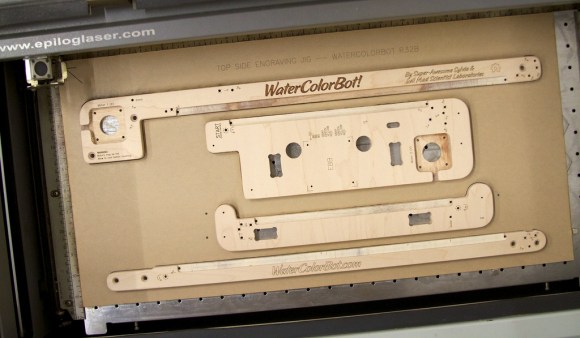
It’s a great insight on how these kits are typically made in a manufacturing environment, especially if you happen to be the founders of a rather successful Kickstarter project like the WaterColorBot by [SuperAwesomeSylvia]. The article goes into great detail on minimizing material waste during CNC routing, mass producing laser engravings using a jig, hardware assembly, and finicky assembly of some of the more complex components. Not to mention boxing, storing, and packaging the finished products!

We’re happy to hear the WaterColorBot is officially shipping now, and available for purchase — Seems like they were only off by a month or so for their kickstarter delivery goals. Remember our recent post about one of these WaterColorBots out in the wild? One was used to create art using inputs from driving a real car!

Circuit Stickers

10931799015_3fdff666bb_z

One of our tipsters just sent an interesting crowd funding project our way. They’re called Circuit Stickers and are a very creative way to get basic electronics into children’s hands through arts and crafts.

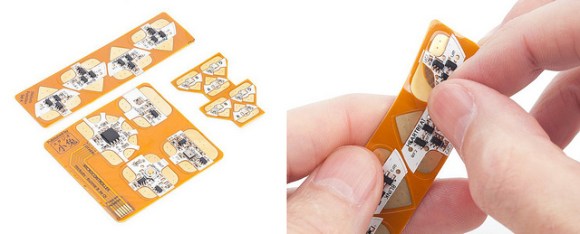
The project is the brainchild of [Bunnie] and [Jie Qi]. [Bunnie] is a hacker, and a Director of Studio Kosagi, a small manufacturing outfit in Singapore. [Jie] on the other hand is a PhD student at the MIT Media Lab, who focuses her research on combining electronics and programming with arts and crafts. They came up with this idea to bridge the gap that exists between electronics and the arts, and the stickers are a great start. They allow anyone to learn basic electronics in a very easy and friendly way, using skills we all learned as children, drawing and sticking stickers on everything.

The current offering includes LED stickers, effects stickers (to control the LEDs), sensors, microcontrollers, and even breakout boards. They are all in sticker form, and can be connected together using  conductive fabric, thread, carbon-based paint, copper tape, pencil graphite, and really, anything conductive. They have already manufactured thousands of the stickers and everything is working as designed, so the crowdfunding campaign isn’t to raise funds to continue research, or even to start their company. It’s more of getting it out there, and getting these stickers into children’s hands to raise the next generation of hackers from a young age.

The video after the break gives a great overview of the project, and if anything we think it’ll give you some great ideas on children’s electronics projects.

Continue reading “Circuit Stickers”