
Making Ice Cream With Heavy Metal

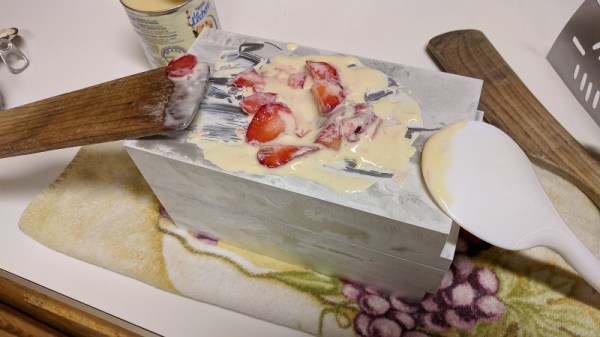
After his last project left him with an eleven-pound block of aluminum, [Jason] got to thinking of what most of us would in that situation: fresh made ice cream. His mind was on the frozen concoctions of the aptly named Cold Stone Creamery, a mall food court staple where a chilled stone is used to turn fresh ingredients into made to order sundaes.

[Jason] did the math and found that an eleven-pound chunk of aluminum can absorb a little over 67,000 joules, which is over twice the energy required to freeze 100 g of water. In place of water he would be using cream, condensed milk, and strawberries, but believed there was a large enough safety factor to account for the differences between his ingredients and pure water.

His first attempt didn’t go exactly as planned, but with his Flir One he was able to back up his theoretical numbers with some real-world data. He found that he needed to start the aluminum block at a lower temperature before adding his ingredients, and through experimentation determined the block only had enough energy to freeze 30 g of liquid.

In the end [Jason] was satisfied with the frozen treat he managed to make from the leftovers of his radial mill project, but theorizes that an ever better solution would be to use a brine solution and drop the aluminum block all together.

Of course, if putting food on a slab of metal from your workshop doesn’t sound too appealing, you could always go the NASA route and freeze dry it. Either method will probably make less of a mess than trying to print objects with it.

Neural Network Gimbal Is Always Watching

[Gabriel] picked up a GoPro to document his adventures on the slopes and trails of Montreal, but quickly found he was better in front of the camera than behind it. Turns out he’s even better seated behind his workbench, as the completely custom auto-tracking gimbal he came up with is nothing short of a work of art.

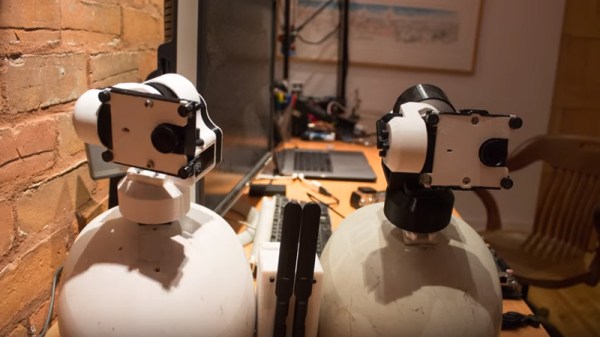
There’s quite a bit going on here, and as you might expect, it took several iterations before [Gabriel] got all the parts working together. The rather GLaDOS-looking body of the gimbal is entirely 3D printed, and holds the motors, camera, and a collection of ultrasonic receivers. The Nvidia Jetson TX1 that does the computational heavy lifting is riding shotgun in its own swanky looking 3D printed enclosure, but [Gabriel] notes a future revision of the hardware should be able to reunite them.

In the current version of the system, the target wears an ultrasonic emitter that is picked up by the sensors in the gimbal. The rough position information provided by the ultrasonics is then refined by the neural network running on the Jetson TX1 so that the camera is always focused on the moving object. Right now the Jetson TX1 gets the video feed from the camera over WiFi, and commands the gimbal hardware over Bluetooth. Once the Jetson is inside the gimbal however, some of the hardware can likely be directly connected, and [Gabriel] says the ultrasonics may be deleted from the design completely in favor of tracking purely in software. He plans on open sourcing the project, but says he’s got some internal house keeping to do before he takes the wraps off it.

From bare bones to cushy luxury, scratch-built camera gimbals have become something of a right of passage for the photography hacker. But with this project, it looks like the bar got set just a bit higher.

Continue reading “Neural Network Gimbal Is Always Watching”








