Tunneling TCP By File Server

You want to pass TCP traffic from one computer to another, but there’s a doggone firewall in the way. Can they both see a shared file? Turns out, that’s all you need. Well, that and some software from [fiddyschmitt].

If you think about it, it makes sense. Unix treats most things as a file, so it is pretty easy to listen on a local TCP port and dump the data into a shared file. The other side reads the file and dumps the same data to the desired TCP port on its side. Another file handles data in the other direction. Of course, the details are a bit more than that, but that’s the basic idea.

Performance isn’t going to be wonderful, and the files keep growing until the program detects that they are bigger than 10 megabytes. When that happens, the program purges the file.

The code is written in C# and there are binaries for Windows and Linux on the release page. The examples show using shared files via Windows share and RDP, but we imagine any sort of filesystem that both computers can see would work. Having your traffic stuffed into a shared file is probably not great for security but, you know, you are already jumping a firewall, so…

Of course, no firewall can beat an air gap. Unless you can control the fans or an LED.

Tech In Plain Sight: Theodolites

We take it for granted that you can look at your phone and tell exactly where you are. At least, as exact as the GPS satellites will allow. But throughout human history, there has been a tremendous desire to know where here is, exactly. Where does my farm end and yours start? Where is the border of my city or country? Suppose you have a flagpole directly in the center of town and a clock tower at the edge of town. You know where they are precisely on a map. You also know how tall they are. What you need is a theodolite, which is an instrument that measures angles very precisely.

Continue reading “Tech In Plain Sight: Theodolites”

Can You Hear Me Now? Try These Headphones

When you are young, you take it for granted that you can pick out a voice in a crowded room or a factory floor. But as you get older, your hearing often gets to the point where a noisy room merges into a mishmash of sounds. University of Washington researchers have developed what they call Target Speech Hearing. In plain English, it is an AI-powered headphone that lets you look at someone and pull their voice out of the chatter. For best results, however, have to enroll their voice first, so it wouldn’t make a great eavesdropping device.

If you want to dive into the technical details, their paper goes into how it works. The prototype uses a Sony noise-cancelling headset. However, the system requires binaural microphones so additional microphones attach to the outside of the headphones.

Continue reading “Can You Hear Me Now? Try These Headphones”

The 6809 Lives On In An FPGA

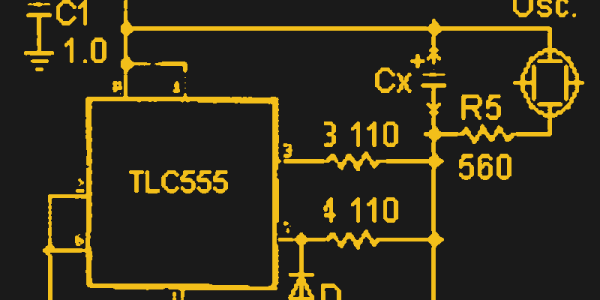
At one point, the Motorola 6809 seemed like a great CPU. At the time it was a modern 8-bit CPU and was capable of hosting position-independent code and re-entrant code. Sure, it was pricey back in 1981 (about four times the price of a Z80), but it did boast many features. However, the price probably prevented it from being in more computers. There were a handful, including the Radio Shack Color Computer, but for the most part, the cheaper Z80 and the even cheaper 6502 ruled the roost. Thanks to the [turbo9team], however, you can now host one of these CPUs — maybe even a better version — in an FPGA using Verilog.

The CPU may be old-fashioned on the outside, but inside, it is a pipeline architecture with a standard Wishbone bus to incorporate other cores to add peripherals. The GitHub page explains that while the 6809 is technically CISC, it’s so simple that it’s possible to translate to a RISC-like architecture internally. There are also a few enhanced instructions not present on the 6809.

In addition to the source code, you’ll find a thesis and some presentations about the CPU in the repository. While the 6809 might not be the most modern choice, it has the advantage of having plenty of development tools available and is easy enough to learn. Code for the 6800 should run on it, too.

Even using through-hole parts, you can make a 6809 computer fit in a tiny space.You can also break out a breadboard.

Digital Meter From 1973, A Teardown

[Thomas] found an interesting probable millivoltmeter with some Beckman displays. Like many instruments from that time period, this one had a lot of tobacco smoke residue inside. The display unit inside had a sticker that not only showed the company that made it, but also had their Telex number on it, another sign of the times. You can see the device in the video below.

The unit looked like a one-off made by a hobbyist or a technician but the case looked suspiciously like old Bang and Olfusen equipment. Someone in the video comments mentions it was built for the service department.

Continue reading “Digital Meter From 1973, A Teardown”

The Emperor’s New Computer

You walk into a home office and see an attractive standing desk that appears bare. Where’s the computer? Well, if it is [DIY Perk]’s office, the desk is the computer. Like a transformer robot, the desk transforms into a good-looking PC.

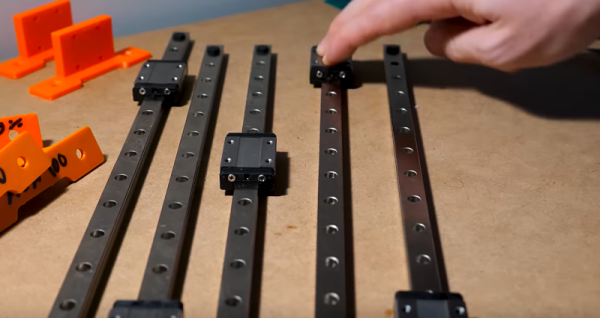
He starts with a commercial desk and creates a replacement desktop out of some aluminum sheets and extrusions. The motion uses some V-slot profiles and linear rails. The monitor and keyboard shelf pop up on invisible hinges. When closed, there’s no trace of a computer.

Continue reading “The Emperor’s New Computer”

Reinventing Rotary Switches With Stepper Motors

When you need to make very tiny measurements, even noise in closed relays can throw you off. [Marco] was able to observe this effect and wanted to build a switch that didn’t have this problem. He found a technical paper that used rotary switches operated by stepper motors instead of relays. So he decided to try making his own version. The video below shows how it turned out.

The first part of the video talks about why relays sometimes inject a tiny voltage into a closed circuit. He then looks at costly switches that would work. However, since he needed many switches, he decided to roll his own.

Continue reading “Reinventing Rotary Switches With Stepper Motors”