TV Repair By Mail

I don’t think there was ever a correspondence school called the “Close Cover Before Striking School” but since book matches — which used to be a thing when most people smoked — always had that text on them anyway perhaps there should have been. There was a time when electronic magazines, billboards, and even book matches were constantly bombarding us with ads to have a career in electronics. Or computers. Or TV repair. So while we think of distance learning as a new idea, really it is just the evolution of these old correspondence schools which date back quite some time.

How far exactly? Hard to say. There’s evidence of some distance learning going back as far as 1728. In 1837, there was a correspondence course to learn shorthand. By 1858, the University of London started its external program for correspondence work and the University of Chicago had a home study division in 1892.  Radio was an early choice of topic, too. In the United States, the United Wireless Telegraph company started a training school — later the Marconi Institute — in 1909. However, it is doubtful that there was any correspondence training going on there until much later.
Continue reading “TV Repair By Mail”

Number Stations Gone Wild

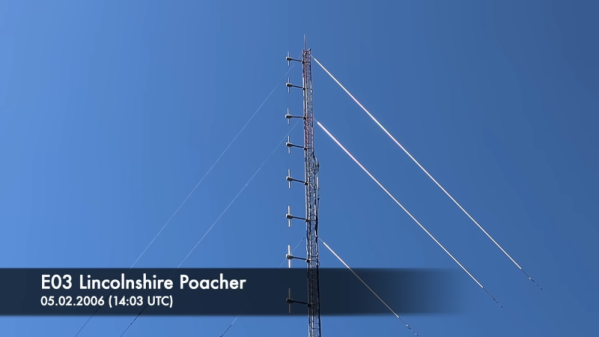
[Ringway Manchester] has an interest in numbers stations. These mysterious stations send presumably coded numbers or other coded information. However, it is rare that anyone claims credit for these stations. Normally they operate with military-like precision, adhering to strict operating schedules and sending out their messages error-free. [Ringway] looks at five times when things didn’t go as planned for these spy stations.

Perhaps it isn’t surprising, however, as machines have likely replaced human operators. That makes them prone to errors when the computers go awry. Many of the errors are ones of frequency, where two number stations wind up transmitting at once. We suppose spies all use the same few frequencies. Some, however, also had computers go haywire and start going through the alphabet which, of course, could have been part of some secret message protocol, but appeared more likely to be a simple mistake.

We were amused, though, to hear the story of a Czech spy station that not only had a licensed call sign but would send QSL cards to people who reported reception. Perhaps they didn’t get the memo about secrecy!

We’ve listened to a few number stations in our time. If you don’t have a suitable antenna, you can always try hunting them online. But don’t expect to catch them making any mistakes.

Continue reading “Number Stations Gone Wild”

Better Sheet Metal Parts With Chemistry

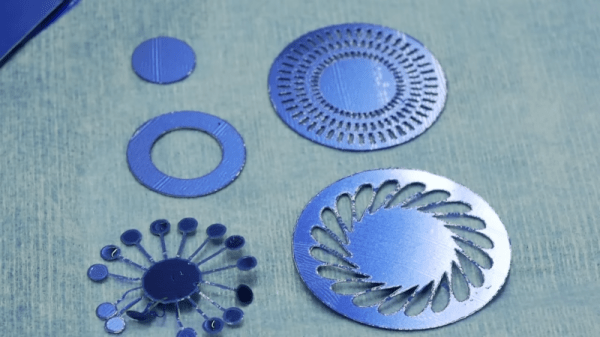
[Applied Science] wanted to make some metal parts with a lot of holes. A service provider charged high tooling costs, so he decided to create his own parts using photochemical machining. The process is a lot like creating PC boards, but, of course, there are some differences. You can see the video of the results, below.

Some of the parts could be made in different ways like water jet cutting or even stamping. However, some things — like custom screens — are only really feasible to do with a chemical process like this.

Continue reading “Better Sheet Metal Parts With Chemistry”

Listen To 64 MHz At Once

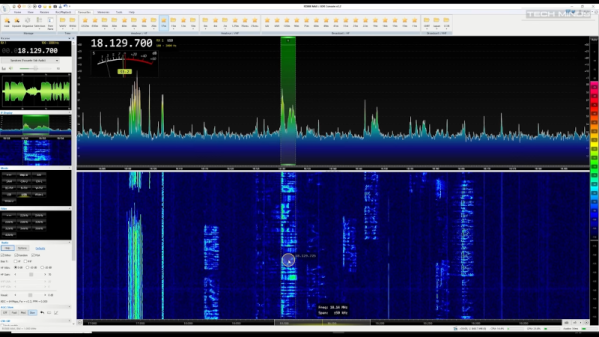
We imagine that if [Tech Minds] told us he was listening to the HF bands, we might ask him which one? His reply might just be “All of them.” That’s thanks to the RX-888 MKII SDR he reviewed which delivers a 64 MHz window on the radio spectrum. You can catch the video review, below.

These are not especially inexpensive, but with that bandwidth and 16-bit resolution, it is worth it if you need that kind of horsepower. There is a separate input for VHF signals 64-1700 MHz where the bandwidth is only 10 MHz, but still.

Of course, making a very wideband front end for something like this is non-trivial, so we wonder how the performance is compared to similar-priced units with less bandwidth. On the other hand, it does seem to work well enough in the video. The software used limited the test to a 32 MHz bandwidth, which is still plenty.

Speaking of software, we noticed that the developers of SatDump and SDR++ are not happy with the state of the software for the RX-888. We aren’t sure if this remains a problem, but the device seemed to work well on the video, at least.

There are many options now when it comes to higher-end SDRs. We like the Pluto for both transmitting and receiving. Of course, the RTL-SDR kind of started everything with hobby SDR, but you can’t expect that much bandwidth with one of those.

Continue reading “Listen To 64 MHz At Once”

Pretty Petite Picolibc Powers Processors

Many times when someone tells you that language X is “better” at something they really mean that it has better built-in libraries for that task. Java is a great example. The language isn’t all that different from C++ outside of garbage collection and multiple inheritance, but the standard libraries are super powerful, especially for networking.  Even C relies on a library to provide a lot of functions people think of as part of the language — printf, for example. That’s not really part of the C language, but just part of the standard library. When you are writing for a tiny processor, the choice of library is critical and [Keith Packard] offers you one choice: picolibc.

The library has its genesis from two other diminutive libraries: Newlib and the AVR version of libc. It provides support for ARC, ARM, i386, m68k, MIPS, MSP430, Nios II, PPC, RISC-V, Sparc64, x86_64, and the ESP8266/ESP32.

Continue reading “Pretty Petite Picolibc Powers Processors”

3D Printer Z Sensor Claims 0.01 Mm Resolution

Early 3D printers usually had a microswitch that let you know when the Z axis was at the zero point. There was usually an adjustment screw so you could tune for just the right layer height. But these days, you most often see some sort of sensor. There are inductive sensors that work with a metal bed and a few other styles, as well. However, the most common is the “BL touch” style sensor that drops a probe below the nozzle level, measures, and then retracts the probe. However, nearly all of these sensors work by detecting a certain height over the bed and that’s it.

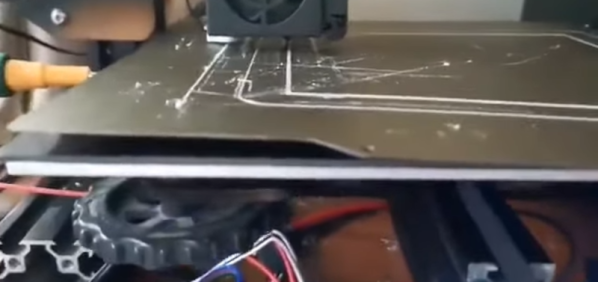
A new probe called BDsensor is inductive but can read the height over the bed in real time. According to information from the developer, it achieves a resolution of 0.01 mm and a repeatability of +/- 0.005mm. We don’t know if that’s true or not, but being able to take real-time soundings of the nozzle height leads to some interesting possibilities such as real-time adjustments of Z height, as seen in the video below.

Continue reading “3D Printer Z Sensor Claims 0.01 Mm Resolution”

Oh Snap! 3D Printing Snapping Parts Without Breakage

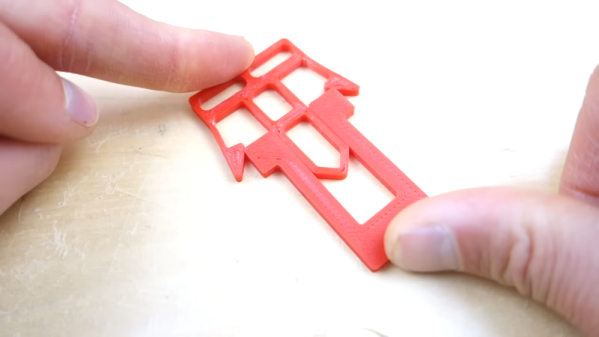
One of the great things about plastic is that it can be relatively flexible. We see things all the time that snap together, but when 3D printing, you don’t often run into snap fit designs. [Engineers Grow] has a video to help you design snap fittings that don’t break.

In the first video that you can see below, he covers three parameters that can help. The first is the length of the snap element. Secondly, the undercut size can be reduced. You can also try making the snap; as thin as possible, although in the example he went too thin and wound up breaking the snap anyway.

The final suggestion, covered in detail in the second video below, is to change the material you use. The key parameter is known as elongation at break. For PLA the typical value for this is 8%. ABS is 10%, PETG is 24% and Nylon is 100%. Simplistically, you could assume that a PETG piece could deform up to 25% before breaking. That may be true, but it will permanently deform long before that. The video suggests using 10 or 15% of the value to assure the part doesn’t lose its shape.

In the third video, you’ll learn, too, that print orientation counts. Making the hooks grow off the build plate leads to a weak hook as you might expect.

We’ve looked at the mechanics behind these before. You can find a lot of detailed technical data about joints, too.

Continue reading “Oh Snap! 3D Printing Snapping Parts Without Breakage”