In 2045: Alpha Centauri

We’ve talked about project Breakthrough Starshot which aims to send a solar sail probe to Alpha Centauri within 20 years. A little basic math and knowing that Alpha Centauri is 4.3 light years away means you are going to need to travel over 20% of the speed of light to make the trip in that time. Some new papers have proposed ways to address a few of the engineering problems.

The basic idea is simple. A very small probe is attached to a very large sail. But calling it a solar sail is a bit of a misnomer. The motive power for the sail would be a powerful laser, which provides more reliable power to the tiny probe’s propulsion system. The problems? First, the thin sail could tear under constant pressure. The answer, according to one of the papers, is to shape the sail like a parachute so it can billow under pressure.

The other problem is not burning the sail up. Space is a hard environment to dump waste heat into since radiation is the only way to transfer it. Another paper suggests that nanoscale patterns on the sail will allow it to release waste heat into the interstellar environment.

Continue reading “In 2045: Alpha Centauri”

Mustool Scopemeter Review And Teardown

There was a time when calculators became so powerful it was hard to tell them from little computers. The same thing seems to be happening now with multimeters. They now often have large screens and basic oscilloscope functionality. The specs keep getting better. While early cheap scopemeters were often relatively low frequency, many are now claiming bandwidths that would have cost quite a bit a few decades ago. A case in point is the Mustool MDS8207 which [IMSAI Guy] reviews and does a teardown of in the videos you can see below. It claims a 40 MHz bandwidth with 200 megasamples per second on a single channel.

The only downside in the claimed specifications is that the sensitivity isn’t great given that the lowest setting is 500 mV per division. Then again for a meter that runs under $100, any scope function would seem to be a bonus. The meter does all the other things you expect a meter to do these days, such as reading voltage, frequency, capacitors, temperature, etc. The response time of the meter is relatively slow, but you can get used to that.

Continue reading “Mustool Scopemeter Review And Teardown”

Tech In Plain Sight: Tough As Nails

When you think of machines you see around you every day, you probably think about your car, computer, or household appliances. However, the world is full of simple machines. One simple machine in particular, the inclined plane, shows up a lot. For example, think of the humble nail. If you are a woodworker or even a homeowner you probably have bags of them. They certainly are all around you if you are indoors and maybe even if you are outdoors right now. Nails have been the fastener of choice for a very long time and they are a form of a wedge which is a type of inclined plane.

What else can you say about nails? Turns out, there is a lot to know. Like other fasteners, there are nails for very specific purposes. There are even nails with two heads and — no kidding — nails with two points. Exactly what kind of nail you need depends on what you are doing and what’s important to you.

Continue reading “Tech In Plain Sight: Tough As Nails”

3D Printing Snap Fit Joints

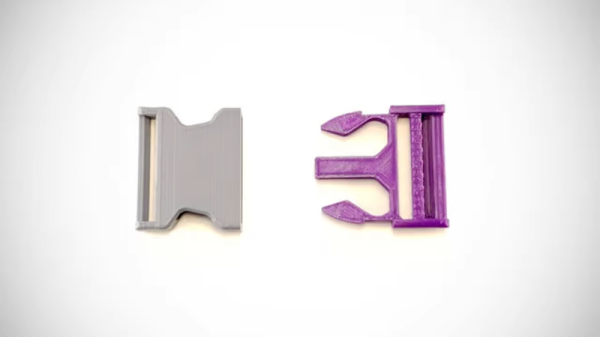
Owning a 3D printer seems to progress through stages. You start printing simple shapes. Then you get serious about calibration and quality. Eventually, you move to trying to design and build practical things. To get practical, you often need to join parts together and that requires glue, fasteners, threaded inserts, and plastic welding. However, you can also make parts that fit together using friction and the springiness of plastic. For example, [Lucas Carolo] recently had a look at 3D printing snap-fit joints. These are commonly seen on the end of straps so that you can connect two ends together.

Of course, you can use them anywhere you need a secure connection. However, you might want to consider that since the jaws compress, there will be repeated stress on the part, so it might not be a good choice for items that you will frequently snap together. Also, brittle plastic such as PLA might not be the best choice of materials. There are several different kinds of joints. The cantilever version has a hook that bends into place and, as mentioned earlier, is common on luggage or backpack straps. The post offers tips on how to design a durable hook. In particular, the orientation of the hook during printing is critical because of the stress involved.

Another type of snap-fit joint is the kind you find on many snap electronic enclosures or things like pen caps. In these joints, a large bump (a boss) fits into a similar groove on the other part. The post has a little less information on these but does mention that you should form the bosses with a chamfer. If you want more details, the post links to a great guide and an enclosure tutorial that you should check out.

We’ve covered this topic before and have some other guides to check out. We’ve also seen some pretty innovative connecting methods.

Clock Testing Sans Oscilloscope?

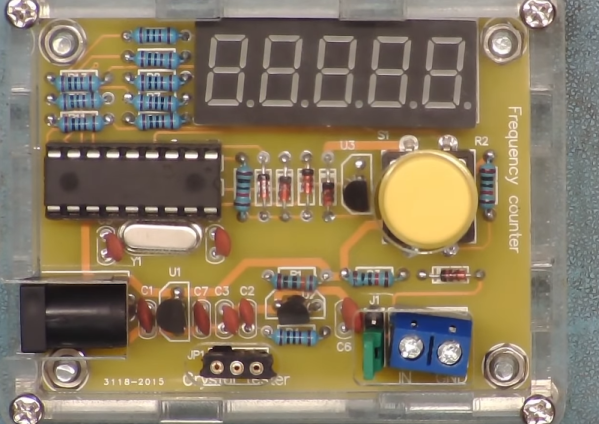
Like many people who repair stuff, [Learn Electronics Repair] has an oscilloscope. But after using it to test a motherboard crystal oscillator, he started thinking about how people who don’t own a scope might do the same kind of test. He picked up a frequency counter/crystal tester kit that was quite inexpensive — under $10. He built it, and then tried it to see how well it would work in-circuit.

The kit has an unusual use of 7-segment displays to sort-of display words for menus. There is a socket to plug in a crystal for testing, but that won’t work for the intended application. He made a small extender to simplify connecting crystals even if they are surface mount. He eventually added a BNC socket to the counter input, but at first just wired some test leads directly in.

Continue reading “Clock Testing Sans Oscilloscope?”

Is Your Tape Dispenser Radioactive?

Do you have anything radioactive in your house? Most people will say no, but they are probably wrong. A host of things ranging from glow-in-the dark timepieces to smoke detectors have some amount of radioactivity. But as [Wheeler Scientific] points out, so do some old Scotch tape dispensers. You can watch the video, below.

The dispenser in question is the C-15 which was very common around offices, military bases, and homes for years. They were made up until the 1980s. You have to wonder why a tape dispenser would be radioactive, and [Wheeler] has the explanation.

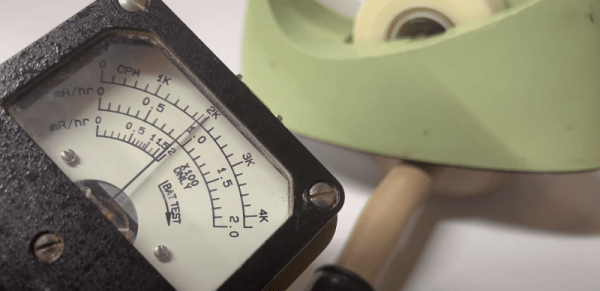
When you pull tape from the dispenser, you don’t want the dispenser to slide around the desk, so it needs to be heavy. But no one wants to have a giant dispenser nor do you want to pay for one made from a dense metal. So the plastic dispenser contains a ballast to make it heavier. In the case of the C-15 that ballast is thorium-containing monazite sand. A vintage counter shows the radioactivity which isn’t much, of course, but still way less than the ordinary sand used in newer models. You can also see in the video that the material is paramagnetic.

Monazite used to be a primary source of lanthanides but getting rid of the thorium led to alternate sources in the 1960s although it is still used as an ore for thorium. We know some lenses are radioactive. If you want to search your home for radioactivity and you don’t have a Geiger counter, you don’t need much to build one.

Continue reading “Is Your Tape Dispenser Radioactive?”

Short Circuit Tracer For A Buck

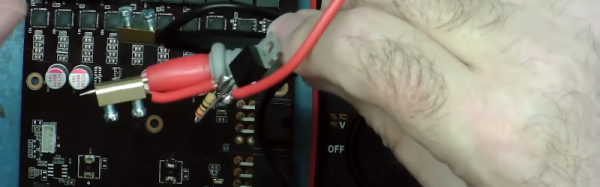
Almost every meter you find today will have a continuity tester. Connect the probes and it will beep if there is a short and won’t if there isn’t. But where is the short? That’s another problem when trying to measure a component that is connected to many other components. [Learn Electronics Repair] wanted to have a tool to find shorts on a board and wanted to build a tester that uses 4-wire resistance measurement to isolate the device under test without having to do surgery on the circuit. His $1 build appears in the video below.

The first part of the video talks about the theory behind resistance measurement with two and four wires. Let shows several diagrams, but he mentions that at one point he shows an incorrect schematic (at 12:03) instead of the early correct one (at 10:35) and mentions it, but if you are skimming the video, you might get confused.

Continue reading “Short Circuit Tracer For A Buck”